Decision making in the NICU_ When clinicians and families don't agree
January 18, 2023 · Salta Neo · 1 hr 10 min
About this recording
An archived video recording featuring John D. Lantos from Salta Neo.
- Format
- Video recording · 1 hr 10 min
- Recorded or aired
- January 18, 2023
- Institution or outlet
- YouTube / Salta Neo
- Archive identifier
- V071
- Speakers
- Jagdish Chinnappa, Mixed John Lantos and event-moderator boundary fragments, Event moderator, John D. Lantos, MD
Transcript
155 passages
- 00:01
Dr. John Lantos
But I'll try to
- 00:06
Dr. John Lantos
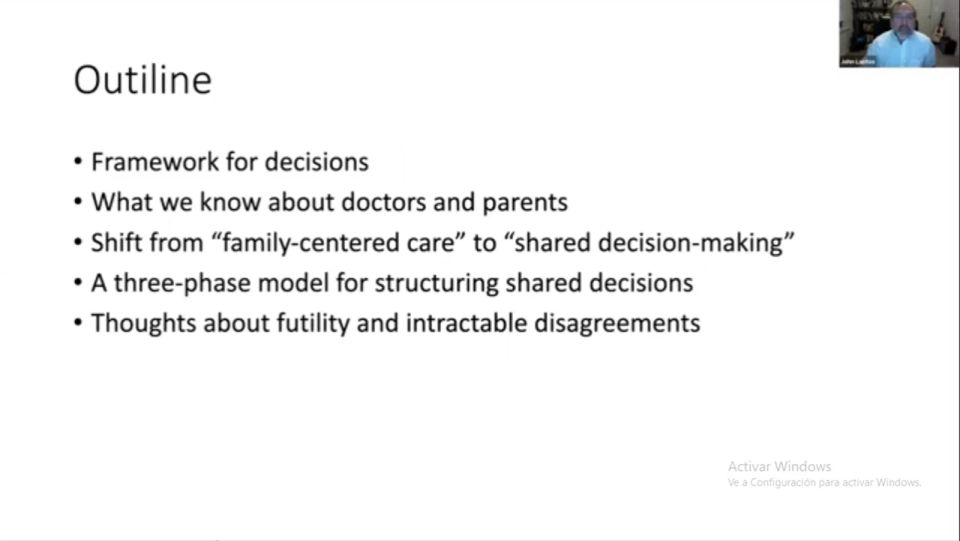
cover a bunch of things. One, a framework for decisions. A little bit about what we know about doctors and parents and their various attitudes. And talk some about what I see as an important shift in the way experts in communication
- 00:22
Mixed John Lantos and event-moderator boundary fragments
are thinking about
- 00:30
Mixed John Lantos and event-moderator boundary fragments
I think it was a shift from
- 00:33
Dr. John Lantos
what has been called family-centered care to what is now thought of as shared decision making. I'll present a three-phase model for structuring
- 00:42
Mixed John Lantos and event-moderator boundary fragments
shared decisions.
- 01:22
Mixed John Lantos and event-moderator boundary fragments
The framework doctor's
- 01:23
Dr. John Lantos
job was on the y-axis, that is, deciding whether treatment was really beneficial, considered ambiguous or uncertain, or
- 01:33
Mixed John Lantos and event-moderator boundary fragments
was futile. We'll get to futile in the end. And once the doctors have figured
- 01:41
Dr. John Lantos
out how to classify the treatments, then the parent's wishes and values get factored in if we think treatment is clearly beneficial, then at least in many countries that treatment is provided whether the parents want it or not.
- 02:06
Dr. John Lantos
Because in many countries, children are legally protected and thought to have a right to treatment. The action has always been in this middle box where sort of we think think treatment's neither futile nor clearly beneficial, but where the outcomes are ambiguous or uncertain. And according to the President's Commission in the United States in 1982, in those situations, our goal was to seek out the parents' views, inform them about why we think outcomes are uncertain or ambiguous, and then respect their values and preferences if they want treatment, we provide it. If they don't, we do not. So this raises the question, what do parents want if their values are supposed to guide treatment? How should we help them? And it turns out that parents are much more complicated than doctors and nurses, and they don't all want the same thing. What they seem to want based on a number of studies I'll show you is different from what doctors and nurses say they would want. for their baby. Although there are some suggestive data that when doctors and nurses become parents, they think more like parents than professionals. But as professionals, they tend to have certain,
- 03:34
Dr. John Lantos
let's call them unique views that are different from the general population. Parents are also much more different from each other than our doctors and nurses. So here's some data that illustrates what I'm trying to say. This is a study that's now almost 20 years old. It was done in Canada. These studies have now been done in 10 or 12 different countries. A lot of them are old. It would be interesting to repeat them. But this was, do you agree or disagree with the statement, I believe an attempt should be made to save all babies regardless of birth weight. It's a Likert scale. And what you can see is parents of low birth weight babies or control parents who are parents of term babies were much more likely to agree and think that an attempt should be made to save all babies. Doctors and nurses were much more likely to disagree or strongly disagree with that statement. Now there's a couple of things to note. One, as I just said, parents seem very different from the doctors and nurses, but the other is parents are more different from each other. than are doctors and nurses. So about a third of parents in both groups disagreed and a few strongly disagreed with that statement. So take home lesson number one, you can't generalize about parents. You have to figure out what each group of parents says they want. For me, the best way to try to get a sense of what parents want is from memoirs or in some cases novels or short stories. that parents write from a very personal perspective about their experiences. And I'm going to try to quickly go through
- 05:21
Dr. John Lantos
some of these narratives. And I'm going to quickly go through everything today, because I really want to leave time for discussion. And as I said, there are a lot of topics. But if people feel any deep moral distress while I'm talking, you could raise your hand, I think, on Zoom, and we could take Take a detour. Kenzaburro, oh, he's a Japanese novelist who won the Nobel Prize in literature. And his most famous book is autobiographical. He himself had a baby born with an encephalocele. And he wrote a novel about a 25-year-old father who was facing decisions. And in the book, the father doesn't want to authorize surgery to correct this and says the fact that an abnormal baby was born to me in my life was a simple accident. Neither of us is responsible. All I can do is leave him at the university hospital, make certain that he'll weaken and die naturally. Some parents want that, although they don't always want to take responsibility for that decision. Some parents want more treatment than doctors think is appropriate. Barbara Farlow had a baby born with trisomy 18. The doctors counseled them on the possibility of terminating the pregnancy. They decided not to and wanted to treasure the time they had left. Charles B. And then in this very disturbing paper that she wrote she described how her daughter developed respiratory distress was admitted to the PIC you the parents wanted. Charles B. ventilation and did not want to dnr the intensive a seeming upset with that and they later found out that a unilateral dnr order had been written they sued the hospital one and use the. Charles
- 07:05
Dr. John Lantos
B. money from the settlement to. do ethics education at the hospital where Annie was born. Some parents changed their minds. Vicki Foreman wrote a lovely memoir about having premature twins born in 1990 at 23 weeks. She talked about how on the first day she didn't want any resuscitation. We want the twins to be DNR. I was against resuscitation at birth. I'm not in favor of prolonging life support. These babies were simply born too early. But two days later, she wrote Charles B. Day before I stood outside of the NICU cried and threatened to rip out every two but attached to my twins but something changed. Charles B. i'd come to accept these compromise babies is mine, I felt ugly fated to be Evan and ellie's mother, this is a phenomenon that i'm sure many neonatologist are familiar with call it bonding call it. Charles B. Whatever you want, but many parents. Charles B. change their minds over the course of treatment and so having a discussion trying to make a shared decision, but then. Charles B. Having a pause and letting people go home and think about it may change the nature of that decision some parents are just scared and uncertain Doug Richardson did a great study that was published in JAMA. Charles B. interviewing parents and they said things like this she's so tiny and fragile i'll touch her, but I can't really touch her I don't know why but i'm scared. I'm very scared. I don't want to break her. And this is even true for parents who are neonatologists. Annie Janvier, who's a neonatologist in
- 08:48
Dr. John Lantos
Montreal, wrote this article and now has written a very moving book-length memoir about what it was like when she had a tiny preemie in the NICU. Violette was born at 23 and a half weeks. And he showed me a neonatologist herself said, I loathe visiting the NICU and she was unstable. I held me and told the nurses I wanted to, even if I dreamt every night of dropping her and seeing her eyes roll on the floor and her brains gushing out. So this fear of the fragility of babies interferes with bonding and interferes with parents' abilities to make decisions. Some parents feel ignored. Robert and Peggy Stinson wrote a harrowing tale of trying to get neonatologists to withdraw life support on their tiny preemie, Andrew, and they felt that their wishes, judgments, and thoughts were rarely of interest to the medical staff who made decisions as though we did not exist. Some parents feel misled. The NICU staff members hide information about the dismal prognosis and neurologic damage. And so as you read these memoirs, you find so many different variations that the question and the challenge for clinicians who are trying to guide parents through this is, you know, how do we deal with all the variation? And when and how should we seek the parents' views? And when, if ever, should we override their requests, either for treatment
- 10:21
Dr. John Lantos
if we think it's inappropriate, or non-treatment if we think it is appropriate.
- 10:28
Dr. John Lantos
So before I get to that, let me just give some caveats about this. The talk is based on the conditions that are common in industrialized countries that have child protection laws, that have a focus on patient and parent autonomy, and most have universal or near universal third-party health insurance coverage so that the direct costs of continued treatment are usually not borne by the parents and are considered by doctors and hospitals only in a very almost abstract way. That is, it's usually not that resources aren't available for this particular patient. It's more whether, as a society, we want to spend money on particular types of care I recognize as I'm going through this, and particularly with this very international audience, that conditions are very different in other parts of the world. There are differences that are both legal and economic. But I will suggest that the ethical issues, the questions of what the right thing to do is, what we would prefer to do, what we would recommend, are actually very similar regardless of these economic, political, or legal structures. And doctors struggle to help families, guide families, work together, even when the ultimate remedies, either legal or economic, are not available.
- 12:03
Dr. John Lantos
So again, the goals for the rest of the talk are to describe a paradigm shift in the way we think about approaching these decisions from the once dominant paradigm of family-centered care which grew out of concerns that parents were not being given the facts upon which to base an informed choice, to an approach that I think is more appropriate for the internet age, the digital media age, where parents have lots and lots of information. Nothing is being hidden from them. In many countries, they have the rights to see their medical records. The model is shared decision-making. And the new approach, the one that's beginning to take hold and that I think is preferable, focuses less on giving parents facts and more on supporting parents in their emotional and spiritual realities as they're facing a truly existential dilemma about what sort of parents they want to be. And I'll suggest that this new approach is more likely to build trust and avoid intractable disagreements than the older approach.
- 13:16
Dr. John Lantos
Where did the older approach come from? It's interesting that it really came from a parent, Helen Harrison, who famously wrote one of the best-selling books about being a parent in the NICU, the premature baby book, and who in essence founded a movement that greatly influenced the American Academy of Pediatrics and many other neonatal Charles B. Associate pediatric and neonatal associations here's Helen Harrison story she had a baby Edward who was born in 1975 of note, he was 32 weeks and 2.7 pounds so he wasn't a tiny preemie. Charles B. But he did develop meningitis very bad case of listeria meningitis and the neonatologist told them that there was no hope for Edward to survive. that the appropriate thing to do was to stop the ventilator. Helen Harrison and her husband agreed. They stopped the ventilator, but Edward did not die. In fact, he lived for another 39 years. I present this because it's a little paradoxical in terms of what Helen Harrison went on to advocate for, but clearly she was given a dismal prognosis for her baby that turned out to be wrong. Furthermore, Edward had a quality of life that a lot of people would consider reasonable. This was from
- 14:49
Dr. John Lantos
his obituary when he died. Despite his handicaps, Edward turned into a delightful human being who sings, dances, plays music, and reads Dr. Seuss books. So he had some cognitive deficits, but was not in pain, had a good life, died at the age of 39. But Helen Harrison, came away from the experience of decision-making for her son Edward with a sense that doctors weren't giving parents enough information. And she started writing about that. Gerald Lucey, who was the editor-in-chief of Pediatrics and a neonatologist, invited her to host a conference and to guide neonatologists on how they should approach these difficult decisions. And she wrote a special article in 1983 called The Principles for Family-Centered Neonatal Care. She kept writing about this for the next 30, 25 years.
- 15:46
Dr. John Lantos
And her main point was that doctors often withheld information about dismal prognosis. And she wrote things like the poor outcomes of extremely preterm birth and the suffering of the baby may be ignored entirely. Parental options to forego resuscitation are rarely Thomas H. mentioned by the doctors, as I said, that was not her own experience, but that was what she came to believe. Thomas H. And this idea of family centered care was that parents must have available to them the same facts and interpretation of those facts as the professionals, including information about uncertainty surrounding treatment access to the chart rounds discussions, etc, and that. Point of view, that approach to doctor-family, doctor-parent communication became the dominant view and was incorporated into major statements by the American Academy of Pediatrics. I'll take you through a couple of them in successive statements. 2002, the AAP's Committee on Fetus and Newborn said, family members should be informed of the range of survival rates, types and rates of long-term disabilities that can be expected. Most neonatologists in practice today who are trained in programs that follow these guidelines think the goal of discussions with parents is to give them the facts about survival rates and the types of long-term disabilities that can be expected. And so many conversations say 70% of these babies die. Many of the survivors have cerebral palsy or blindness or chronic lung disease. What do you want us to do? John K.: AAP repeated that in 2008 parents should be given the most accurate prognostic morbidity and mortality. I'm not going to belabor this too much. John K.: Again in 2015 the primary goal of antenatal counseling was to allow parents to make an informed decision. John K.: Regarding the intervention. The thing that all these statements have in common is the idea that our job is to give parents the facts and parents then John K.: Are sort of left on their own to make what would be considered an informed decision now that we've given them the facts.
- 18:06
Dr. John Lantos
We've learned a lot about this current approach from studies of doctor-patient communication, and most importantly, from many of these memoirs that parents write, where they recall this conversation where the doctors came in and gave them the dismal facts, as Helen Harrison and the American Academy of Pediatrics advocate doctors should do, And in many parents, what that conversation evokes is rage. They perceive it as a conversation where the doctors are trying to persuade them to let their baby die, where they're focusing on the dismal outcomes rather than on giving the parents some hope. But there are other problems with the current approach, not just the parents' responses. And let me just go through four of these. The first is that John K.: Facts themselves are not simple and straightforward, so the ideal that we should give parents, the facts, it seems like. John K.: Something that everybody should agree, whether it has been achieved or not, but as i'll show you in a minute, that is not the case second problem is that doctors themselves.
- 19:23
Dr. John Lantos
I put the word hate here, but maybe a better way to say this would be are not comfortable with gray zones and of deferring to parents when it means that similar babies will be treated differently based on the parents' values and preferences. So instead, many places have a set of guidelines for treatment. We resuscitate all babies at 24, but not at 23 weeks or some such thing. And the idea that There's a gray zone where we defer to parents is not widely accepted. And I'll show you a little bit of data on that. We all have biases and decision-making, particularly parental decision-making is not particularly rational. So what are the problems with facts? Well, one way to think about them is that they are denominator problems. So we know how many babies survive, but what's the appropriate, Denominator, the studies that report survival at various birth weights or gestational ages often don't account for non-treatment, substandard treatment decisions to withdraw life support or rates of disability among survivors rather than rates of disability or death among all babies who are born. So here's an example. This data comes from the NICHD's neonatal calculator.
- 20:50
Dr. John Lantos
John K.: Data itself is a little dated, but they're updating it constantly. But if you go to the neonatal calculator and you can put in variables like birth weight singleton gestational age gender. John K.: And ask the calculator. How many 500 grand 23 weeks singletons survive unimpaired you get these answers for boys and girls and whether the moms got steroids or did not get steroids. Couple of things to notice when you think about facts, there's a fourfold difference in survival even at this same birth weight and gestational age between boys who got no steroids and girls who got steroids. Survival rates double for both if you give steroids and this doesn't just give the mom steroids and this doesn't distinguish death from disability in survivors. This is just survivors who are neurologically intact. But if you go to the calculator and ask just a slightly different question, instead of how many 500 gram 23 week singletons survive unimpaired, you ask how many 500 gram 23 week singletons who survive are unimpaired, you get very different answers. In this case, for boys and girls, steroids or no steroids, it's 50% or above in every category.
- 22:16
Dr. John Lantos
If we're going to give parents the facts, which fact should we give? Should we give both facts? We could give other facts. We could incorporate things like race. We could incorporate adequacy of prenatal care. We could incorporate whether the baby's been born at a tertiary care center. We could incorporate the hospital's policies on survival or non-survival. And all of these influence the fact So the facts are not derived from nature in this situation so much as they are derived from the way we construct facts, both
- 22:55
Mixed John Lantos and event-moderator boundary fragments
through our policies.
- 23:03
Mixed John Lantos and event-moderator boundary fragments
Come data from the
- 23:04
Dr. John Lantos
NICHD neonatal network. This phenomenon that I'm about to describe is true in every data set from every country that I've looked at. John K.: Overall, in the NIC HD neonatal network 24 hospitals for babies born at 22 weeks of gestation in the early 2010s overall survival was 5% and that is a fact 5% of babies born at 22 weeks survived, but if you look at the babies who actually got treatment 23% survived so.
- 23:44
Dr. John Lantos
And one hospital at 34%. So what is the actual survival rate or what was the actual survival rate within the neonatal research network? Probably somewhere between 3% and 34%, depending on whether the hospital had a policy to provide active treatment or not. In this, Mortality is a self-fulfilling prophecy. If hospitals think all babies will die and therefore don't treat them, turns out all the babies die. And the fact is confirmed. If the babies are treated, many survive. And in fact, many survive without significant neurodevelopmental impairment. Here's the data on that for babies born at these different gestational ages. So even at 22 weeks, two thirds of the survivors did not have severe neurodevelopmental impairment. That means that one third did, but whether that fact should be given to parents is the point of this.
- 24:51
Dr. John Lantos
Doctors don't do well in gray zones. Here's some data on that. This was a study about who should make decisions in the delivery room and who does make decisions in the delivery room. Charles B. Doctors were aware that it should be a shared decision making process, this was done in 2005. Charles B. Almost four fifths of the doctors said doctors and parents should make them together, but then they asked who actually does make the decision and far fewer said they engaged in a shared decision making process instead they said half the time we just make the decision ourselves. or a similar study looking at whether decisions were made to resuscitate, provide comfort care, or defer to parents for babies at along the x-axis 23, 24, 25, and 26 weeks of gestation. And you can see that at no gestational age did more than a third of doctors defer to the parents. So this idea that in the gray zone we should defer to parents is nice in theory, not well operationalized in practice.
- 26:07
Dr. John Lantos
What about biases? When we go into counsel, do we have certain attitudes about survival or survival with disability or chromosomal anomalies that we bring to the discussion and Therefore, don't simply present the facts, but present our own beliefs and attitudes at the same time. You can ask yourself questions like, do you think trisomy 13 and 18 are uniformly fatal? As many textbooks state, many policies reinforce, but the data do not
- 26:44
Dr. John Lantos
bear out. Do you think of severe birth defects as tragedies? Do you go in and talk to parents with a, face filled with grief and mourning that they are having a baby with trisomy 21 or trisomy 18 or bioluminescence. Do you think that having a disabled child will ruin parents' lives? Those are widely held beliefs, but they can also be thought of as biases about the value of life with various disabilities, biases that not all parents share. parents who write about doctors bringing their biases in notice that not everybody gives the same attitude when they're counseling. Kelly Benham wrote a series of newspaper articles and a wonderful book about having a preemie in the NICU. And she said, critically sick babies are cared for by a constantly rotating team of doctors, nurses, nurse practitioners, resident specialists. Some treat aggressively, some don't. One doctor is pro-life, one has disabled kids. One was unexpectedly widowed. All these factors influence how they talk to parents, how they assess quality of life, and how they interpret risk. And parents are sort of bombarded by these different attitudes and these different biases as they're trying to figure out what's going on with their baby and what choices ought to be made. Here was a fascinating study from Hong Kong.
- 28:17
Dr. John Lantos
comparing doctors' and parents' attitudes to severe disability compared to death. And you can do this yourself here. There's three categories here, but the first two are where the action is. Which do you think is worse, death or severe global impairment? And in the study, they gave some details. They said severe global impairment means confined to a wheelchair, lifetime unchanging intelligence of a one-year-old unable to speak read or write incontinent and no activities of daily living would it better to live life in that state or to die and they asked both doctors and parents and it turns and nurses turns out that doctors and nurses uh over half think that severe disability is worse than death and they asked parents who had a term maybe it was lower 40 percent
- 29:10
Mixed John Lantos and event-moderator boundary fragments
And
- 29:10
Dr. John Lantos
parents who'd had a baby in the NICU, it was just 25%. Again, this is like the Striner study I showed earlier showing systematic differences between the way health professionals and the way parents think about disability. There are key elements of the NICU or prenatal milieu. Parents are in the grip of strong emotions. The deliberative process is not sensitive to subtle statistics. And what parents focus on is not whether their baby's gonna have a 38% or a 52% chance of mild to moderate cerebral palsy, but what they are called upon to do in order to be a good parent. And in many cases, that means advocate for their child and advocate for continued life. In some cases, it means advocate for withholding and withdrawing
- 30:03
Dr. John Lantos
life support. And as the Vicki Foreman, Text showed sometimes people change their mind on that. In this paper by Marlise Hayward and colleagues, they interviewed many parents and came to the conclusion that suggesting a standardized set of facts is too simplistic, that an understanding of risk information is dependent on relationships, trust, balance between cognitive and affective emotional elements. John K.: Life experiences subjective interpretations tolerance of risk and other personal factors these personal memoirs suggest just how. John K.: unusual the thought processes of parents who are trying to understand what's going on with their tiny baby in the NICU unusual those thought processes are vicki foreman wrote this beautiful passage, the world receded everything took place in slow motion. And was viewed as if down the wrong end of a long telescope. So much was unfamiliar that if I was asked my name, I had to think for long moments. Or Kelly Benham, I had crazy thoughts. If she died, would we get a birth certificate? Would there be a funeral? Would we get a box of ashes? What size box was she aware of us? Did she recognize me? My point here is that if you're going to go in and try to give parents a lot of facts without acknowledging what their mind is doing in this crazy situation, you're not going to get to the kind of informed choice that is appropriate. What people have started to talk about then is a different idea of what it means to be autonomous. I mean, the older approach says, we give the facts. Once they have the facts, they are prepared to make an autonomous decision. A new idea which grows out of a lot of feminist philosophy and bioethics talks about the idea that autonomy is inherently relational. We don't act independently alone. We act in concert with trusted friends, lovers, advisors, spouses, family members, and that our identities are formed and realized and our values and preferences in a strange situation Charles B. Determined within the context of these important relationships and one of the most important is with an empathic doctor who, like a good psychotherapist can help parents to understand their own values in relation to this. Charles B. value challenge that they're facing and to figure out what it means to make an authentic choice parents can't do that alone. Charles B. They can't do that if they're simply given the facts.
- 32:59
Dr. John Lantos
So this has led to a lot of research being done by a lot of people around the world on what it means to do shared decision-making in this context. And I've synthesized a lot of research in a paper that I published in the New England Journal a couple of years ago that draws on work being done by Stephanie Cokor at Michigan and Annie Janvier at Montreal, Saroj Sehgal. In Toronto, Renee Boss at Hopkins, there's lots of people who are,
- 33:34
Dr. John Lantos
and some of these parent memoirs too. Vicki Foreman has been at conferences. Kelly Benham has spoken to our ethics committee. And the work that's being done empirically in studies and the work that comes out of these moving memoirs from parents all suggest a new way of thinking about what kinds of conversations ought to take place. I ended up describing it as three phases. The first phase is to prepare yourself as the professional for this conversation. And preparation means reminding yourself that while this is all in a day's work for you, this is the most important conversation these parents might have in their entire life. And they'll remember every word, every gesture, every expression. So preparing yourself to be open and present And here's the key difference from the old approach, not ready to talk and give them facts, but ready to listen.
- 34:35
Dr. John Lantos
In this self-preparation, examine your own biases. What do you think about birth defects? If the parents are from a different racial or religious or cultural group, do you have stereotypes about that group? Are there things you're expecting to hear and maybe on guard against? Have you decided already what's best for the baby? Do you have a goal for this conversation to get them to agree to withdrawing life support? You should be aware of all those things. And then by this approach, you should try as hard as possible, knowing it's never fully possible, to put all your own attitudes, biases, goals, beliefs aside, because the real goal of this first conversation John K.: Station is to be non judgmental not to inform or direct parents, but to build a level of trust that will allow this approach to relational autonomy and shared John K.: Decision making to take place to essentially offer yourself to the parents as a trusted confidant who wants to hear what's important to them. John K.: So the goal is, and this is part of the centering to create trust to listen to learn what their goals and values are And then eventually to come up with a plan
- 35:54
Mixed John Lantos and event-moderator boundary fragments
that
- 35:55
Dr. John Lantos
everybody can affirm. Phase two is about logistics and etiquette. Find a quiet room, avoid interruptions, maybe invite one other healthcare professional, but don't bring a lot of people into these conversations. There's a role for a team meeting where you bring all the specialists together, but for a family meeting to make decisions about life sustaining treatment. The fewer professionals, the better, because otherwise it becomes frightening and overwhelming. Encourage parents to bring anybody they want for emotional support. Find a place where you can sit down and act as if you have all the time in the world. Introduce yourself, explain your role, know the baby's first name, and then engage in what I think of as an iterative process of trying to figure out where the parents are and what decisions are on the table. First step is to acknowledge emotions.
- 36:56
Dr. John Lantos
Some of the quotes I gave suggest the kinds of emotions parents are feeling.
- 37:03
Dr. John Lantos
Say that you know that this is a tough time for this. I'm really sorry you're going through this. Tell me how you're feeling. That will build trust and then move to eliciting their fears and their hopes and their goals and their values with open-ended questions. Like some of the ones here, what are the main problems for you and your
- 37:22
Mixed John Lantos and event-moderator boundary fragments
family?
- 37:23
Dr. John Lantos
What are you hoping for? What's your biggest fear? What information do you need that you're not getting? Let them guide you about what facts they need. They may feel like they have enough. And then reflect the parents' views back to them. What I'm hearing you saying is, whatever it is they say in response to these open-ended questions. And then to the extent that it's a decision-making time, say we face some tough decisions here or we may face some tough decisions soon,
- 37:56
Dr. John Lantos
we're going to be there for you, we're going to go through this together. And then comes what's for many people the hardest thing of all, which is to let a little silence grow. These are tough conversations. They're emotional. Often people are crying. And sometimes the best thing to do is just to sit and be with people, although the silences can seem long and in some cases agonizing. But when people have done studies on this, they find that doctors tend to be impatient with silence and fill silence in three or four seconds, whereas patients and parents will go 10 or 15 seconds not two minutes. So if you can just wait and see what bubbles up after this circular conversation, it may take you around the circle again if they talk about their emotions or their fears or their hopes.
- 38:55
Dr. John Lantos
So the conclusion for this part, and then I'm going to finish up with a few thoughts on futility. Microethics seems to be replacing macroethics, shared decisions replacing family-centered care, iterative circular communication, focusing on the development of relational autonomy. Let me just quickly give a few thoughts about futility and then hopefully still have some time for discussion. What do we mean by medical futility? There's what I think of as old fashioned futility, just a treatment that won't work. And then there's kind of a modern definition where futility has become a code word for an intractable disagreements between Archie Spencer- disagreement between doctors and patients or surrogates parents, but the appropriateness of providing marginally beneficial treatment. Archie Spencer- In a sense, the debate about futility is a debate about whether it's ever appropriate to unilaterally refuse to do certain treatments, even if patients or parents wanted.
- 40:03
Dr. John Lantos
The discussion about futility began at a particular time. This article in the New England Journal in 1987, Must We Always Provide CPR?, was the first use of this modern idea of what futility is. And Dr. Blackhall presented the case of a woman with metastatic ovarian cancer. No further chemotherapy was available. She was clearly dying. Doctors thought she should have a DNR order. And she said, nope, I want everything. I want CPR, I want intubation. I want to die in the ICU getting pressures and ventilation. And Leslie Blackhall raised the question, can we just say no? And this led to an avalanche of scholarly writing about this. There have now been thousands of articles, dozens of books. Many hospitals have policies. There's a law that differs wildly from jurisdiction to jurisdiction about whether doctors can make these unilateral decisions. And here's the sort of case that generates this controversy. I'm sure everybody on this call could come up with a similar case from their own institution, but this was one that ended up going to court in the media in Texas.
- 41:17
Dr. John Lantos
It's about 15 years old now, but Emilio Gonzalez was born in 2005, first baby to his mom. had all sorts of neurologic problems in the NICU and eventually was diagnosed with Lay's disease, an irreversible neurodegenerative disorder that leads to death in the first couple of years of life. He stabilized, he went home, but came back at a year of age with a viral illness, went into the PICU and everything went downhill from there. Semicomatose, no gag, on a vent with an NJ tube and the doctors recommended a DNR order and withdrawal of life support. And the mom said no. So they went to the ethics committee that agreed with the doctors. Treatment's a constant assault on Emilio's fundamental human dignity. The burdens outweigh the benefits. It's medically inappropriate to continue aggressive care. They recommended comfort measures only. Code status should be DNR and spiritual and pastoral care for the family.
- 42:23
Dr. John Lantos
John K.: mother did not accept the recommendations, the doctors sought a court order, allowing them to withdraw treatment, the Court agreed with the doctor mother appealed and she went to the Texas legislature. John K.: Where she testified that her rights were being violated her child's rights were being violated, she went to the press and showed pictures of herself sitting there with her baby and garnered national support. for her David-like stand against the Goliath of a heartless medical system. And this picture, which she sent to newspapers and was published in the press, I think is evocative because of the way it
- 43:09
Dr. John Lantos
mimics the Pietà with Mary sitting there with the suffering Jesus on her lap. And it suggests that uh, Katerina Gonzalez was pretty sophisticated in evoking the idea that there's something holy about not giving up hope and that her struggling and fighting for the right to keep Emilio on life support resonated with a lot of parents, parents whose views are similar to the ones in the surveys that I showed and very different from the doctors that even a life with severe disability, um, is. life worth living. These cases create moral distress all around. If you do stop life support, mothers are forced to watch their children die. If you don't, caregivers are forced to provide futile care. Hospital administrations and judges are forced into uncomfortable positions. And this is what it feels like when you have one of these cases in your intensive care unit.
- 44:15
Dr. John Lantos
James W. raises a question why parents demand feudal treatment, they may not have been told in terms that they actually understand i've sat in and a lot of these conversations where. James W. Doctors call for an ethics consultation and before we go into make with the parents, they tell me this kid has no chance he's dying suffering every day, and then we go into talk to the parents and doctors say to the parents well things don't look so good or. We don't think there's much chance of survival. Fudge the hard truths. Don't speak clearly about their deep beliefs that treatment is both futile and torture. And parents grasping for any straw, any reason to hope, hear that as, well, if there's not much chance, there must be some chance. Otherwise, why would they be asking me what I want to do? The other thing is parents and adults making decisions for adult family members come with ideas shaped by television and the movies. We actually studied this a few years ago and published a paper in the New England Journal where we looked at outcomes after CPR on three of the most popular television shows of that year. And what we showed was that on TV, survival rates after CPR range from two thirds to about 100%. And furthermore, on television, no survivors have any neurologic disability. In fact, many begin a new romantic relationship on that same episode on television. Survival rates after CPR, even in hospital CPR, are closer to 10% to 15%. So these ideas that people bring may shape their responses to these discussions more than any of the facts. Some of you may remember this survivor, E.T., almost died during the movie and had a vigorous episode of CPR done by physicians who were jobbed in from L.A. County Hospital who were really good at resuscitation. But it didn't work and E.T. turned gray and his heart stopped until his little buddy, Elliot, tells him I love you at which point E.T.''s little red heartlight begins to glow again, and he phones home and makes it back to his planet. The take-home lesson seems to be that if you truly love someone, you will not give up, even when the doctors give up. Love can succeed where medicine fails, because there is magic in the world.
- 46:55
Dr. John Lantos
What do we do with that, then? This is the last thing I'll say. There are these different categories of futility that have emerged from the debate that are important to keep in mind when you're struggling with these tough cases. There's one that people have called physiologic futility or that I call real futility. That's a biologic reality. This is when a kid's in the unit and they're in multi-system organ failure and they're on four pressors and maximal ventilator settings and their blood pressure is dropping and their oxygen saturations are dropping. And even if you attempted CPR, it wouldn't work. We all know that kind of physiologic futility. That is not the kind of case that generally creates the most moral distress. Instead, the kinds of cases that create moral distress are when we're worried about the quality of life. That would be the Emilio Gonzalez case, or when we're worried about the cost. When we think
- 47:55
Dr. John Lantos
the cost is too high, The treatment to burdensome the baby's suffering and has a miserable quality of life and the treatments are working. They're keeping the child, the baby alive. That's the most problematic futility. It's problematic, not because it's physiologically futile, but because it actually works. And therefore, babies and children stay in ICUs for weeks or months or some terrible cases even longer. Here's an example that just came out this month of physiologic futility. I won't go through this in detail. Basically, it's a study of CPR for patients with COVID-19. And what they found was 63 patients suffered a cardiac arrest. The in-hospital mortality was 100%. These sorts of data are not available for most treatments that we call futile, but suggest that with this sort of data, you might be able to say, doing CPR, is futile. That's not the sort of data that would apply to someone like Emilio
- 49:01
Mixed John Lantos and event-moderator boundary fragments
Gonzalez.
- 49:03
Dr. John Lantos
So the resolution of futility cases, I mean, often it seems like there should be a local case-by-case resolution, but it turns out the outcomes in these cases are pretty much determined by the legal and political framework. Can physicians legally force treatment if parents don't want it? often physicians support that kind of legislation because we think babies have a right to treatment. But the flip side of that is parents can demand treatment even if the physicians judge it as inappropriate if the law errs on the side of life and allows anybody who advocates for treatment to have their wishes
- 49:46
Dr. John Lantos
respected. There's also the question of who pays. which shapes these decisions in a powerful way. If parents are picking up the bill for treatment, they are much less likely to advocate for continued treatment. And if they're picking up the bill, it raises important questions about justice. So conclusions about these intractable disagreements. Disagreements are common. Often the first discussion, doctors and parents aren't on the same page. Intractable disagreements are blessedly rare, although the ones that last a long time have such a powerful effect in creating moral distress that we remember them and think of them as more common than they are. They cause moral distress out of proportion to their frequency. As I say, they reflect the socioeconomic and cultural milieu in which technology is available. Parents are empowered. Child protection laws give children legal claims to treatment.
- 50:49
Dr. John Lantos
And finally, most futility controversies arise because treatments are not physiologically futile, but instead because they preserve life that some people think is a life of pain and suffering at a great cost, and therefore seem to violate the principles of beneficence and justice that often powerfully influenced doctors' views on this. I left a little time. I wish there was more, but I'm happy to take questions and I can stay longer than the top of the hour.
- 51:27
Event moderator
Thanks, John. We might just unshare screen so people can come. Thank you.
- 51:36
Event moderator
Thank you for a great talk about such a complex topic. It strikes me that
- 51:43
Event moderator
sort of framed things in a way that so that it's
- 51:48
Mixed John Lantos and event-moderator boundary fragments
so contextual and that you know it's very personal
- 51:55
Mixed John Lantos and event-moderator boundary fragments
not only for the parents but also for
- 51:58
Event moderator
the clinicians and that it as you've said is iterative and you know i know that you've spoken and written about um you know this many many times But it also comes to me that hope is the thing with that lodges in the soul. And we can't really account for that hope that parents have and how much weight it has for them. I'm going to throw out now two questions. And I noticed that Dr. Kishore Kumar is online from the Cloud Nine Hospital in Australia. neonatal unit and I wondered if you had a comment Dr. Kumar or a question or something because you have a very different system there.
- 53:13
Event moderator
And also, Srini Bolasetti, I saw you online, Srini. Are you able to jump on and make a comment from Royal Women's Hospital?
- 53:31
Dr. John Lantos
Looks like Jagdish Chinnappa has raised his hand too. Yes,
- 53:37
Mixed John Lantos and event-moderator boundary fragments
go ahead.
- 53:41
Mixed John Lantos and event-moderator boundary fragments
Jadish, how are you?
- 53:45
Jagdish Chinnappa
Thank you. I'm fine, thank you, sir. Thank you very much for that wonderful lecture. Really a well-researched and beautiful lecture on the evolution of care of preemies. I had only one question. I think the model which you presented was on shared decision making. In India, the predominant factor is on paternalistic because parents say, doctor, you decide what has to be done for this child and we don't want to take the decision. The other question I had was there's a lot of gender bias in India in terms of boy babies are treated much more aggressively than girl babies. Wanted to know some of your comments on that.
- 54:26
Dr. John Lantos
So for the first one, I think that is true in many parts of the world. This model of patient autonomy and shared decision making is, as I said at the beginning, peculiar to the West and even more located in countries within the Anglo-American philosophical tradition, less common, for example, in Southern Europe than in
- 55:00
Dr. John Lantos
England, North America, and the UK and Australia. So to the extent that parents actually voice the desire for the doctor to make decisions, that is a form of autonomy. And I think we should take that burden or accept that burden as a way of respecting their choices about how they want decisions to be made.
- 55:31
Mixed John Lantos and event-moderator boundary fragments
The
- 55:32
Dr. John Lantos
gender bias issues are really, really hard.
- 55:41
Dr. John Lantos
If there is a framework of child protection legislation, it could address that. But
- 55:51
Dr. John Lantos
from what I understand of India, that also does not exist. So that although parents defer to doctors in many situations, they also have the right, the absolute right, to make decisions about whether their children should be treated or not. And if they take a girl baby out of the NICU in situations where they wouldn't take a boy baby, there's no legal remedy for that. And so that reinforces my idea that all of these decisions take place within a legal and cultural context. gets as ethically problematic or you wouldn't have raised the question and probably as troublesome for the doctors there as it would be here. You just don't have the
- 56:50
Dr. John Lantos
legal right to override those decisions.
- 56:55
Event moderator
John, there's a couple of other questions and I don't know whether you're happy to stay on for another 10 minutes or so. We've reached
- 57:02
Mixed John Lantos and event-moderator boundary fragments
the time.
- 57:05
Event moderator
and
- 57:06
Mixed John Lantos and event-moderator boundary fragments
so if anyone
- 57:10
Mixed John Lantos and event-moderator boundary fragments
I know I'm aware
- 57:11
Event moderator
of the sessions times they can jump off now if they would like to and thank you for attending but there's been a question about how to approach senior doctors to give facts
- 57:23
Mixed John Lantos and event-moderator boundary fragments
and yet expect parents to choose leaving parents feelings they'll
- 57:31
Mixed John Lantos and event-moderator boundary fragments
abandon their child if they don't continue So that gets back to that first table that I
- 57:44
Mixed John Lantos and event-moderator boundary fragments
put up where, again, at least in the West or in many countries,
- 58:06
Dr. John Lantos
the doctors have the first obligation to decide whether treatment's clearly beneficial. And if it is, then I think we should be straightforward about that and say we're legally required to provide treatment. If parents said they didn't want an acute care for a baby born at 27 weeks in Australia, I think we would say you're not allowed to refuse because survival rates are so good. The baby has an independent right
- 58:46
Dr. John Lantos
to such treatment. If it's in the gray zone, if it's in the zone of ambiguity or uncertainty, if we think it's appropriate to defer to parental preferences, then it gets back to examining our biases. Are we trying to lead them to a decision to continue treatment and therefore make them feel guilty about stopping or are we trying to get them to stop and
- 59:19
Mixed John Lantos and event-moderator boundary fragments
perhaps laying on some guilt about other babies suffering to get them to agree
- 59:26
Mixed John Lantos and event-moderator boundary fragments
to stop
- 59:28
Event moderator
and there are another questions come in and i think this actually um touches
- 59:32
Mixed John Lantos and event-moderator boundary fragments
on a number of points and one of the things i
- 59:38
Mixed John Lantos and event-moderator boundary fragments
think with ethics is really important to
- 59:41
Event moderator
start with commonalities rather than disagreement or expect disagreement. So one of the questions is about what strategies can you offer as to how to translate this knowledge of
- 59:54
Mixed John Lantos and event-moderator boundary fragments
part of certainly training for healthcare and
- 1:00:00
Mixed John Lantos and event-moderator boundary fragments
perhaps also signifies
- 1:00:04
Event moderator
for early signs that potential disagreement, how do you mitigate that?
- 1:00:13
Mixed John Lantos and event-moderator boundary fragments
So a certain amount of
- 1:00:18
Mixed John Lantos and event-moderator boundary fragments
disagreement, I think, is both
- 1:00:20
Dr. John Lantos
inevitable and healthy. That is, these are complicated decisions. And the hope that everybody is going to come to them with a shared set of values and common principles, I think, is neither. realistic nor desirable. I think everybody should struggle with these decisions. And so having the sorts of conversations that acknowledge
- 1:01:00
Dr. John Lantos
disagreements, that
- 1:01:02
Mixed John Lantos and event-moderator boundary fragments
promise continued dialogue and respect, and that tries to unpack
- 1:01:15
Mixed John Lantos and event-moderator boundary fragments
the thresholds that parents have. And in most cases, parents will have thresholds for when they would say continue treatment is no longer appropriate. But letting
- 1:01:30
Dr. John Lantos
the parents own thresholds and values and preferences guide
- 1:01:35
Mixed John Lantos and event-moderator boundary fragments
both the discussions and the
- 1:01:40
Mixed John Lantos and event-moderator boundary fragments
ultimate decisions.
- 1:01:43
Dr. John Lantos
I think will lead to disagreements that start out seeming like they
- 1:01:49
Mixed John Lantos and event-moderator boundary fragments
might become intractable, but
- 1:01:56
Mixed John Lantos and event-moderator boundary fragments
eventually lead to agreement and consensus. And I think that's the best we can hope for.
- 1:02:06
Event moderator
Thank you.
- 1:02:09
Mixed John Lantos and event-moderator boundary fragments
There's also a couple of questions about
- 1:02:16
Mixed John Lantos and event-moderator boundary fragments
Our other strategies
- 1:02:18
Event moderator
in ensuring self biases or your own distress and thinking about the complication that the child had may have been due to the own unit or not having provided optimal care and the baby landed up with
- 1:02:35
Mixed John Lantos and event-moderator boundary fragments
the complications such as an infant with
- 1:02:40
Mixed John Lantos and event-moderator boundary fragments
ventricular hemorrhage and sepsis.
- 1:02:46
Mixed John Lantos and event-moderator boundary fragments
Wow, that's
- 1:02:48
Dr. John Lantos
a
- 1:02:49
Mixed John Lantos and event-moderator boundary fragments
great question and really
- 1:02:51
Dr. John Lantos
complicated topic.
- 1:03:01
Mixed John Lantos and event-moderator boundary fragments
And gets at, I
- 1:03:03
Mixed John Lantos and event-moderator boundary fragments
think, physician's own emotional fragility and concerns about their own professionalism.
- 1:03:18
Mixed John Lantos and event-moderator boundary fragments
and incompetence it may not be you feeling individually that you made a mistake but if you think your NICU did not provide the best care then collectively you made a mistake
- 1:03:37
Dr. John Lantos
and then feel guilty and responsible in ways that might not have been the case if you thought everything had gone well, but
- 1:03:48
Mixed John Lantos and event-moderator boundary fragments
bad things happened instead. I
- 1:03:59
Dr. John Lantos
think the only way to deal with those sorts of issues is through the kinds of collective rituals we've developed, and I call them rituals, things like morbidity and mortality conferences in which people have an opportunity to look at and quality improvement programs and stuff to look at what's going on in the NICU to compare
- 1:04:32
Mixed John Lantos and event-moderator boundary fragments
outcomes in each NICU with some collective
- 1:04:38
Dr. John Lantos
repository of outcomes like people are part of. their national neonatal network or
- 1:04:45
Mixed John Lantos and event-moderator boundary fragments
Vermont-Oxford or something like that.
- 1:04:48
Mixed John Lantos and event-moderator boundary fragments
You can
- 1:04:50
Mixed John Lantos and event-moderator boundary fragments
get data on your own NICU and other NICUs.
- 1:04:56
Dr. John Lantos
Often it turns out things that people perceive as mistakes
- 1:05:05
Dr. John Lantos
may not be errors. They may be situations where, in retrospect, things might have been done differently that would have led to a better outcome, but
- 1:05:23
Dr. John Lantos
I don't think there's a death or a bad outcome in the NICU where, if you look retrospectively at the days or week prior to care, you don't find things that might have been done differently. might have led to a better outcome so they're all it's their question is when they cross some threshold of uh quality
- 1:05:49
Mixed John Lantos and event-moderator boundary fragments
that is guilt and do sitting and therefore emotionally troubling
- 1:05:56
Event moderator
and there's a a question from yi xiang chai which i think is goes to the heart of this too is that they
- 1:06:04
Mixed John Lantos and event-moderator boundary fragments
their unit handles many illegal immigrants and when the financial
- 1:06:11
Mixed John Lantos and event-moderator boundary fragments
constraints coming between the decision for continued
- 1:06:15
Event moderator
care, especially when the chances of survival is very good, but often the parents feel helpless as they cannot afford to pay. And that is incredibly difficult for both the clinicians, but also the parents because the child protection, of course, aims to protect the rights of the babies.
- 1:06:40
Mixed John Lantos and event-moderator boundary fragments
to the
- 1:06:41
Dr. John Lantos
political and economic milieu. I mean, I think every country has different rules about who gets care and who doesn't. You're either part of the pool that's covered by collective subsidies or you are not.
- 1:07:11
Mixed John Lantos and event-moderator boundary fragments
Those ultimately become tragic political choices that trickle down
- 1:07:20
Mixed John Lantos and event-moderator boundary fragments
to the folks working on the front lines. But I think the only way to address them is at the political level. can't provide care that they are not reimbursed for.
- 1:07:41
Mixed John Lantos and event-moderator boundary fragments
Sure. I think we're coming up
- 1:07:47
Mixed John Lantos and event-moderator boundary fragments
to time. Srini, are you
- 1:07:51
Event moderator
online? And maybe you'd like to comment as we close up and thank John very much. Srini, I saw you, just to unmute.
- 1:08:14
Mixed John Lantos and event-moderator boundary fragments
Or James?
- 1:08:26
Mixed John Lantos and event-moderator boundary fragments
I'm sure that they're all listening in so
- 1:08:29
Event moderator
intently.
- 1:08:35
Mixed John Lantos and event-moderator boundary fragments
That's just what I was thinking.
- 1:08:40
Event moderator
John, I guess this is a topic we think we could talk about all afternoon. It goes to so many areas of intensive care and sort of interacting with parents and making inherently high stakes decisions. I think you've encapsulated so much in such a succinct talk and we're really very, very grateful for your expertise here. And I hope that we can perhaps look at one of the topics that has sort of become more prevalent in this and tease it out a little bit more perhaps about shared decision-making and what that word shared means in shared decision-making and how we think about that at
- 1:09:33
Mixed John Lantos and event-moderator boundary fragments
another
- 1:09:33
Event moderator
session. Thank you very much. much for your um for your words of wisdom and for the talk it was it's incredibly erudite and um and and really useful i'm sure for for a lot of technicians online to thank you
- 1:09:51
Mixed John Lantos and event-moderator boundary fragments
thanks for having me it was fun
- 1:09:54
Event moderator
and thank you everybody for attending and hopefully we'll be there at the next session
- 1:09:58
Mixed John Lantos and event-moderator boundary fragments
see ya thank you
- 1:10:05
Mixed John Lantos and event-moderator boundary fragments
bye-bye