Publication Pressures: Underrepresented Scholars
October 25, 2021 · The American Journal of Bioethics · 1 hr 13 min
About this recording
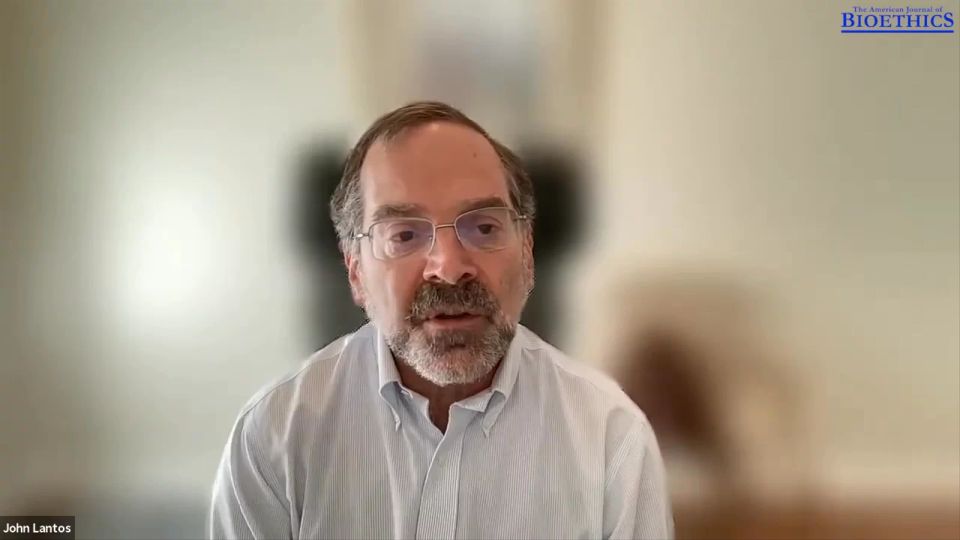
An archived video recording featuring John D. Lantos from The American Journal of Bioethics.
- Format
- Video recording · 1 hr 13 min
- Recorded or aired
- October 25, 2021
- Institution or outlet
- YouTube / The American Journal of Bioethics
- Archive identifier
- V060
- Speakers
- Dana Howard, Toby Schonfeld, John D. Lantos, MD, Audience member 1
Transcript
98 passages
- 00:08
Dr. John Lantos
Welcome everyone who found their way to this session on publication pressures and the unique challenges faced by underrepresented scholars in bioethics. My name is John Lantos. I'm a pediatrician at Children's Mercy Hospital in Kansas City and on the editorial board of the American Journal of Bioethics, which has sponsored this session. Here's how it's going to work. Thanks to everybody who's joining us. I'm going to briefly introduce our wonderful and distinguished panel. We're going to let them each respond to a general question about some of the publication pressures or perhaps other pressures they've faced in their academic and scholarly life. Then we're going to open it up for a general discussion. Panelists can talk to each other, respond to each other's comments.
- 01:03
Dr. John Lantos
You can use the chat or the Q&A. I'll be monitoring both. Or you can use the raise hand function, which would be best of all. If you do use the raise hand function and you want to speak or ask a question, it would be great if you could turn on your camera so we can see you. But if not, you can just speak up. I know during Zoom time, not everybody is in a place where they want to turn on their camera. With that as background, let me just introduce our panelists. Barry DeCoster is an associate professor of philosophy and bioethics at Albany College of Pharmacy and Health Sciences. His research interests focus on areas of bioethics and philosophy of science and medicine. His recent writing is focused on vulnerable and underserved patients, women's health, lesbian, gay, bisexual, and transgender health, racial minority health, And he's tried to engage and respond to the particular needs of these communities. Rosemary Garland-Thomas is Professor Emerita of English and Bioethics at Emory University. She's a Senior Advisor and Fellow at the Hastings Center, where she is also Chief Project Officer for a project called The Art of Flourishing Conversations on Disability and Technology, a project that's supported by the National John Weiner, PSI Services, Endowment for the humanities so so the 2020 national endowment for the humanities public scholar and a Phi Beta Kappa visiting scholar for 2021-22. John Weiner, PSI Services,
- 02:41
Dr. John Lantos
Nani Bah
- 02:42
Dr. John Lantos
Garrison is associate professor at the University of California in Los Angeles and has appointments in the Institute for society and genetics, the Institute for precision health and the division of general internal medicine and health services research. She's teaching faculty for the UCLA Genetic Counseling Master's Program and is a recipient of an NIH K01 Career Development Award to explore perspectives of tribal leaders, physicians, scientists, and policy makers on genetic research with tribes. Finally, Patrick Smith is an Associate Research Professor of Theological Ethics and Bioethics as well as a senior fellow of the Kenan Institute for Ethics at Duke University. He's also director of bioethics for the Trent Center for Bioethics, Humanities, and History of Medicine. He's also an associate professor in population health sciences and serves as a member of the board of directors of the American Society of Bioethics and Humanities. So thank you all so much for joining us. And thanks to all the attendees, as I say, please use the chat or Q&A. Let me throw out a general question, then I'll call on you one by one to give a brief response. Can you each start by talking about your experiences and give us some example of some of the challenges you may have faced related to your underrepresented status?
- 04:21
Nanibaa' Garrison
Patrick, do
- 04:22
Dr. John Lantos
you want to go first?
- 04:26
Patrick Smith
Sure, John, thank you so much. Thanks to all those who are here for this session. And also, it's just a pleasure to be on this panel with such esteemed scholars. And so I'm excited to be here. So in terms of, I think, my experience, oftentimes I have a hard time trying to identify particular experiences, even if they are negative. So I'll speak in some broad terms here just to get us going. When I was in graduate school studying philosophy, it was very interesting the way we would think about the history of intellectual thought in many respects, and especially when we would read and study and think about social political philosophy and how oftentimes what was absent from
- 05:18
Patrick Smith
Our readings and our conversations and discussions was how race and racism was playing itself out in a lot of those conversations, so I was having to do a lot of work on the side talking with other friends of mine. Bryan Samuels, Ph.D.: Listening to other scholars in so far as I can find them on top of the work that I was trying to do to understand. Bryan Samuels, Ph.D.: The racialized dimensions of these various conversations, and so it was interesting because I was kind of a burden that was put on top of the work that I was already trying to do to become familiar with the cannons as it was kind of as as they were. were established by a particular department, say, in philosophy. And so a lot of that was really abstract in that experience. And there was a kind of detachment that I was feeling was interesting is that I had opportunity to do some work at a hospice care center, being the ethics director of a department there. And that, for me, was a real game changer, John, I would say, because what it did is it gave me an opportunity to be in a real-life context dealing with real people. real experience, these embodied lived experience. And it forced me to begin to think about the abstract analytic philosophical work that I was doing in more concrete ways. This connected very closely with two other aspects of my kind of biography. And first would be this emphasis in terms of kind of African-American religious thought. to focus on particularities and to really wrestle with those embodied lived experiences. But then also this kind of interdisciplinary aspect of thinking about how disparities play out along questions of death and dying and bringing all of these issues together. And so this leads to some of the challenges.
- 07:15
Patrick Smith
For those of us who became interested in this kind of nexus, trying to find advisors who would sometimes fully appreciate all of these distinctives sometimes is challenging or hard. Often they would want to redirect you in other areas. Sometimes they had the best of intentions in some ways in terms of getting certain projects done. Other times it was just kind of a blindness, not really understanding why these issues are important. And so for the larger work that I'm trying to do now, if we fast forward in terms of my ongoing professional life here, I would just say that some of the challenges that continue to face that I'm trying to encourage people to think about is to see racism as an ethics issue or an issue for bioethics. I think over the last year or so that has become People are starting to, I think, appreciate this a little bit more. There is still a kind of hesitancy, I think, on the part of some. Secondly, I would say another challenge that I've faced in these conversations, whether dealing with publishing or just thinking about the scholarship of the field, is the proclivity to talk about health disparities along racialized lines in terms of kind of race as opposed to racism. There's an important distinction there. And the notion of racism needs to be put front and center, especially given its deleterious health outcomes. Then I would also say just demands on time. Oftentimes when you're engaging in this kind of work, there's a tension. People are trying to be extremely sensitive. So they do want to bring scholars involved at times.
- 09:03
Patrick Smith
You're trying to do your own work. because there are so few folks who have um been nurtured right in these ways uh it just creates a kind of burden and then there's that whole dynamic which leads to the to the fourth one here uh discerning uh ways in which i'm best situated to do certain work Right. And so that's often a challenge because there are a lot of good things, good projects that one could be involved in. One has to ask herself, himself, themselves. What am I best situated to do? to make a contribution to these overarching issues, and who can I recommend for some of these other kinds of things? And so, as I was often told when I was coming up, saying yes to something is saying no to something else, even if you don't know what that no is yet, right? And so I think I'll just kind of stop there, John, and maybe pass it on over to one of our other esteemed colleagues here.
- 10:04
Dr. John Lantos
Thanks. No, that's a great start. I heard sort of the minority tax, finding mentors, and then figuring out where to focus. Nottingbug, Arison, do you want to tell us a little bit about your experiences?
- 10:17
Nanibaa' Garrison
Sure. Thank you so much. And thank you so much for inviting me to be a part of this panel. I'm really excited to hear what everybody has to say. I think my experiences, some of my experiences are pretty similar to what Patrick had described already, but I am, I come from a Native American background. I'm from the Navajo tribe and was born and raised there. And so a lot of my experiences and my perspectives come from that upbringing and my cultural background. I think one of the biggest challenges that I had early on was just figuring out how to align my background upbringing, my cultural values with my scholarship and research, because I started off in genetics. And there were no Native American geneticists that I could really look up to. Well, there were two, really. But the numbers were so small that it was hard to rely on only two people in the entire country to be my mentor.
- 11:16
Nanibaa' Garrison
And I was actually in a position where I started to see a lot of Indigenous peoples express hesitation and mistrust around genetic research. And that prompted me to go into bioethics. I was really interested in understanding the reasons for why people were hesitant to participate in research. I was curious about
- 11:38
Nanibaa' Garrison
issues around policy and community engagement. So that's kind of where my research has focused over the past 10 years or so. And I think some of the pushback that I got early on was, why is this even relevant? There was a perception that Native American people were not interested in genetics research, and so why even bother? Why bother to engage? Why bother to increase the numbers of people represented in research? Why train Native American geneticists to go into research? Or I actually had a little bit more support in bioethics than I did in genetics research because I could kind of see a better pathway for my interests. But I think I faced a lot of naivety when I first started both on behalf of my perspectives and also on behalf of the people who were mentoring or supporting me there are a lot of questions about how does this work align with other communities and so over the years i've kind of learned to have multiple research paths multiple research portfolios all kind of balancing out each other where some are really focused on the indigenous issues that i really care about and others are much more applicable to a broader population or different underrepresented populations that are not necessarily the same that I grew up in. And so I think that's a big challenge. And I find myself just overwhelmed a lot of times because there are too many different fires going and too many different pots on the stove. They won't all fit on the stove. So how do I balance that? And it's really difficult. I think I'm at a point where just definitely have too much going on and need to find ways to um
- 13:24
Nanibaa' Garrison
increase the number of other trainees who can carry on some of this work or be become involved in this work i'm struggling with that now and i think that that's um a struggle that other people have experienced as well i think what the the reason why to struggle is because for years i was the only one um every time anything related to Indigenous peoples and bioethics or Indigenous peoples and genetics came up, people would reach out to me. And I was inundated with so many requests that it became overwhelming. And it still is overwhelming. But I think there's a problem with the pipeline when you only have the numbers of people who can respond to certain types of requests. If you can count them on one hand, that's a problem. And I think that we need to find a way to shift that. So I'll pause there because I have a lot more to say, but I want to hear what others have to say too. Thanks.
- 14:22
Dr. John Lantos
Thank you. Just for the people who joined late, we are just going around and letting the panelists give a few preliminary thoughts, but we really want this to be interactive. So if you have questions or comments or experiences of your own you'd like to share and get some feedback from the panel, type it into the chat or the Q&A or raise your hand and we'll uh call on you to speak uh for the panelists of course you can respond to each other as well but next rosemary garland thompson tell us a little bit about your experiences
- 14:56
Rosemarie Garland-Thomson
thanks um i'd like to respond to both your question john and also what uh our fellow uh panelists have said and i want to thank everyone for contributing and for the opportunity to participate in this panel. I wanted to focus on three words that we're hearing a lot and that were part of our charge here. And that, first of all, is underrepresented. Second is burden. And third is barrier. And so I'd like to talk a little bit about that from my own perspective and experience. So I am we might say, a member of an underrepresented group, politically and socially, as well as academically, and as a bioethicist. And that is that I'm a person with a disability. And of course, I have positions in the other social systems that we think of as protected groups and categories. There's something quite specific about being a member, if you will, of this underrepresented group that we think of as people with disabilities. And that is that it's not quite so clear to most everyone that people with disabilities are in fact a community or an underrepresented group. And that has to do a lot with the history of how
- 16:36
Rosemarie Garland-Thomson
underrepresented groups or marginalized groups or minority groups have been constituted and pulled together through civil and human rights legislation and practice that has, of course, been acted out in all sectors, including our sector, which is the the educational sector, if you will. So I wanted to start with this story, since John asked that, and kind of why I'm here. And that is I have published a few things in the American Journal of Bioethics. And what I discovered, especially most recently, is that there were unexpected barriers to that publication process. that kind of emblematize the challenges that people with disabilities have, the particular challenges. And it's like this. So I'm involved in the process and I went to, you know, what Bella told me I needed to do. And I started moving through that process and I thought, oh my God, I can't do this.
- 17:54
Rosemarie Garland-Thomson
And that puts all of us but i think people with disabilities into a particular tailspin because what you do when you run into unexpected barriers is that you recognize if you identify as a person with a disability and understand your rights and obligations with this is that you pull yourself back together and instead of saying something like i can't do this i'm going to have to quit or I can't do this, what am I going to do? Or I can't do this, I need help. What you have to say to yourself is, hmm, I have run into a barrier here and I need to request accommodations to participate fully in the demands of the workplace in order to keep my job. And that framing is a little bit tough. for people who may not be expert people with disabilities. So I've been trying to, I've been working with accessible technology and requesting accommodations for a long, long time. I have been understanding myself as a person with a disability for a long time.
- 19:23
Rosemarie Garland-Thomson
And I've also come to understand how bioethics as a field, as a knowledge enterprise, if you will, how that operates in terms of its multi or interdisciplinarity, as well as its ethical commitment to inclusion and diversity and equity, those ascendant terms now that are part of the commitment of
- 19:56
Rosemarie Garland-Thomson
Jane Woodward- Higher education, but also of bioethics in specific, so what I think we want to try to do is to figure out how to. Jane Woodward- Help if you will that's not the right word how to educate maybe people with disabilities, who are going into bioethics and who practice this bioethicists about how to identify how to request accommodations. how to think through the very particular barriers that people with disabilities face in the professional world.
- 20:38
Dr. John Lantos
I wonder if you could describe just briefly what the barriers you faced in trying to submit to AHRQ.
- 20:46
Rosemarie Garland-Thomson
Thanks. So they are particular to my disability status and
- 20:55
Rosemarie Garland-Thomson
So because of my disability, which is interesting, it's a genetic disability, but it's also a congenital and stable disability. And I'm having to talk here like I'm a patient, which is one of the things that has happened since I have transitioned from being an English professor to being a bioethicist is suddenly I am seen as a patient. But that has a certain amount of productivity to it. keyboard. I don't type. I talk. I dictate. And so what that means is that I have a distinctive relationship with technology. Other people with disabilities do too. For example, a deaf bioethicist or a blind bioethicist or a neurodiverse bioethicist. We all have particular relationships with technology. And the problem is that technology is perpetually changing. So
- 22:01
Rosemarie Garland-Thomson
when I went to the website, I saw that I had to do all this stuff that was a digital burden. It required me to engage with the like the keyboard and the computer and the mouse and also the time and the pace. that is part of our whole digital burden and that's a really important term because it doesn't matter what your body is or what your status is in terms of disability we're all overburdened with digital commitments um and so i thought i can't meet this deadline i can't set up an account i can't do any of these things and so i pulled myself together and called bella up on the phone and said, I need instead of saying I need help, I said, I need accommodations. How can we make this work? And basically, she was willing to go around the whole app, exhausting apparatus of just my head to do that, like copy edit the damn thing.
- 23:17
Dr. John Lantos
Thank you.
- 23:19
Rosemarie Garland-Thomson
So that's one example.
- 23:22
Dr. John Lantos
that's very helpful in particular that distinction between help and accommodation i think is
- 23:26
Rosemarie Garland-Thomson
right and i might say that we are all becoming disabled by our technology machines have always disabled us so things like repetitive stress
- 23:41
Rosemarie Garland-Thomson
syndrome or injuries or anxiety and depression or you name it the kinds of disabilities that are created by the workplace and the technological environment that we all have to live in now make you all candidates for joining me in figuring out how you may need to, all of us may need to request accommodations and figure out how to use our technologies in effective ways.
- 24:13
Dr. John Lantos
Thank you. We're going to go to Barry DeCoster now. those of you who joined late we're just going around the panel letting them uh give some uh introductory thoughts and then i would love to take your questions glad to see we have one in the chat you can raise your hand if you have a question or comment either specifically for a panelist or generally or if you want to tell a story in response go ahead mary da costa
- 24:39
Barry DeCoster
So before I jump into me, Rosemary, when I was an undergrad at an engineering school, like my junior project was working on like doing survey work with a group of patients who had a wide range of neuro injuries and a number of things. And like back then that was like whatever ancient windows products. And there was all those problems that you listed off where back then, and you know, a quarter century later, we're just entrenched in it. So I'm sorry, like, yeah. And I've kind of actually, I'm embarrassed. I knew that stuff then and I'm completely blind to it or it's just invisible. It's like, it's so roped to me that I hadn't even forgotten. So thank you for a little kick in the butt. Let's see, so I'm a philosopher by training. I started off like at an engineering school and biotechnology actually as an undergraduate. And I wanted to sort of escape the sciences for a little while. So I went to Michigan State to do what I thought was gonna just be a master's. Ended up staying on for a PhD after that. And I don't know, you have those moments where you land at the right place and you could never plan something better. That's ended up being what Michigan State was for me. So it was a good sort of thriving philosophy department that embraced
- 25:55
Barry DeCoster
philosophy and bioethics, but from interdisciplinary perspectives as well. But it also had this glorious feminist community, folks interested in race, and a fair number of out faculty that, I don't know. I never would have thought to ask that, like when I was applying to grad schools or even kind of consider that. So it ended up being just about a wonderful place for me to land in that way and really nurturing environment. So there's a way in which part of why I didn't bring that up is some of the stuff that I'm writing about now was stuff that I kind of felt like I had a safety net, at least in grad school. that I didn't have to be the one thinking about it because I had sort of senior folks who were doing really good work in especially like lesbian philosophy. Marilyn Frye was there and there's other queer folks on campus, but like they were doing the work and I got the gift of being able to just shut up and sit in the back room and listen and learn a lot of things and now somebody a buddy of mine who i'm still in touch with today right sort of gave me that advice or she just kind of pointed out sometimes you should just sit and listen just that's all you have to do is sit and listen and i did that for a long time my master's paper uh ended up being on sort of if we do sex conversion therapies what is that thing that is being converted right because there's really conflicting arguments there about um sexuality is innate or um you know it's uh and therefore it seems like you can't fix it or change it right or then there's others who like if you're converting there's implication that you should be able to switch it so there's um scientific and religious debates around these things so that was sort of a
- 27:37
Barry DeCoster
thing that was in the air at the time and then I intentionally kind of walked away from what well yeah people had given me advice saying kind of don't do a lot around sexuality or LGBT stuff in your dissertation because you won't get a job like philosophy there isn't a you can't land in there right if I wanted to write a dissertation on Rawls or something like that I could get a job but like naming that sort of LGBT philosophy would have been one it wasn't it was questionable whether or not that was really an area of study and certainly people were not hiring off in that area and so i sort of stepped away and i wrote probably half a dissertation that i really despised i didn't like it and um i ended up again feminist theory kind of saved me so i went to uh what was the precursor to the now conference fems f-e-m-m-s-s so it's feminist epistemology metaphysics and science studies and so went to that first meeting and like basically came home and threw out everything i'd written and kind of started a new project and it was better it was it was better but it also was better because i liked it like it was about me in certain ways it was about things i was really interested in it wasn't it wasn't queer in that way it was though about gender and power and that kind of deeper stuff that i was probably trying to intentionally avoid maybe for some future job that might be out there and all that sort of imposter syndrome maybe that's kind of going around that stuff. So I would say like I linked it into a place that let me do the work I wanted to and then again just sort of I've noticed too for some of the things I've written sometimes you land in a problem a question your friends are having and that might not be reflected in the literature. I remember like there was a phase where bioethicists in the literature were like obsessed with the bisexual lying husband, like there was a rot around HIV issues, right? And sort of like, there was always this kind of, yeah, a lying bisexual, right? And it was like, but a lot of folks are just out and happy and that's not the problem they're having. So like, who is this character? Who is that character serving, right? And so there were moments where I felt like even to respond to the literature, there was LGBT philosophy or LGBT bioethics. was often kind of uninteresting or just not some of the problems that I wanted to face. It felt like sort of unpacking somebody else's anxieties about bisexuality or one of the other things. And that just wasn't what I was interested in. It wasn't, quite frankly, what the people in my life were worried about. So
- 30:17
Barry DeCoster
I think somebody's already raised this once or twice. You pick on the projects that you think you can take up. I felt like I sometimes had this other issue. Sometimes I knew the project I wanted to say, but that meant having to write a paper as a preliminary to get some of the ethical baggage out of the way about the generic stuff for all of bioethics. And then you kind of come to your specific community's needs. And so there was like this, because if you put all of it together, it was just too long a paper or it was an incoherent paper. So sometimes it meant... fracturing papers up and that was okay, right? If you can kind of pull it off, but it did seem like a lot of extra work. Again, this kind of extra step that, you know, the folks kind of just writing specifically about Rawls, for some reason he's on my mind today. Like if I'd been writing just in Rawls land, right? Like I would have had a whole literature to keep bouncing off of.
- 31:05
Barry DeCoster
So I think by the end, it ended up having to be a lot about taking energy to decide what isn't being said and who am I writing for? And sometimes, That was for clinicians. Sometimes it was for sorting things out in my head for, so, you know, pretty much writing for me and hoping somebody else cares. Sometimes it was like, you know, very much thinking about, you know, this is my student, you know, having him or her in my mind and saying like, no, she needs this. So that when she sees this in 10 years, like she has a thing to work on. And I know there's a fair amount of extra little, baggage or work processing on some of these things that I think maybe some of my peers don't have. And I envy them on that. But also, the positive spin is probably it makes something a little more creative and more meaningful. But there is that extra burden there of trying to say, I didn't quite have the easier path, the mentors, the literature to respond to. And so I guess we create it. That's part of what being marginalized groups does. If you don't have it, part of the work is you have to kind of create it and then work from there and gather some allies. So that might be the final thing I would say before I like hush up for a minute is like, because of some of the work though I've done, I've made really good friends, right, and found like interesting people and people who John Kane- want to do similar things and i've made connectors between different disciplines and that's been a blast so you know that kind of a original language of just kind of sometimes being quiet listening and you know, making connections, when you can it's been a lot of fun. John Kane- i'll stop there, yes. John Kane-
- 32:42
Dr. John Lantos
Thank you, we have a couple couple of questions lined up let's do toby toby shown phil first then we'll go back to anybody who wanted to make a comment that I think about rosemary's. And then to Greg Kaepnick, the editor of Hastings Center Report. Toby.
- 32:59
Toby Schonfeld
Thanks, John. Can you hear me? Yep. Excellent. Hi, everyone. So this has already been a wonderful panel. I will say that these days, more than ever, I'm in solutions mode. And by that, I don't mean I'm going to solve all the world's problems, or if so, I need to do that quickly, right? But for me, I'm thinking about some of Barry's last words were about well, when you're part of a marginalized group, then this is what comes. I think it is an obligation on those of us who are not part of the marginalized group to make it less hard for those who are feeling as though they are marginalized. And so I hear two sorts of things going on so far. I hear Rosemary's very specific issues about, publication or or even presentation you know applying to something like asbh because often that's preliminary to publication you work out ideas here right and so part of what i'm wondering is is part of attending to as you mentioned rosemary these terms diversity equity and inclusion is part of that saying something as simple as we've got a group of people here who are here to offer whatever assistance it is that you need so yours in particular has to be with the digital nature. Other people might have other concerns. And so maybe it's as simple in making it less hard for you to be able to achieve some of those things, right? And I'm wondering if, so that's one question. And the other question is, it sounds like what may have a common thread for the other three presenters is something like having an easier access to other
- 34:46
Toby Schonfeld
role models or pathways or mentors or partners so that, Barry, you don't have to do all of that work yourself, right? You have groups and this one who's interested, this one does the roles part and this one does the other part, right? And so that you work together. And I'm thinking about the who cares part, right? It may be, or I'm wondering if, is it helpful to have at least sort of that one person who cares, right? So that you know that one person is sort of on your side and is rooting for you and is helping you. And can an organization like ASBH help to do that and help to create the pipeline so that Nanaba isn't doing all of the work, right? But that if we have some other sort of supportive community, it encourages people to go into discourses that are heard here, less frequently and that's part of what i heard patrick speaking to right because patrick straddles so many let's get some let's get some
- 35:47
Dr. John Lantos
responses
- 35:48
Toby Schonfeld
yeah please
- 35:49
Dr. John Lantos
let's get some responses to toby patrick is it as asbh helped you find uh your pathway through this or
- 35:58
Patrick Smith
been indifferent yeah yeah so This is tricky for me to answer, and I worry this comes off the wrong way. So
- 36:16
Patrick Smith
ASBH is good, I think, for me professionally. I love the folks here to be able to interact, to see folks to do the work together. But I don't really look to ASBH to be that kind of, formative kind of partner and presence in terms of helping me think about my work. I have been fortunate, which is not the case with everybody, which I would certainly acknowledge, fortunate to have a strong community of a few other scholars in different places where we can, in certain areas, encourage each other, challenge each other, help us think about our ideas. And then we look at a place like ASBH, well, it's good for what it's good for. So in that sense, while I do have obviously expectations of the organization and want to continue to lean into the organization, but my expectations aren't for certain kinds of things, right? Now, again, I have been on record saying, look, we can do better in terms of helping center racism and those kinds of things. And I think ASBH is trying to move forward.
- 37:28
Patrick Smith
organizations in terms of journals which will i'm sure will come to questions of publishing um um have done some uh taken on some initiatives i think that are going to be helpful in moving us but one of the things i often try to tell younger scholars or junior scholars uh especially those who are kind of racial minorities is to find a strong community some people that you can connect with and as those of us who are maybe mid-career I encourage them, as I am encouraged to find those junior scholars and kind of come alongside them run interference for them right, let them be able to put their head down and do the work. So that they can get to the point where they can run interference for others old mentor once told me years ago, he said, look, even if you're at the table by yourself and never be alone, in other words, have your if I can speak kind of. uh colloquially here have your crew right uh that you know that supports you uh helps you in the work so i'll stop there maybe hear some others uh in that so so toby i think there's a lot of other points i would love to interact with you on uh what you raised there but just for the uh sake of the time i i'll pass it on to my colleagues here
- 38:35
Dr. John Lantos
yeah toby if you have other thoughts uh uh just type them in the chat if you will not about you have some thoughts on that
- 38:42
Nanibaa' Garrison
yeah thank you um earlier when rosemary was speaking, and I think toby also kind of started to allude to this, I was thinking about accommodations and how. You know I don't necessarily think about accommodations enough or if I need accommodations for different things related to my work, but I do work with tribal communities and sometimes tribal communities require approvals to submit manuscripts or to publish manuscripts in peer reviewed journals. And I started really thinking about, you know, why is that such a barrier? It's often really difficult. A lot of people decide not to work with tribes or certain communities because of a requirement to, you know, have some review of a paper before it gets published or even a presentation.
- 39:27
Nanibaa' Garrison
And sometimes it takes a lot of time. You know, when you send a paper out, it might take several weeks or even months. Maybe it's not a priority for them to review it because they have so many other competing priorities. Maybe they have a harder time reading and deciphering academic manuscripts. It's hard to predict how much time they have. And I'm actually currently stressed out right now because there's a special issue of a journal that we really want to have a paper published in, but we're still waiting for final tribal approval. And we might even miss the deadline for that and might need to pull out of that special issue. And so I'm just, and I was thinking, how can we, make this process um better i don't know how to ask um for additional accommodations but when toby was speaking you know how can we make it less hard and it made me wonder can journal editors um write letters to help us support um you know if they're interested in a manuscript to help prod a community that might be sitting on a manuscript um that could be published And so I don't know, it's just an idea that I'm throwing out there, but I'm thinking about different ways of reducing barriers to publication, reducing barriers to research projects moving forward. And we got to think about accommodations in multiple different ways. I'm really sensitive to and really appreciate Rosemary sharing her story with us because it made me realize that I didn't think about
- 41:03
Nanibaa' Garrison
accommodations enough and different ways of removing those barriers so that we can get really good work out there. And I think there's barriers in many different places and we haven't really identified what they all are. And maybe if we did, that would help people from backgrounds where they are really struggling to get papers published, identify those barriers and remove them or at least lower those barriers. Thanks.
- 41:30
Dr. John Lantos
It's really interesting to think of a barrier coming from the community rather than from the publisher. But you threw out a question for an editor, and we have an editor who has a comment. Greg, let me see if I can unmute you here.
- 41:50
Dr. John Lantos
And then I'll get back to you, Rosemary, I promise. And then Dana's in the queue as well.
- 41:55
Mixed speaker fragments
So can I be heard, John?
- 41:57
Dr. John Lantos
Yes.
- 41:58
Mixed speaker fragments
John Krinsky CCNY- Very good, thank you, thank you, the panelists for interesting and important remarks
- 42:04
Dr. John Lantos
I appreciate it
- 42:06
Mixed speaker fragments
yeah so my question, it was generally about the review process that none of us beginning to talk about, although I was concerned more about the editorial and. John Krinsky CCNY- Nanobon response to your question about whether editors might write letters and support. John Krinsky CCNY- That is not something i've ever thought about. Not a request has ever been made of me, but yes, I would be willing to do that, absolutely. And if I did it, I would work with the author in writing the letter. So yeah, that would be fine. My question was sort of open-ended. I'm curious to get the panelists' perspectives on the review process and the particular barriers that that the blind peer review process poses. Are there particular concerns you have about it given your social and scholarly perspective and suggestions you have about how to ensure that you get a fair read? And I'll just say that part of my question here comes out of Nanabal's earlier comment about the pipeline. There are... some number of papers that
- 43:31
Mixed speaker fragments
can be written from a marginalized background perspective and are addressing that and can't really be adequately reviewed except by somebody who, to some degree, shares that perspective. It's always an interesting task in manuscript review to find somebody who's going to be critical but also is kind of fundamentally on the side, if you wish, of the author. It's gonna be open to the perspective that the author has. And it just seems to me that that poses some special challenges here. And I'm always worried about the burden that I might be placing on reviewers when I turn to them to offer that kind of service.
- 44:23
Dr. John Lantos
Anyway. Anybody want to talk about the special problem of finding reviewers who get what you're trying to talk about? Go ahead, Rosemary and then Barrett.
- 44:37
Rosemarie Garland-Thomson
Thank you. Greg, you really hit upon something that I wanted to say about the enterprise of publishing in general that relates to
- 44:51
Rosemarie Garland-Thomson
both the benefit and one of the challenges of bioethics as a field. So bioethics, as we know, is a interdisciplinary or multiply disciplinary field. And what that means is that those of us who practice bioethics come into the field with different methodologies, different sources of what counts as research, and evidence, different practices and assumptions, critical assumptions about what research is, what a publication is. And those also are manifest, those differences that interdisciplinarity is manifest in how we write and in our writing styles and in what we do. And so I think that the very premise of an underrepresented group or membership in an underrepresented group is only recently part of a way of thinking about authorship and about rhetorical style and methods of research. that reviewers or journals can and do, I think, think about a lot. For example, positioning oneself as an author in the social world by claiming who you are in an article is part of the rhetorical methodology, if you will, of
- 46:46
Rosemarie Garland-Thomson
some forms of humanities discourse, if you will. And so if you get a reviewer who doesn't work in that same tradition of producing academic prose and talking about a research project, there can be some kinds of dissonances, I think, between the evaluation process and what it is that you are trying to do and what kinds of voice you've developed basically and what kinds of um practices uh of research and writing that you have as a person who's a member of an underrepresented group
- 47:36
Dr. John Lantos
thanks barry
- 47:37
Dr. John Lantos
have thoughts on that
- 47:40
Barry DeCoster
Ross Marius, that was good. Yeah, let me turn to a different spin. So I like a lot of what you said, and I want to underline some of that, but okay, let me start this off with my own positionality, right? I am on this panel as a white cis male. The world was built for me. Like, I should have no complaints on a bunch of things, right? Like, so there's a lot of privilege that I'm carrying in here. So there's a little certain nuance there, which, you know, okay, as a gay guy, like, maybe there's some baggage, but like you gotta kind of keep some i gotta keep some of that in relative mind so when i'm talking about my own positionality versus some of my queer family members right like it can be really different um so i wouldn't begin with that but i guess what i was starting to think through is for maybe all of us in the panel here um our identities were kind of problematic for medicine as an institution at certain points like medicine was often very not friendly to our people in different ways, right? And that's
- 48:42
Barry DeCoster
part of what our work is often doing is sort of looking at the power dynamics of like what we're writing today and thinking, okay, medicine can do better, but bioethics, and especially I would say philosophical bioethics, right? We survived by somehow like lynching on, not lynching, that's where we're at. like hooking on to something like medicine and riding that power dynamic, the financial and the sort of credibility there. So like good chunks of philosophy, right, are alive today because we have philosophical bioethics. And I think other disciplines probably have something similar there.
- 49:19
Barry DeCoster
When we're critiquing medicine, we're often critiquing our own disciplinarity too. And that's a rough place to begin with. So this is all sort of pre-story to this question of who your reviewers are. And so I think that gets difficult fast. Like by the time we've come up with a topic or the title of our papers, we're already sort of facing an uphill kind of challenge and everything. And I would also say that that interdisciplinary focus is a good thing in bioethics. That's part of what I still love about the field. But it does make certain things really messy. So I think I had something under review recently, and I'm editing it. It feels like it was written. I'm sorry. I wrote it as a philosopher with a co-author who's also a philosopher. And I'm pretty sure we got it reviewed by a sociologist. And the blindness of that is frustrating because I want to talk to that person a little bit more than the review I got.
- 50:16
Barry DeCoster
Gilbert Lopez- growling at the critiques I want to know a little bit more, because I think there's something we're missing we're just kind of a few assumptions like it's still a little difficult so. Gilbert Lopez- let's see I guess I want to say like again that review process for some of us our projects may be kind of complicated in that we're critiquing we're critiquing the people we're working with and trying to publish with and that's. I know possibly I would say to a junior colleague like maybe don't pick those fights like if you want an easy life like maybe don't pick those fights. I still think it's worth it and I think we should keep doing this but it's, it is challenging. And then, no matter what the publishing. thing is its own issue, and that's what we're talking about today. But then selling that to something like your P&T at your institution and why all this is messy. It's hard to explain some of these challenges. That's its own writing project, is to talk about some of these messinesses.
- 51:13
Dr. John Lantos
Greg, if that didn't quite answer yours, type some comments in the chat. We'll try to get back to them. But let's go to Dana Howard. Can you unmute, Dana?
- 51:25
Dana Howard
Hi, thank you so much for this conversation. I'm also interested in the intersection between bioethics and the way in which it has this weird, precarious place often in academia, and how that potentially compounds the marginality of your like being underrepresented within bioethics. So I mean, just sort of piggybacking on Barry's last point, so much I feel being a philosopher in the College of Medicine is like trying to find my niche and like trying to explain and also feeling like I'm pulled in a lot of different directions. And I'm just wondering
- 52:13
Dana Howard
how bioethicists can support underrepresented sort of colleagues when there is a sort of institutional precarity, I guess, for the positions that you find yourself in. So not only do you have to sort of figure out your niche and your space in bioethics, but then you also have to figure out as a bioethicist your niche and your space in whatever field or department you are in an academic institution.
- 52:51
Dr. John Lantos
So that whole thing of both the community,
- 52:58
Dr. John Lantos
the underrepresented community that you feel yourself to be a part of, but then also the whole multidisciplinary thing and finding reviewers with the expertise. Devon Stahl had a comment on some comments from reviewers. Do you want to? Speak to those yourself, Devon, or should I read
- 53:24
Dr. John Lantos
what you read?
- 53:25
Devan Stahl
I'm proctoring exams. Hopefully, my students don't get mad at me. They're wrapping up. I just wanted to say that this happens to me all the time and I get so frustrated that I'm told by reviewers or by the editors of journals to use person-first language to refer to my disability rather than disability-first language, which is interesting. It's just very bizarre that it's a somewhat antiquated there's there's debates right about first person language about disability or disability first language, but to be told that I have to refer to myself in a particular way is like just incredibly insulting. it's just one little thing that and then i'm constantly having to then write to the editor to explain why it is that disability first language is often preferred by people with disabilities and I just am sick of explaining that.
- 54:17
Dr. John Lantos
John Krinsky CCNY- And do you ever prevail or due to the journal standards. John Krinsky CCNY- generally went out.
- 54:27
Devan Stahl
Jennifer L. it's probably 5050.
- 54:30
Dr. John Lantos
Interesting. John Krinsky CCNY- The question from a neonatologist Dr Peru. John Krinsky CCNY- data in regards to disparities in neonatal outcomes with race and accessibility to resources as. some of the factors. Any thoughts on how to advise clinicians or researchers about how to think about sort of talking about race in that context versus talking about other social determinants
- 55:02
Dr. John Lantos
of health?
- 55:08
Patrick Smith
John, could you say the last part of that question again? I thought I lost track of the last part of the question. I'm sorry.
- 55:17
Dr. John Lantos
uh dr perugo do you want to uh let me see if i can unmute you and you can uh
- 55:24
Audience member 1
hi um Hi. This was just fantastic. Thank you so much. I'm a neonatologist and a pediatric palliative care specialist. Just to make my question short in the interest of time, there's a lot of data coming out about disparities in health care and differences in outcomes based on where babies are being taken care of. Just giving one example of babies with hypoxic ischemic encephalopathy and those babies can have severe neurocognitive disabilities later on, And these babies are mostly born in community hospitals. And there's just a lot of importance to one factor that the moms are able to stay with their community, have the family support. But at the same time, we see some new research or we see different standards of care being established at some of the safety network or more research-based settings. So I was just wondering... to make this done in a more timely manner would you suggest we when we talk to these moms how do we approach this sure continue to deliver at community hospitals we'll provide the best care we can and then consider transferring out or oh there are different options but they might not be geographically accessible and there's a lot of other complex social determinants and whatnot to how a child baby or child will do thank you i'll unmute i'll mute myself now
- 56:55
Patrick Smith
Yeah, so I would love to hear from maybe even John and Barry on this as well. And I'll give you just my kind of initial thoughts. So thank you so much for your question. And sounds like the work that you're doing is quite challenging on many levels. And so the way that I've often thought about these issues is that they are certainly complex and they're multifaceted such that I resist a kind of formulaic response or a kind of one prong approach. I think that because these areas are the issues that you have raised, this nexus has a lot to do with our public policies, questions of socioeconomic status, the way we have arranged our neighborhoods and our communities that we have to do multiple things at the same time and so for me these are situations that you have to take on a case-by-case basis right what are the certain individuals certain communities or families What do they realistically have access to what immediately in the moment when the problem presents can the hospital or the staff or the resources that are part of that particular system. can do whether it's referring out providing the best care possible, while also finding creative ways to deal with these larger kind of social, economic and political issues in which we. think about doing life together. And so the issue is very, very complex. And I would just say, for me, it's really a case-by-case basis trying to always expand our moral imagination in ways in the particular moment. But I don't know if Barry or John, especially John with your work in health care system, but others as well on the panel may want to chime in on this.
- 58:43
Dr. John Lantos
When the question gets to the essence of intersectionality, I think, I mean, to try to isolate race or socioeconomic status or disability and come up with a categorization. I mean, we were just looking at the data from our neonatal intensive care unit and looking at outcomes. And if you're looking for disparities, the difference between analyzing the data by saying sort of black versus non-black, you get different results than if you do black versus white versus Latinx versus other. So how you categorize And race is self-reported. So if a mother says, and it's reported by the race of the mother. So if a mother self-reports as black, we don't look at the father's race. And so, I mean, there are so many ambiguities just looking at a variable like race that trying to figure out how to analyze it in a way that's respectful of differences doesn't John Kane- inadvertently overemphasize one variable and thereby reinforce stereotypes, but that gives valuable data, I think, is really true, I mean i'm sure in each of your communities you've run into similar issues. John Kane- Anybody want to come Barry do you want to comment on that one too.
- 1:00:13
Barry DeCoster
or anybody else? Somewhere in the middle that I got thinking, one kind of important set of allies that we haven't really talked about is our students, right? Like the way we teach and sort of the long-term goal of some of this is to kind of improve healthcare and probably most of us are teaching and that's an interesting way in. I might throw that question though about intersectionality back to the panel here.
- 1:00:36
Barry DeCoster
i think we're on this panel each of us as sort of members of a group but we overlap in some other ways too and like that matters and so it's an interesting thing to think through like how do we improve maybe the visibility for the groups that are underrepresented but understand like it's not like we're doing all these things in isolation or we should not be i think in many ways uh and it feels that way like we are John Kane- Isolated like I can't think of another reason, though, if we hadn't come on here is sort of like slightly siloed. John Kane- Scholars that the four of us would have been on a panel together, which is sort of disappointing right but says like Okay, well, we got a great thing we can do for next year we're going to pull something together that's really interesting and complex. John Kane- So the I guess, maybe what i'd be interested in from you all is sort of like. role of intersectionality and has that been a helpful way into better writing the different scholarship or is it um have you felt like you've had to sort of
- 1:01:35
Barry DeCoster
silo your projects in a certain way in order to make them coherent to again bioethics or again to medicine like depending on what your audience is i know for me it's often felt like i've had to be more narrow um In sort of the original targeting, but then you know if I say something like LGBT bioethics or queer you know that automatically is sexuality and gender and then you know I kind of it, I feel like I slip in the intersection ality later, but if I led with that I think I would have. A more difficult challenge getting that work out there.
- 1:02:16
Dr. John Lantos
PB, John Gerstle:" So to generalize that one and maybe throw it out to the group, I mean it is being. PB, John Gerstle:" Are there projects that you wanted to do that you found particular barriers to doing in part because you're pigeonholed and expected to. PB, John Gerstle:" be a representative of some community or other but. PB, John Gerstle:" gets in the way of the work, you really want to do go ahead and and and mother and Rosemary.
- 1:02:45
Nanibaa' Garrison
Yeah, I think that's a big struggle that we have. And I think that that's one of the reasons why I personally feel so stretched thin. A lot of times I feel like I should join these large writing projects that are focused on broader issues or broader perspectives, broader communities than the community that I'm from or that I work with. So sometimes I do feel, I mean, sometimes I feel pigeonholed as sort of being the scholar who works on indigenous issues. I struggle with that because that that's what I care about, but at the same time I don't want to I don't want people to think that that's all that I do and that's or that's only what I do. That I can I want to show that I can do more than that, so it's sort of a struggle there, but when I I sometimes feel like when I write papers that are focused only on indigenous issues.
- 1:03:39
Nanibaa' Garrison
I get a lot of pushback from people saying well, this is great and all but. this only applies to a small percentage of the us population or this only applies to the small community so like you know how how how could this be applicable to more populations why should we publish this why should we care and um over time i've learned to kind of broaden my discussion so that it's related to other populations or other people but it's hard for me to do that because i'm not from the you know other populations i'm from the i'm from the group that i came from and just trying to figure out how to bridge that. So I think working with collaborators and other co-authors has really helped with that, just trying to make my work more interdisciplinary and working with people from a wide range of interdisciplinary backgrounds and also cultural backgrounds has really been important. And it has helped to enrich a lot of the work that I am engaged in, some of which I lead and others which I am sort of a supporting author. Yeah, I think we just can't. Well, I shouldn't say can't, but it is really hard to do our work in these siloed spaces.
- 1:04:52
Nanibaa' Garrison
But I recognize that in bioethics, we have people who publish solo pieces and people who publish these large co-authored pieces. So it's kind of a mix, I think.
- 1:05:09
Dr. John Lantos
Rosemary, did you have a comment on that as well?
- 1:05:13
Rosemarie Garland-Thomson
Now, I wanted to return just a bit to my comment about bioethics as an academic field of both theory and practice. And to emphasize that term that we brought up, and that is intersectionality, it's such a useful term. And it's been politicized, of course, recently. But it's a useful term in that it indicates to us that there are differences in traditions of the different academic fields that compose bioethics. And that intersectionality comes to us from critical theory. uh critical race theory but critical theory in general and it's a way that um that suggests that there are multiple modes of knowledge making and multiple perspectives in making knowledge so it's a really important critical term but it might not be a very familiar term to um practitioners in, say, traditional science or medicine as part of their training and academic background. So I think one of the things that we can do is to have more conversations about this multidisciplinary aspect of bioethics and what kind of a commitment there is to bring together our perspectives, our critical language, our methods, our practices, and how they can mutually illuminate one another and not compete with one another in
- 1:07:25
Rosemarie Garland-Thomson
our shared enterprise of practicing bioethics and what that might actually be So doing a lot of that around the very concept of an underrepresented group or intersectional or other terms like justice or moral landscape. I mean, these are really interesting and productive terms that all work together in the enterprise of bioethics. And that could be done through the professional organizations. It can be done through special issues of journals. It can be done through the apparatuses of the academic field of bioethics, symposia, conferences. And we have those things. But we could call for more of them. So they would be tied up with mentoring. They would be tied up with know coaching tied up with the ethics of uh intersectionality interdisciplinarity um all of these commitments that we have but to think about how the how the field itself can structurally uh support this um is i think something we can all do together
- 1:08:58
Dr. John Lantos
We just have about five more minutes. There was a question about expanding the bench of reviewers. Patrick, do you have thoughts on that one?
- 1:09:10
Patrick Smith
Yeah, I've thought about this some. And I just remember an article, I think, that came out. Oh, gosh, was it summary the last year or this year? COVID has kind of messed up my. my timetable in terms of when some of these things have happened. I think it was Rhea Boyd and talking about the issues of publication and in terms of questions of racism in publication. And so this is kind of specific. But one of the things, if I recall, the authors of that particular essay mentioning, especially for either scholars of color or those who have a particular type of expertise in disability theory or whatever category we have identified on this panel and then some is to consider or to figure out who are some of those major figures and thinkers and maybe who are some of the folks who are doing research in those areas and then maybe
- 1:10:13
Patrick Smith
identifying financial resources. to give as a stipend for people to do reviews. The reality is that our institutions, our organizations, we put money behind that which we value. And so the question is, if we value these things, is there a way that one can do this to recognize the fact that there are these various demands on one's time? Now, some of us are in different positions where to do those kinds of...
- 1:10:43
Patrick Smith
to take on that kind of work could be beneficial in other ways. and maybe don't need a stipend, other people are not in that position. And so I think it's really important to kind of recognize that there's a kind of expertise that is needed in terms of spending the bench, because again, people are always making calculations as to what they're saying yes to, meaning that it's gonna be saying no to something else, even if they don't know what it is. Something else that I know that we've had conversations at our institution and also with various departments, for people serving on APT committees that are considering promotion and tenure considerations for folks. to find ways that faculty can kind of dislodge themselves from certain ways of thinking and really advocating or maybe uplifting this type of professional service in a way that can be even perhaps more weighty than is considered in some ways, recognizing its value to the field, to the discipline, whatever it is that's being considered. And so to start that kind of culture work. within our universities, because oftentimes scholars, they have certain pragmatic considerations that they are wrestling with at the same time. And then obviously they're committed to the work overall. So trying to find a blend of those who want to do the work, whoever probably wants to do the work, but who are in a position to do the work, but then others who need various incentives so that it can be a win-win all the way around.
- 1:12:19
Dr. John Lantos
Thank you so much. We're just about at the end of our time, so let me, on behalf of American Journal of Bioethics, who sponsored this panel, thank Barry DeCoster, Associate Professor of Philosophy in Bioethics at the Albany College of Pharmacy and Health Sciences, Rosemary Garland Thompson, Professor Emeritus of English and Bioethics at Emory. Nancy Bugaris, an Associate Professor at University of California, Los Angeles in Society and Genetics and Precision Medicine, and Patrick Smith, Director of Bioethics at the Trent Center for Bioethics, Humanities, and the History of Medicine, and many other titles at Duke University. Thanks so much for taking the time and talking about this complicated, tough issue.