The Ethics of Human Brain Surrogates Research
January 28, 2021 · The American Journal of Bioethics · 1 hr 15 min
About this recording
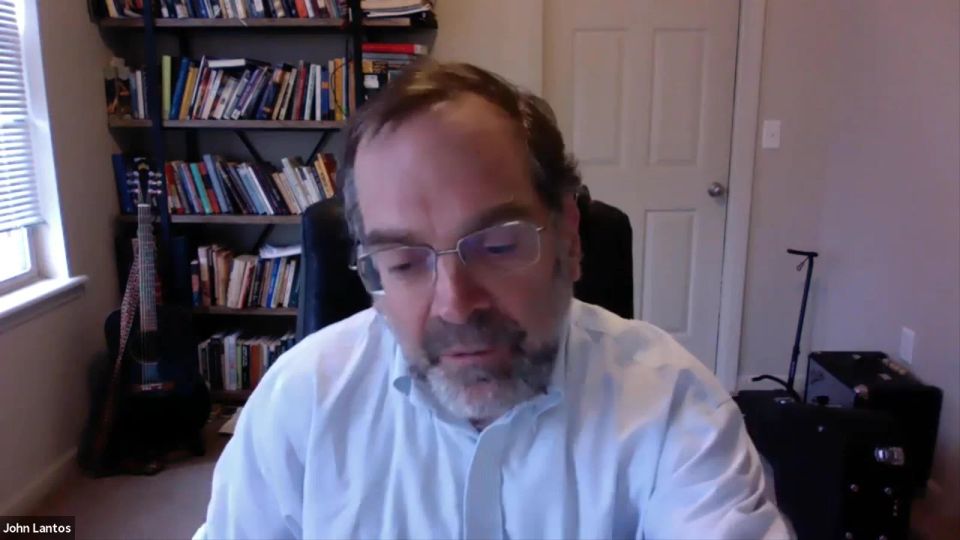
An archived video recording featuring John D. Lantos from The American Journal of Bioethics.
- Format
- Video recording · 1 hr 15 min
- Recorded or aired
- January 28, 2021
- Institution or outlet
- YouTube / The American Journal of Bioethics
- Archive identifier
- V055
- Speakers
- Karola Kreitmair, Hank Greely, Jason Robert, John D. Lantos, MD
Transcript
106 passages
- 00:00
Hank Greely
Alrighty, it
- 00:01
Dr. John Lantos
is 11 a.m. Central Time. I am coming to you from Kansas City. My name is John Lantos. I run the Children's Mercy Hospital Bioethics Center, and I'm an associate editor of the American Journal of Bioethics, which is sponsoring this webinar on the ethics of human brain surrogates research. As everybody knows,
- 00:25
Dr. John Lantos
research on neurologic diseases and brain diseases has run into many problems. There's still many devastating diseases out there and an urgent need to do more work on these diseases. One of the more innovative ways to do that is to create surrogate brains in laboratories and do the research on the surrogate brains rather than on human brains. But when does a surrogate brain become a moral agent? We have a wonderful group of panelists to discuss them. Here's the way the webinar is going to work. I will briefly introduce all three of our panelists. They will speak for seven to 10 minutes about various aspects of this controversy. While they are speaking, you can type questions into the Q&A box, not the chat box, but the Q&A box. Once they are done, we will open it up to a panel discussion. We will take your questions. The panelists can ask questions to each other. I will ask questions and we will try to unpack some of the interesting and complicated issues related to brain surrogate research. Let me briefly introduce the panelists and we will get started. First will be Hank Greeley, who's the Deanne and Kate Edelman Johnson Professor of Law. And a professor by courtesy of genetics and director of the Center for Law and Biosciences at Stanford University. And he has written a lot about and specialized in ethical, legal, and social issues arising in the biosciences. Carola Kreitmayer is an assistant professor in medical history and bioethics at University of Wisconsin Madison School of Medicine and Public Health. She's a clinical ethicist and philosopher specializing in ethical issues around brain and mind interventions. She will speak third. And Jason Robert is the Dean's Distinguished Associate Professor in the Life Sciences at Arizona State University, a bioethicist and philosopher of biology. Professor Robert's research and teaching is animated by the question of what is good science that is science that is both efficacious and ethical.
- 02:58
Hank Greely
Hank, you're up. Great. Thank you, John. I blame L. Frank Baum personally. When I was about six or seven years old, I discovered a treasure trove of old, I think probably 1920s vintage Oz books that had been in my family since at least my father had been a kid and maybe earlier, and I loved them. I love the fantasy. I love the imaginativeness. Ultimately, that led me to science fiction, which I devoured insatiably in my teens. And I still read a little science fiction. But that gave me an interest in speculative edges of science and fantasy. And what better for that than human brain surrogates? I first got involved in this issue intellectually and academically around 2000,
- 03:52
Hank Greely
2001, when one of my Stanford colleagues, a stem cell scientist named Irv Weissman, came to me seeking advice. He had this plan to make a mouse that had its brain cells, or at least the neurons in its brains, completely composed of human neurons. He actually never did it, but we put together a committee. We drafted a memo that gave him some advice. It eventually turned out to be a paper in a job in 2007. But in the meantime, in either 2002 or 2003, I was invited to a meeting at Dalhousie run by Jason Robert and his colleague, then colleague Francoise Baylis on the issue of chimeras. And that led to my first publication on the question. And I wrote some more about chimeras. There was a surge of interest in chimeras and sort of the mid aughts, mid to late aughts. around the time also of the National Academy's guidelines on human embryonic stem cell research. So I finished up, I thought, my thinking on that, had a book chapter in about 2011, packed it away, and then things started picking up again. With 2014, I began to pay attention to this thing that had been announced in 2012, this CRISPR thing that seemed to have implications for gene editing. In 2016, I first heard of some truly interesting and strange research being done by Nenad Sestan at Yale about keeping pig brains, keeping them, quote, alive, close quote, quote, reviving, close quote. The verbs are unclear for long periods of time after they had been, quote, dead, close quote, for four hours. I said, that was interesting. And then in 2017, I got an email from a Stanford colleague named Sergio Paschka, wanting to talk to me about these human neural steroids, is what he was calling them at that point, which he was creating. I think I'd heard a little bit about organoids by then, but it was really my contact with Sergio that got me interested in it. And about that time, or maybe the following year, certainly by 2018, I
- 06:08
Hank Greely
had come to my particular focus on this. The idea of the dilemma of human brain surrogates. Brain disease is a terrible thing, and it afflicts all of us, either directly, personally, or through friends, relatives, and so on. Having just lost a dear friend and colleague as a result of depression,
- 06:32
Hank Greely
it's there. And we are terrible at treating almost all of it. And we've made very little progress on it. But of course, the best way to study how the human brain works and doesn't work is a living human brain and a living human. But there are limits to what we can do. I can't take Jason's brain out of his skull, slice it up, look at the thin slices, and expect IRB approval for that. We try to make surrogates. And we've done this for a long time. We study mice and rats and monkeys and birds as sort of surrogates for human brains. We study thin slices of human brains in petri dishes as sort of surrogates for human brains. They help, but they're not great. So people have been trying to invent new surrogates that are closer to being human than what we have had. but don't come with the ethical problems of trying to slice up Kerala or Jason's brains, or John's for that matter.
- 07:36
Hank Greely
But there's the dilemma. The closer you get to it being human-like, the greater the risk that you're backing into the ethical issues that drove you away from research with humans. And so that's my frame on this. And the piece I published in a job this past, I guess it came out technically this month, It looks at that, it has examined four categories of these surrogates, genetically modified non-human animals, genetically modified so that genes involved in brain activity or development are more similar to human variations, either the normal wild-type human variation or pathological human variations.
- 08:19
Hank Greely
Those non-human animals that have had human brain cells or tissues put in them, chimeric animals, organoids, little balls of human brain stem cells that form and grow and live and develop, very little, size of a very small pea at best, maybe a peppercorn so far, but really interesting. And then ex vivo brains or chunks of brain, the idea of taking a brain out of a person, presumably a dead person, or a piece of brain and keeping it alive and seeing what happens. Those are tools. But each of those tools, if taken too many more steps, begins to make us nervous. I argue it makes us nervous because of concern about the welfare of the tool, of the surrogate, concern about the human donors who gave cells or genes or brain parts to make these surrogates, some possible non-research implications of this on the definition of death or on the treatment of non-human animals, some non-research potential uses for these, particularly of the chimeras, chimeric animals. Issues about, quote, humanization, close quote. I'm using a lot of scare quotes in this talk, but it's that kind of topic. And then questions, not so much about the welfare of these entities, but whether they have rights, and if so, what those rights are. So I think that's really interesting. It's certainly weird. It falls, you know, it... follows the trajectory of my interests. Well, there was a fifth that I had in, but took out because my heart wasn't really in it. And I don't know that I believe in it, but it's electronic simulations of brains, something that the European Brain Project first pursued heavily, although they've withdrawn from that. So I am happy to say that it's not just me. I mean, John has gotten Carola and Jason to talk about this. There are other people talking and writing about it. The International Society for Stem Cell Research, ISCR, is revising its, I understand, I'm not part of this effort, is revising its guidelines that speak to this. And that should be out sometime in the next few months. And there's a National Academy of Sciences committee that I do sit on that is coming out with some findings on these kinds of issues. And I should make clear, everything I say today is just me. Doesn't necessarily, I can honestly say, doesn't, John Gerstle, entirely reflected doesn't necessarily reflect at all the views of that committee, so I think this is really interesting, I think it has the potential to be really important and it's certainly fun to think about and i'll turn things over to I think Caroline. John
- 11:02
Dr. John Lantos
Gerstle, back to john.
- 11:02
Hank Greely
John Gerstle,
- 11:03
Dr. John Lantos
I think it's Jason going next. John Gerstle, Just to remind everybody who's a. listening here we're gonna have the three panelists uh speak briefly first about some of their ideas and perceptions of the issues uh you can type any questions or comments into the q a box not the chat box the q a box and once people finish we will uh get to your questions jason
- 11:31
Dr. John Lantos
you do i have to unmute
- 11:42
Jason Robert
Okay, no more buttons. Perfect. Yeah, it said I wasn't allowed to unmute myself, which probably is a good thing. So as Dr. Lanto said, I'm Jason Robert. I'm a philosopher of biology and a bioethicist. And what I thought I would do today, given the nature of Hank's presentation, as well as the nature of his article, which is to... describe and then raise a whole lot of questions without formally addressing them, although he's got ideas about how he would address them and hints at some of those toward the end of the paper. And given that Cruella Kreimeier, as I understand it, is going to be focusing more on some of the moral issues, what I wanted to do is focus on some of the translational issues, as it were. And so arguably, the study of human brains the greatest challenge to modern science. And this has been the case forever, more or less. Aristotle completed the first detailed brain dissection back in 340 BC. And that sort of started the history of neural anatomy. But as we know, brains are heterogeneous, interconnected, complex, and variable. And on top of that, they're relatively inaccessible as
- 13:10
Jason Robert
Professor Greeley pointed out. So one of the things that has been really interesting to me is why is it the case that we have made so little progress despite the fact that over the last few decades there have been some really important advances in areas like brain imaging, neurochemistry, genetics and genomics, and so forth. Why is it that we're still in the situation that Hank described, which is we know people who suffer from all sorts of neurological and neurodegenerative diseases, and yet we're pretty bad at treating next to any of it. And so one thought is that Part of the challenge, because we can't do what we want to do in human brains and human bodies, we have to look for surrogates, as Hank was saying. But the challenge with surrogates is that they need to be the right ones for the job. And the preferred experimental animals in the neurosciences are rodents, and one group actually referred to it as an extreme bias in the neurosciences toward rodents, in particular mice and rats. And so it's possible that the focus just on mice and rats may end up giving us
- 14:41
Jason Robert
some false starts, if you like. For instance, we'll inadvertently miss things like substantial variation in cortical organization, even amongst rodents, because we have to bear in mind that Rodents represent nearly 2300 species within 34 families and five suborders. And so the idea of a rodent model of anything is a completely fabricated one. And it could be one that is dangerous in translational neuroscience. And at the same time, when there has been a push toward studying non-human brains as surrogates for human brains beyond the mouse and rat and cat and, in some cases, macaque or marmoset, as well as birds and various other creatures, there's been some substantial resistance to that. The resistance comes in part from members of the public who are very concerned about what, some of whom are very concerned about the the treatment of non-human animals in research, despite the fact that it's heavily regulated and undertaken by people with goodwill doing the best work they can. But there's also some resistance from scientists to expanding beyond the relatively small number of animals that we tend to focus on. And typically, that resistance comes from a
- 16:11
Jason Robert
kind of deep entrenchment in what it is that they've been doing all along.
- 16:18
Jason Robert
we end up getting constrained, potentially, by the animals we use. And we keep using those animals because we know so much about them, even if what we know about them doesn't actually translate to human beings. So I'll give you an example of this. So given available techniques that have been developed around mice and rats, concerns about scarce resources, widespread ethical worries about research with certain species of non-human animals, we end up focusing on mice and rats, even when the research question to be asked, in fact, makes no sense to ask of mice or rats. For instance, Parkinson disease research is predominated by two species of non-human animal. There are others, but predominated by two species, the rat in which most of the research is undertaken and the rhesus macaque in which a minority of research is undertaken. And aside from concerns that drug lesion induced Parkinsonism fails to replicate Parkinson disease in either species, the fact that rat brains do not have a supplementary motor area makes them an especially poor model of this motor disease. But sometimes we get stuck in our models and we can't get out of them. Last year or two years ago, there was a symposium, a Sackler colloquium on non-human primate models of neurological and neurodegenerative diseases that led to a special issue of the proceedings of the National Academy of Sciences. And what was frustrating about that meeting at which I attended but didn't participate, I'm more of a groupie than a core participant like Hank.
- 17:58
Jason Robert
What ended up happening at that meeting was instead of taking advantage of the opportunity to say, here is what we can uniquely learn or do better in learning about brains by focusing on this particular animal, people just sort of patted themselves on the back for the nice discoveries that they'd been making. And so there wasn't any attempt really to justify non-human primate research beyond the work that people were talking about there. And that can be a little bit problematic in the sense that we've got a significant resistance to non-human primate research writ large, even when it could be the case that the kinds of things we can learn, we can learn exclusively by studying the brains of non-human primates. So I don't want to take up too much time except to say one of the really interesting things that's come about from, in particular, cerebral organoid research is that We know that human brains differ from our closest living relatives, but one really interesting group led by Pollen showed that primate research, or at least primate cerebral organoid research, may be preferable
- 19:19
Jason Robert
as a means to translational success than research based on rodent systems. And this is because what the group did was confirm the overall fidelity of organoid cellular composition to primary tissue across three species, human, macaque, and chimpanzee. And even though there is lots of individual variability in samples and lots of individual variability in terms of organoids, what they were able to show is that we may potentially need to do research using cerebral organoids derived from non-human primates as a stepping stone toward translational success now they didn't say those words they're focused more on on the study of of brain evolution across those species in a comparative mode but that's one of the implications that I discussed with them and they're entirely interested in the prospect that we might be able to do something here that we couldn't otherwise do and so I'm just going to wrap up with one last thought which is that Hank said this research is sort of out there and speculative, or at least the commentary on it is. And that's absolutely true.
- 20:38
Jason Robert
The reason I studied philosophy of biology was to do a better job at bioethics because I'd be able to have a better understanding of the science and also be able to discuss the work with scientists in a way that afforded me some credibility. The fact that this research doesn't raise any unique ethical issues shouldn't beguile us into believing that the ethical dimensions of this research are unimportant or unworthy of thoughtful consideration. And Hank makes an especially nice plea in his paper to make this an exploration that doesn't just include false and ethicists, but many others as well. So embedded as it is within the complex, controversial, and ever-changing enterprise of basic and clinical translational research and development, I think human cerebral organoid research and some of these other kinds of research will be, as it should be, subject to public interest and scrutiny. Already, media attention to this research has sensationalized the findings. As one journalist wrote in reporting hyperbolically on Lancaster's work in 2013 with the first human cerebral organoid,
- 21:50
Jason Robert
The journalist wrote, say hello to baby Frankenstein. And yet, even two centuries after the teenaged Mary Shelley bequeathed Frankenstein to generations of anxious readers, its most important lessons remain crisply relevant today. Create carefully and care responsibly. Thanks.
- 22:11
Dr. John Lantos
Thanks, and thanks again to everybody for joining. I can see people are already typing in some questions and comments to the Q&A box, and that's great. We will get to those. For people who joined late, use the Q&A box, not the chat box, and we'll have plenty of time for discussion. Finally, Carola Kreitmeier from University of Wisconsin.
- 22:35
Karola Kreitmair
Thank you. I am so thrilled to be on this panel. I'm very excited to be speaking with my other panelists about this really fascinating area of research. As was noted, I'm going to focus on the sort of moral and philosophical questions. And I'm going to focus on brain organoids, although I think what I'm saying is applicable to the other human brain surrogates that are mentioned in Hank's paper. So I think what makes us uncomfortable with kind of research that involves these circuits is that we have some sense that these entities have some moral status but it's really hard to for us to figure out what kind of moral status because they don't clearly fit into any of the categories for which we have well-developed intuitions and norms and regulations such as you know human subjects we have pretty good intuitions what you are and aren't allowed to do with human subjects in research the same goes for human tissue samples even embryos and embryonic stem cells we have some norms and guidelines around and also non-human animals. But these brain organoids and human brain surrogates in general don't fall neatly into any of those categories. And so we don't have a good grasp of what kind of moral status they have. And as a result, we don't really have a good sense of what we are and aren't allowed to do to them. And
- 23:57
Karola Kreitmair
to be clear, moral status isn't something that you either have 100 of or you or zero percent of there is some such a thing as partial moral status but there is a question of what is it that gives something moral status in the first place and so because we don't really have a good category for these cerebral organoids it does seem like we can't get around the question of having to ask well why does something have moral status in the first place um and
- 24:26
Karola Kreitmair
that answering that question and if we could see if that applies to cerebral organoids that would allow us to understand how we would be allowed to treat them in research now what are the sort of going candidates for what grounds moral status um you know there's a lot of views about why something an entity has any kind of moral status and one view is that entities that are persons have moral status so the idea this is sort of the kantian idea of any autonomous agent has moral status, any agent that can rationally give laws to itself. That's certainly controversial. There are a lot of entities that don't have that level of rational autonomy, and we still think of them as having moral status. Children certainly are not rational most of the time, and we still consider them to have moral status. So we might think anything that has interests. Animals have interests of eating and Even plants have interests of sort of gaining nutrition and turning to the sun. So maybe something like that grounds moral status. Or maybe it's just being a member of a certain group. So maybe it's being a member of the human species that grounds moral status. And all of these are problematic in their own right. But one popular view is that consciousness has something to do with moral status. So the idea is that consciousness is at least sufficient moral status um that is to say if something is conscious then it has some moral status we haven't said necessarily that it's it's necessary for moral status but if if there's consciousness then there's some moral status there and so it would be really useful to know if these brain organoids have consciousness that would tell us something about their moral status and here it's important to distinguish between consciousness and the capacity for consciousness because we you know, when you go to bed at night and you fall into a dreamless state of sleep and you are unconscious, it seems weird to think that you've then lost all your moral status. So, you know, and someone could just kill you in your sleep and would not be committing murder because you didn't have any moral status. So maybe it's not really consciousness per se, but it is rather a capacity for consciousness, which comes with its own problems because it sort of hearkens back to the Faith Morrison, Issues around the moral status of embryos that seem to have a capacity down the line for consciousness, but certainly aren't conscious at the time. Faith Morrison, And how do we delineate what constitutes a capacity do do unfertilized sex cells have a capacity for consciousness. Certainly we don't treat unfertilized sex cells with the same regard we treat you know persons, but even if we can sort of figure out the consciousness versus capacity for consciousness issue, we're left with two really fundamental questions when we think about how consciousness relates to moral status. The first one is that consciousness is not a unitary phenomenon. So all conscious states share a certain feature, and they have a certain what it's likeness about them. But there are many kinds of possible conscious states. There's sort of mere sentience.
- 27:40
Karola Kreitmair
Daphne Miller- Detection of warmth and cold, maybe light and dark that's a form of consciousness there's more full blown qualitative consciousness of seeing red and the taste of a strawberry. Daphne Miller- And all these things there's conceptual consciousness, the ability to have concept in one's consciousness and use them and manipulate them to reason. Daphne Miller- There is self consciousness, the awareness of a self there is even. narrative self-consciousness so the awareness of a self that persists through time and has features that can continue over time and you know we tend to think that's the kinds of and we're the kinds of entities that that have that so the reason why it's important to differentiate between these different kinds of consciousness because they come along with different amounts of moral status something that has mere sentience, we tend to think has less moral status than something that has full narrative self-consciousness. So that's an important thing to keep in mind. But the second fundamental issue to do with how consciousness relates with moral status is even harder to wrap your mind around. And it's not for nothing that it's called the hard problem in philosophy of mind. the fact that consciousness is an essentially subjective phenomenon. And it cannot be directly accessed with third person means, but those are the kinds of means that science has available. So all evidence we have about the presence of consciousness in anyone other than ourselves is inferential. I mean, the reason I know Hank is conscious is because he behaves in a certain way. that behavior being very similar to the way I behave. And so I infer that, oh, I'm conscious. Therefore, Hank is conscious. I can't access Hank's consciousness in the way I can access mine. And that's true with how we know about consciousness of anything outside of ourselves. So the things we know about consciousness in a scientific sense are all based on either self-reports in conscious humans or behavioral evidence. even behavioral evidence in non-human animals. So animals trigger the release of analgesic when they're hurt and we infer that they're experiencing pain. But we can't use these behavioral methods in cerebral organoids. First of all, they don't have any behavioral outputs. Secondly, we wouldn't even know what kind of behavior would be correlated with what kind of a conscious state in a cerebral or a brain organoid. It seems very strange to think about How would an organoid behave if it experienced a certain conscious state? So what we're left with really in order to determine whether a cerebral organoid could be conscious is to look at the neural correlates of consciousness. And this is an area of study in neuroscience to determine what brain state, what neural state is both necessary and sufficient. consciousness and then we could go if we if we could find that we could go to the cerebral organoid and say aha that state is instantiated therefore we know it is conscious or we say oh that state is not instantiated therefore we know it is not conscious and it's really hard to find these neural correlates of consciousness because again we can only use conscious humans to understand when a brain is conscious and it's very hard to get an unconscious human to report his or her unconsciousness, at least at that instance. But that is certainly, it seems like, the only way we would be able to gain any insight about whether a cerebral organoid
- 31:39
Karola Kreitmair
is conscious or could have a capacity for consciousness. But even if we were to determine, OK, we found the necessary and sufficient conditions for the neural correlates of consciousness, They're not present in this organoid. Therefore, we can conclude that this organoid is not conscious. That still hasn't settled the question of what kind of moral status such an entity would have. Because all we've said is that consciousness is a sufficient condition for moral status. We haven't said that it's a necessary condition. So it might be that even entities that are not conscious could still have some moral status.
- 32:20
Karola Kreitmair
And if you think that someone who's an individual in a permanent vegetative state who by definition lacks consciousness and lacks the capacity for consciousness has moral status, then you also think that consciousness or the capacity for consciousness is not necessary for moral status. So while determining this issue of whether cerebral organoids are conscious would be very helpful, it wouldn't even, if we found out that they're not, that wouldn't even settle the question with respect to the moral status of cerebral organoids. So with that, I think I'll leave it at that. And I'm looking forward to the discussion.
- 33:02
Dr. John Lantos
Thank you. Those were great introductions to this complex topic. Thanks to all our participants for joining us this morning. We were talking about some of the ethical issues in human brain surrogate research. This is a discussion that focuses on an article that's in this month's issue of the American Journal of Bioethics that is January 2021 by Hank Greeley about the ethical dilemmas, the onrushing ethical dilemmas associated with human brain surrogate research. If you have questions or comments, type them into the Q&A box, and we will try to get to as many of those as we can. Let me start with one that's in today. In some of the comments that are coming into the Q&A box and for the panelists, if you're following the Q&A box and you want to grab one of the questions out there, just, you know, shout it out. But everybody or a bunch of people seem to be trying to find the right analogy for areas where we have existing regulation. So there was a question about whether this will have implications for brain death.
- 34:13
Dr. John Lantos
regulation, whether it has implications for human fetal tissue research or embryonic tissue research. There's certainly a lot of questions about how moral status is attributed to organoids or other brain surrogates compared to moral status for animals. Jason talked about this a little bit. And Hank, you hinted at moral machines or you know, artificial intelligence devices, which also may or may not have or gain consciousness or moral status. For all the panelists then, do any of those analogies help? Do any of those analogies raise red flags about whether what we're doing to brain surrogates might have implications for regulation in other areas?
- 35:10
Jason Robert
Hank?
- 35:11
Hank Greely
You want to take it? It depends. Always the best two words to start any answer with. I mean, it depends on the implications and on the model. Now, I don't think there's that much trouble seeing chimeric animals as fundamentally animals. And IACUCs, the Institutional Animal Care and Use Committees, with their pluses and minuses, have regulatory authority there. You may want some more expertise. There may be some other issues about humanness, but They're sort of in that, they fit more or less in that box. Organoids don't really fit anywhere. Right now, I'm convinced that the organoids are sufficiently simple, that I'm not worried about them being conscious at any level, even to the extent of just perceiving pain, but that's right now. And people are working hard to make them bigger and more complicated and better models.
- 36:09
Hank Greely
what are they uh they're not currently regulated as animals they're not regulated as people they're not a regulated thing similarly brain tissue from dead humans it's not a person there was some person involved whose consent presumably you needed to get which would have gone through the consent process would have gone through an irb but if you've got you know jason's left frontal lobe in a vat in 70 years after the rest of jason has passed on It's not a person, it's not an animal, it's not regulated. Is there an analogy that we want with it? And I think for the organoids, if they get complicated enough, maybe they get to the level of being animals, or I should say vertebrates, because it's vertebrates that are covered by IACUCs.
- 36:59
Hank Greely
With the brain and the VAT, maybe at some point it gets to person status, but it depends. It depends on... on how far they go and what the science looks like and also how our regulatory and ethical structures develop.
- 37:16
Karola Kreitmair
I would say to answer your question
- 37:22
Karola Kreitmair
from a sort of analytic position, the important thing is that when we have guidelines that tell us what sort of research is permissible on each kind of entity, that they have to be consistent in terms of how we think of moral status. So we don't wanna end up in a position where we have much more leeway with fully conscious non-human animals. And we think that it's consciousness that grounds moral status when we're much more permissive with such entities than we are with, let's say, cerebral organoids that lack any kind of consciousness. So it's important that when these guidelines develop, they are internally consistent with respect to what does ground moral status. And I think the issue right now is that these entities are so novel. We don't have good intuitions that we have developed with respect to them. With non-human animals, we have a good sense of what it's like to
- 38:31
Karola Kreitmair
engage with them and interact with them. We just have no intuitions about brain organoids other than their baby brains in petri dishes, which is false. So I think that's a real challenge.
- 38:43
Jason Robert
And I'll just say really quickly that if we focus just on the organoid, as it were, in a dish, that raises one set of issues. But there's also the, what are we going to do with it? So on the one hand, there's the eventual disposition of it or destruction of it, which we might have something to say about, but there's also, if it is the case that we're creating cerebral organoids specifically for the purpose of potentially being able to treat or at the very least get a better model of a non-human, sorry, a human neurodegenerative or neurological disorder, then the organoid in the dish is only gonna take us so far. Hank hints at this, that the next step might be to transfer a cerebral organoid into the either developing or fully developed or fully developed and scooped out chunk of brain of another animal, whether, probably not a human initially, but if we're thinking of mouse or rat, or if we're thinking of
- 40:00
Jason Robert
non-human primate, then we end up with potentially other considerations. Now we're worried not about, for instance, the moral status of the organoid, but rather the moral status of the creature that now has the organoid within it. This is something that Rob Streifer and Hank and various other people have worried about for a couple of years. a couple of decades about, as it were, the subjective experience of the resultant entity. And one analogy that I've always found useful in thinking about that is, are we potentially creating entities that effectively
- 40:42
Jason Robert
exhibit locked in syndrome? So they could be potentially fully conscious and aware, but completely incapable of expressing any of that. to us, and is that something that we need to be concerned about as we move forward?
- 40:56
Hank Greely
Yeah, the analogy that's almost irresistible but I think dangerous is Gregor Samsa from Kafka's Metamorphosis, the guy who wakes up as a cockroach, sort of a cockroach, some sort of bug, and he's stuck in there. Is there, is Kerala stuck inside the body of that rat and without any way to express herself? That's a nightmare. I think it's only a nightmare, at least
- 41:27
Hank Greely
now. And I think it will always just stay a nightmare, but I can't be sure. To get back to Carol's point about consistency across fields, I agree with you. But I'm trained as a lawyer. I'm lucky enough to be a law professor. So I think about regulatory structures and so on. There's nothing that has jurisdiction over all these different things. To get consistency, it would be nice to have somebody that is looking across them. Even the National Academies Committee that I sit on is looking at the chimeric animals and the organoids. It's not looking at the ex vivo tissue. It's not looking at genetically modified entities. It's certainly not looking at electronic simulations. And yet they would all be potentially subjects to Carol's point about the value of consistency across lines. We don't have anything to even think and talk about that, let alone enforce it at this point. Maybe a new presidential bioethics committee could take it up, but who knows?
- 42:38
Karola Kreitmair
And you know, there's two reasons why consistency is good. One, maybe from a regulatory perspective, and that's what... what you're suggesting from a legal perspective. But then there's just the ethical reality, right? We ought not to treat likes differently and unlikes the same. And there is just an ethical imperative to have that sort of consistency independently of whether it's achieved in our current regulatory structure.
- 43:07
Hank Greely
Right. my point was not just that we don't have a regulatory regime that cuts across all these we don't have a forum for uh ethical for discussion of the ethical issues cutting across all these there's no there's no body that's charged with it
- 43:26
Dr. John Lantos
or to the extent that we make an analogy to our moral intuitions about non-human animals there's no consistency in our intuitions people have
- 43:41
Dr. John Lantos
wild 180 degree opposite intuitions about what's permissible and what's not in various contexts. A research lab versus a slaughterhouse might lead to very different intuition.
- 43:58
Hank Greely
I'm glad you brought up the slaughterhouse. The pig brain experiment, those were animals raised for food that were slaughtered in a slaughterhouse. blood was drained from the heads for four hours, they were dead, which means both because they were agricultural animals and because they were dead, IACUC, the Yale IACUC said, we got no jurisdiction over it. So even when it's clearly a vertebrate that would otherwise be subject to it, there are, I won't call them loopholes, but there are limitations in
- 44:32
Jason Robert
jurisdiction. Absolutely. And despite the concerns about public perception of this, It's fascinating when the slaughterhouse becomes a source of tissue for experimental research. It's possible to build a quite interesting library of non-human animal brains to which you can do any number of things by collaborating with the slaughterhouse, as distinct from ordering your rodents from the slaughterhouse. the animal supply catalog. And this is a really interesting prospect. I mean, the reason I mentioned this is that there's a group in Australia that's learned some pretty fascinating things about brain evolution by studying brains that typically don't get looked at, the ones that are left on the slaughterhouse floor.
- 45:30
Dr. John Lantos
So there is a question here related to this. Roland Adler writes, I find myself wondering about public perception of human brain surgery research. I could imagine this would provoke significant backlash motivated by everything from fear and misunderstanding to more principled ethical objections. What do the panelists think about the lengths to which these research programs might go to avoid becoming lightning rods for political intervention?
- 45:58
Jason Robert
Absolutely. One interesting prospect, of course, is that this work hasn't been around for all that long. So even with regard to human animal chimera research, even animal animal chimera research is only about, invertebrates is only about 50 or 60, maybe 70 years old. This is not stuff that's been with us for forever. And of course the non-human animal human, chimera systems were, you know, developed in the late sort of developed in the 90s, late 90s and early 2000s. And so we've been ethicists and philosophers and other folks have been paying attention to this for two decades, there have been some some really interesting discussions I've had over the years with people about the their perception of this kind of work. Some people think it's absolutely crazy. Some people think it's absolutely fascinating. And I suspect it runs the gamut here. So unless somebody has something more specific to say, I think the most important thing we can do is, as scientists, is not try to hide the work that's going on, but to try to justify it.
- 47:17
Karola Kreitmair
And also, I would add that, you know, rather than And I'm saying this as a philosopher. Rather than sitting in our armchairs and saying the public will react like this, it's actually something that can be studied. We can do studies on how the public perceives certain experiments or certain new technologies. And we can also evaluate how best it is explained or what kind of language to use. So I think this is another forum for the need for the interdisciplinariness of this kind of research and why. And I agree with Jason that it should be transparent, but it should also include the kind of social scientists who understand how the public can be brought into this. And this kind of research or public engagement, I think, is very important here. And I don't think that this, I think the worst thing to do would sort of to keep it very quiet and not tell the public about it at all and then 30 years down the line, suddenly revealed to the public what's been going on behind closed doors.
- 48:21
Hank Greely
Yeah. To me, there's an imperative here for the researchers, the researchers' organizations, i.e. the university public affairs offices that write press releases, that find everything as a breakthrough, the funders and others to make sure that you can't control what reporters are going to write. although good science reporters are really, really good. Typically, I think the problem is with folks who are not real science reporters who get assigned a science story, and of course, headline writers. The reporters will always tell you that they had nothing to do with the headline. I think to make clear two things, what you've actually got and the limitations of it, you're not making the chimp from beyond the planet of the apes. And organoids are not mini brains. I think the field has been trying hard to squelch the term mini brain because they are brains. They're organized in odd ways and maybe like certain brain substructures occasionally, but they're not little three-part brains with two cerebral hemispheres, et cetera. So make it clear the limitations of the model, but also make clear why you're doing it. So for example, some of the organoid work, that I know about
- 49:46
Hank Greely
involves trying to make neural organoids out of people who have the deletion on, I think it's 18q, chromosome 18q that's strongly associated with really severe autism and other mental illness, taking induced pluripotent stem cells from patients with that problem, also making organoids from people who do not have that deletion, and looking to see how those neurons develop in ways to see if there are differences. And at least there's some preliminary reports that they do seem to develop in different ways. I mean, make it clear you're not doing it because you're the mad inventor, you're Dr. Moreau who's stitching together things because it's cool and interesting. And maybe that's part of why you're doing it, but you're getting paid to do it to try to relieve human suffering ultimately.
- 50:42
Dr. John Lantos
John Krinsky CCNY- question about technology, helping us figure out when consciousness exists. John Krinsky CCNY- Question has an idea of Adrian the owens fmri studies of individuals in PBS shown that some of these individuals were conscious, you know they were diagnosed with PBS as they were able to respond to prompts such as imagining playing tennis or imagining a piece of music. John Krinsky CCNY- Is that is this. going to advance the sophistication with which we can determine whether an organoid has something like consciousness? Or is it just another sort of different variation on the behavioral analogy?
- 51:26
Karola Kreitmair
Well, I mean, this goes back to this issue of the neural correlates of consciousness. And Adrian Owens' fMRI study did seem to indicate that the activity going on in a patient that was believed to be in a vegetative state was similar to that that was going on in someone who was conscious. And as a inference then, again, an inferential method like all methods, it could be inferred that this patient, even though they were incapable of having any behavioral output, any observable behavioral output, actually had some retained consciousness. And so very much in the kind of, so this is the idea of the minimally conscious state. And the issue here is, yes, this is the kind of thing we could be doing. We could be looking at, well, what are the neural correlates of consciousness in humans? And then are these present in cerebral organoids? And there are a number of live theories about the neural correlates of consciousness. The perturbational complexity index, which is a sort of EEG pattern. that seems to be a good indicator of that going on. If that's going on, then there are some conscious activity. It still leaves open the question of,
- 52:48
Karola Kreitmair
do we have a good indicator of the absence of consciousness? Because if we care about consciousness, that would be something that would be a good thing to be able to identify in a cerebral organoid. If we could say, yes, the markers for the absence of consciousness are present. Therefore, we don't have to worry about consciousness. doesn't seem like that is as easy to find. And then again, even if we could find that, that might settle the question of consciousness. But it might not settle the question of moral status unless we're willing to say that the only thing that matters is consciousness. And I don't think we are.
- 53:28
Hank Greely
So I think this effort to find a non-behavioral marker of consciousness is a non-external behavior. marker of consciousness is certainly worth pursuing. But I think it's going to be hard to do without any behaviors. I mean, with the chimeric animals, you've got the animal's behavior. That's less of an issue. This is really an issue for the organoids and I think the ex vivo brain, so ex vivo brain tissue, where you don't have behavior. Even if you had something, and let's stick with the organoids for a second, even if you had this perturbational index, which is an interesting and promising approach, may work may not work even if you had that does what works on a human brain on a living human brain actually apply to this very different organoid we don't know and in order to get some sense i think you need to you'd want to have some sort of behavior and although part of me is gets nervous at this you could get organoids with behaviors in two different ways you could give them inputs And you could give them outputs. And you could give them both inputs and outputs. And this is already, I don't think any one organoid has had both yet. But Paola Arlotta at Harvard has created organoids that have some retinal cells attached. And when you shine a light on it, the retinal cells fire and the organoid acts in a way, acts. There are firings in the organoid that are different than when the light's not on. And Sergei Pashka at Stanford has done an organoid that's attached to a muscle tissue. And sometimes the organoid makes the muscle tissue contract. So you could imagine an organoid that could have inputs and could have outputs and could have behavior. Either you could use the behavior then as some evidence of consciousness. So you could use the behavior to sort of try to ground truth your perturbational index or other, non-directly behavioral methods of ascertaining consciousness. But then, of course, once you give them inputs, the issue of whether they're able to feel pain, for example, becomes more worrisome.
- 55:46
Karola Kreitmair
You're muted, John.
- 55:49
Dr. John Lantos
I have to go back to Aristotle's work on locomotion, why any organism moves. or reacts to light. Steve Latham asks, is it possible that a pig brain in a vat could have greater moral status than a pig brain in a live pig?
- 56:11
Dr. John Lantos
And similarly with any other non-human animal.
- 56:15
Hank Greely
I will note that Steve is at Yale and has been the ethicist mainly involved in the pig brain work with Minad. And I sit on a committee that he chairs that's providing ethical advice with respect to that. Good question, Steve.
- 56:35
Hank Greely
I don't know. I mean, but in fact, you know, so we do, both with slaughterhouses, with pigs we eat, and with pigs we do research on, there are rules about humane treatment that try to avoid pain. We do kill them, but we're supposed to kill them in relatively painless ways. If a pig brain in a vat, it's not really a vat exactly, in a bag,
- 57:04
Hank Greely
could feel pain, there's some question about the extent to which we should be, we should try to detect that, monitor it, and minimize it, not necessarily eliminate it, because if you think of the pig brain in the vat as like a pig, like an animal, we do allow research that causes animals pain, although we try to limit and discourage it.
- 57:27
Karola Kreitmair
To address the question the way it's written, it says, could a pig brain and a vat have greater moral status than a live pig brain? And I think there's a distinction between does it have greater moral status and do we treat it as though it has greater moral status? And I think that's what we want to be really careful about. And what I was saying with the issue about consistency, if we treat Anna Voelker, entities that clearly have fewer sensory inputs and outputs and you know this pig brain in a vat as as sort of on par with the kind of protections we have for. Anna Voelker, Human subjects or something like that, and then we look at pigs and slaughterhouses as though they have you know very little if. Anna Voelker, Not no moral status and that's just inconsistent and something is off there, and even even if we don't have the regulations to fix that that just morally is.
- 58:28
Dr. John Lantos
wrong are you proposing that we have an ayah cook for slaughterhouses
- 58:34
Karola Kreitmair
i mean that wouldn't be that let's say slaughterhouses have a lot of ethical issues inherent in them just as they stand we could probably do another webinar on the ethics of
- 58:43
Hank Greely
slaughter if possible burgers taste pretty good i have to say but i do think the um
- 58:55
Hank Greely
i think The pig issue is interesting in terms of the fact that we do sometimes treat research differently. So we hold research to higher standards than in many parts of life. Consent in research is supposed to mean a hell of a lot more than you check the box for the latest Microsoft Office update that says not only do you get consent, Mark Doyal- To all these things you've never looked at, but that you've read them, even though, of course, you haven't so you know and consent when the COP pulls you over and says mind if I look in your trunk. Mark Doyal- Is that the same kind of consent that we require from research, so one possible distinction is we do hold research to higher standards ethically. Mark Doyal- Whether we should or not, and the extent to which we should interesting questions. But that's the difference between the slaughterhouse and the research context, or the slaughterhouse for food versus the slaughterhouse for research.
- 59:55
Dr. John Lantos
Question for Professor Robert from Lynette Martins regarding your comment on creating responsibly. How do you propose we balance innovation and the prospects for benefit in treating neurologic diseases with the increased value placed on profits over? people, what guardrails do we have to have to ensure that this is not just a product line created for profit?
- 1:00:25
Jason Robert
So I have a couple of quick responses. I read that question when it came up, and I was hoping you'd ask it. I have a couple of quick intuitions about this. One of them is that it's not clear that innovation and ethics don't go hand in hand, especially where there's a goal that we're interested in achieving, for instance, a better treatment for a neurodegenerative disorder or a treatment at all for neurodegenerative disorder. It's possible for the innovation ethics partnership to actually proceed. But at the same time, I think what I'm, this is gonna sound really controversial, I hope. I think what I'm more concerned about right now is the fact that we are spending hundreds of millions of dollars on research that has exactly zero potential to not just turn into a product, but even to inform our basic understanding of a disease, for instance. And I'm not suggesting that there's no value in basic research. I'm suggesting there's plenty of value in basic research. But if the thing that you're studying doesn't approximate the thing in the world in the right sort of way,
- 1:01:43
Jason Robert
then we're just throwing good money after bad by continuing to invest in that thing. This is one of the reasons Hank's seen this paper that I tried to publish years ago, but it really pisses psychiatrists off and psychiatric researchers. But at the end of the day, there are significant limitations to studying, say, schizophrenia in a rodent. And no matter which of the 2277 rodents you choose for this and yet and for what it's worth it's not as if people don't know this right take a look at every single article. On rodent models of schizophrenia they all have a first paragraph that says it's impossible to model schizophrenia in a rodent here are eight reasons why here's our model of of schizophrenia in a rodent and this to me is is what we end up. is sort of getting into a kind of rabbit hole situation where we're spending public money really badly without actually either enhancing the scientific knowledge base or producing anything that could be potentially profitable. Still at the end of the day, I do worry about innovation at times. And for me, the easiest thing was to leave a philosophy department and to join a school of life sciences where I have a chance to interact daily, not just with the professors, but also with the students are actually going to be the ones doing this work as we move forward. And I think at that level, the ability to collaborate and potentially influence the way people think about this ends up potentially being much more beneficial than rules or regulations that we might implement later.
- 1:03:16
Dr. John Lantos
But it sounds like you're looking forward to innovations that are useful enough to be marketable and profitable.
- 1:03:23
Jason Robert
Absolutely. I mean, not always. I'm super keen on basic research. I mean, the stuff on Studying brains comparatively using organoids has, I think, zero, potentially zero potential beyond intellectual or
- 1:03:40
Jason Robert
beyond the comprehension of how it is that human brains and the brains of other animals are similar and different in ways that are important. I think that's great work as long as it actually hooks onto something in the real world.
- 1:03:56
Hank Greely
So an example, a specific example of what Jason's talking about is Alzheimer's research. Mice don't get Alzheimer's, but we've made mice that have something that sort of looks like Alzheimer's and have shown that you can cure those mice often by amyloid, beta amyloid blocking drugs and technologies, which have then gone to clinical trials and in my estimate have spent something like 20 to 40 billion dollars in clinical trials, all of which have either completely failed or almost completely failed, mouse isn't a good model for that. So I think these surrogates, I think that pursuing the surrogates is an ethical, almost imperative because brain disease is such a terrible thing. And if we can get better models, we hope, we think we've got a better chance getting good treatments and we know that our crummy models have not worked very well exactly but but there are issues
- 1:04:59
Jason Robert
but i think you're absolutely right but the concern is the fact that we know that these other models haven't done any good hasn't stopped people from doing that research yeah um and you know poor as i suggested earlier pouring uh good money after bad i mean once we get to a point at which something is a non-starter we ought not to let people start it
- 1:05:21
Karola Kreitmair
All of these are ethical issues, right? These are not regulatory issues. These are all questions about what ought we to do. And the idea of, oh, we have to be so careful with these brain organoids because what moral status do they have? That's certainly important. But from a utilitarian perspective, we also have, as Hank said, have an imperative to consider all the suffering that is occurring. So potentially, there is suffering on the part of these brain surrogates. And there are certainly things that need to be done to address that. There is also suffering on the parts of the people for whom this research is being done. And that is a moral imperative just as much. So the utilitarian view is very important here as well. And that also feeds into Jason's point of resources are not limitless. Every time you spend money on something, you're not spending it on something else. And these are all ethical decisions being made.
- 1:06:16
Hank Greely
But the fact that they're ethical doesn't mean that they aren't also regulatory.
- 1:06:21
Karola Kreitmair
I totally agree, yes.
- 1:06:23
Hank Greely
Ideally,
- 1:06:24
Dr. John Lantos
the regulation should reflect our best ethical thinking. Let me switch to a somewhat different topic for what I think will be the last question. But an anonymous attendee wants to hear more about human animal brain chimeras and says, what if an in vivo human dash something brain chimera were made to study language ability? and this chimeric organism were able to develop command of a human language? Would additional ethical dilemmas and questions, particularly with regard to moral status, be raised by the ability of a non-human organism to verbally communicate?
- 1:07:06
Hank Greely
Yes.
- 1:07:08
Karola Kreitmair
Once you have an entity, whether you want to call it human or not, using language to communicate, that looks to me like it's a person, and that That seems one of the issues I think that we need to get away from is to think about, well, how much is it like a human? What is it that grounds moral status in humans? If that entity has that thing, and if it's the ability to reason, if it's the ability to have complex cognition, whether it's human or not is sort of beside the point. It's saying something as close to being human is sort of an easy shorthand of getting at that thing ought to be given moral status. But it doesn't actually. explain why yeah
- 1:07:50
Jason Robert
it's quite remarkable if you if you um instead of focusing on the on approximating the human as it were uh if instead you are um you have a non-anthropocentric starting point uh you end up potentially learning very different things because you're asking a very different question
- 1:08:12
Hank Greely
i do think the whole person it's it's useful to think about personhood and humanity as sometimes overlapping, but not the same category. And it's the whole data in Star Trek The Next Generation, the intelligent android, not human, but a person, as that show Next Generation tried to show 17 different episodes. I don't think we're anywhere close to that with human, non-human chimeras at this point. Putting even a few million cells into a rat brain isn't going to make it human. There are size constraints. There are organizational constraints. There are a whole bunch of constraints. But there was a paper way back in 2005. And gosh, it came out of a group organized at Johns Hopkins. paper in science in July of 2005, I was one of 17, 147 authors on it, talking about this with non-human primates and saying, look, if you're putting a few cells into a healthy adult gorilla brain, probably not a big deal. If you're putting a bunch of human brain stem cells into a two week old chimpanzee embryo in the area that's gonna become a skull, well, maybe a big deal. So again, it depends. Right now, I don't think we're anywhere close, but we could be. And it's something that without getting
- 1:09:47
Hank Greely
overly overwrought about it, it's something that deserves and requires consideration, oversight, and somebody to keep an eye on
- 1:09:53
Jason Robert
it. And I think what is really important at the end of that comment, Hank, is that in order potentially to be able to learn what we might need to learn, we might end up having to create such an entity. And then that brings us all the way back to all the questions of justification in the first place. And it's not clear that moral status arguments are by themselves going to resolve this, no matter how important they are, because they affect us every day.
- 1:10:28
Hank Greely
In the mid-aughts discussion of human and non-human chimeras, I actually thought Rob Streifer had the best work. He's a philosopher, I think, still at Wisconsin.
- 1:10:37
Karola Kreitmair
Yep, might have
- 1:10:37
Hank Greely
been. And his worry was, we're not there yet, but if we made things that had enough whatever, we wouldn't treat them right. They're persons, but we wouldn't treat them as persons. And that was the biggest ethical concern he saw. We're nowhere close to that as far as we know yet, but it's not an issue that can be just summarily dismissed.
- 1:11:03
Dr. John Lantos
And with language in particular, it's not just human-animal chimeras, but the artificial intelligence and machine learning Turing test type things. I mean, once a machine can communicate in a way that evokes emotions and seems to respond to emotional content.
- 1:11:21
Jason Robert
It's funny, this semester I'm teaching artificial intelligence, ethics, and law with some colleagues on Mondays and neuroscience, ethics, and law with a colleague on Thursdays. And it actually is going to intersect these classes. that some of the material will intersect for the first time this time around doing those courses. I do want to just highlight that.
- 1:11:41
Dr. John Lantos
Before you do, here's what we're going to do because we're running out of time. Everybody's going to get one minute for a final comment. So this will be
- 1:11:47
Jason Robert
yours. Beautiful. Thanks.
- 1:11:50
Dr. John Lantos
So
- 1:11:51
Jason Robert
a couple of years ago, there was a really nice meeting at Oxford on
- 1:11:58
Jason Robert
on moral status, reevaluating moral status, that's leading to a volume that's coming out this year. And the paper that Francoise Bayless and I have coming out in that book focuses more on trying to respond to Rob Streifer's question, even though we don't quite put it in this way, namely, how are we going to treat these things rather than what are these things in the first place? So it's as if behavior precedes ontology here. Roll up.
- 1:12:30
Karola Kreitmair
Thanks. Yeah, I think all of this discussion today points to the need for ongoing interdisciplinary cooperation in this area. And these are not questions that neuroscientists by themselves can answer. These are not questions that philosophers by themselves or lawyers by themselves or social scientists by themselves can answer. But these are questions that sort of robust cooperations between those sorts of and researchers can make some serious headway on. And so I'm pretty excited about the kind of collaborative work that can come out of those people working together to address some of these issues.
- 1:13:12
Dr. John Lantos
Thanks. And Hank?
- 1:13:14
Hank Greely
Collaborative work is not only essential, it's often fun. You meet new people, you learn new stuff, your brain, metaphorically at least, grows. I commend it very highly. I do think not only is this going to be increasingly important, most of these issues are not issues that are ever going to be resolved finally and completely. Because as the technology keeps changing, the questions presented, the data you work on, all the things on which it depends change. So I'm not worried about organoids right now, but you get assembloids that have, you know, 57 organoids connected to each other, and they're now the size of a mouse brain, and they've got input and output mechanisms. Well, when we get close to that, we need to think about that. So I think there will be work in this area, fun work to be done in this area for a long time to come. And I hope some of you listening to us will help undertake. I know some of you are undertaking it. And I hope more of you will look into it, consider it, and follow it. It's important, it's interesting, and it's fun.
- 1:14:30
Dr. John Lantos
And if you want to read more about it, this month's issue of the American Journal of Bioethics, January 2021, Hank Greely's article, Human Brain Surrogates Research the Onrushing Ethical Dilemma, with about a dozen open peer commentaries discussing various aspects. of the paper. This was a webinar sponsored by the American Journal of Bioethics. Let me thank our panelists, Hank Greeley from Stanford, Karola Kreitzmeier from University of Wisconsin, and Jason Robert from Arizona State University. I'm John Lantos from University of Missouri, Kansas City, home of the soon to be the second in a row Super Bowl champion.
- 1:15:13
Hank Greely
Oh, boy, you don't worry about jinxing, do you? bye
- 1:15:17
Dr. John Lantos
everybody thanks everyone
- 1:15:19
Karola Kreitmair
bye thank you
- 1:15:20
Dr. John Lantos
bye