John Lantos, MD "Challenges to the Doctor-Patient Relationship in an Era of Health Reform"
December 17, 2013 · UChicago Bucksbaum · 1 hr 12 min
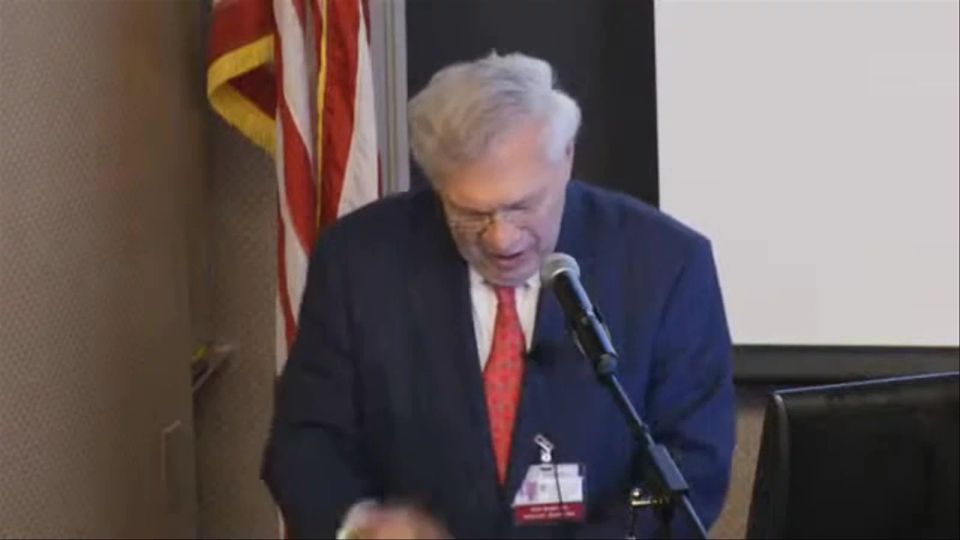
About this recording
An archived video recording featuring John D. Lantos from UChicago Bucksbaum.
- Format
- Video recording · 1 hr 12 min
- Recorded or aired
- December 17, 2013
- Institution or outlet
- YouTube / UChicago Bucksbaum
- Archive identifier
- V017
- Speakers
- Audience member 1, Community health center family physician and policy commenter, Audience member 2, Audience commenter on time and human connection in clinical practice
Transcript
90 passages
- 00:01
Dr. Mark Siegler
Good afternoon. I'm delighted to see so many people at 5 o'clock. John remarked to me, it's 5 o'clock. Who's going to come to hear my lecture? And also so many young people. It's great to welcome you all. My name is Mark Siegler, and along with Matt Sorrentino. Matt, you better raise your hand. We run the Buxbaum Institute for Clinical Excellence, the mission of which you see before you on the slide. The primary mission is to improve patient care and to strengthen the doctor-patient relationship. When we were thinking of who would best be able to capture those goals of the Buxbaum Institute,
- 00:50
Dr. Mark Siegler
we immediately thought of John Lantos. John was a longtime friend and faculty colleague here at the university. He was on the faculty at the University of Chicago for 21 years, where he was a professor of pediatrics. And for 18 years, John worked very closely with me as an associate director of the Maclean Center for Medical Ethics. Currently, John is a professor of pediatrics at the University of Missouri in Kansas City School of Medicine and the director of the Children's Mercy Hospital Bioethics Center in Kansas City. John has received many awards for outstanding clinical care and teaching, including the prestigious Pellegrino Medal from the Healthcare Ethics and Law Institute of Stanford University last year. John's scholarly research has focused on ethical norms in innovative therapy in pediatrics and on the doctor-patient relationship He's analyzed ethical issues in genetic testing with Bill Meadow, who's here in the back, in NICU care, in growth hormone, ECMO, bone marrow transplantation. I
- 02:14
Dr. Mark Siegler
see Mike Bishop in the back. John wrote some early papers on that. He's achieved great national recognition and has served as president of the two leading bioethics organizations in the United States. the American Society of Bioethics and Humanities, and also the American Society of Law, Medicine, and Ethics. John was named one of the best pediatricians in the country, testified in front of the President's Council on Bioethics, and perhaps most importantly, has appeared on the Oprah Show.
- 02:52
Dr. Mark Siegler
John is a frequent contributor to scholarly publications, Pediatrics, JAMA, the Journal of Pediatrics, and of course, Who can forget John's seminal book from 1997, Do We Still Need Doctors? In writing that book, John sparked an ongoing debate over the face of what medicine is and should be, a debate which continues to the present day. Today, John will speak to us on a timely issue, and that is challenges to the doctor-patient relationship in an era of health reform. Please join me in welcoming back to the University of Chicago, John Lantos.
- 03:48
Dr. John Lantos
Thank you very much. It is an honor to be back and to see what's happened here with the new Buxbaum Institute. an institute for clinical excellence within a top medical school is such a preposterous idea that only the leadership of someone like Mark Sigler could have brought this about and brought along so many extraordinary clinicians to think together about what it is that doctors actually do, what makes a master clinician a master clinician, something that Most medical schools, I think, don't pay enough attention to. I'm going to talk a little bit about doctors, patients, and cultural sensitivity. I thought I'd start with a cultural sensitivity story about a German, a Frenchman, and a Jew who were hiking. They hadn't packed enough water, so their canteens went dry. The German said, I'm so thirsty, I must have a beer. The Frenchman said, I'm so thirsty, I must have a glass of wine. And the Jewish guy said, I'm so thirsty, I must have diabetes.
- 05:10
Dr. John Lantos
So you have to think about where your patients are coming from.
- 05:19
Dr. John Lantos
This is Children's Mercy where I work. It looks a little bit like... Disneyland, I think. I'm going to mostly tell some stories here today and present a little data. The first one began a few years ago when my 70-year-old mother-in-law was diagnosed with breast cancer. She underwent chemotherapy and radiation. It was tough. She lost all her hair. She lost a lot of weight. She was tired all the time. The chemo worked, and a few years later, when she was declared disease-free, we had a celebration at my sister-in-law's house, a farmhouse in the rolling hills of central Pennsylvania. It was a beautiful night. Beth Ann prepared a wonderful picnic for the family reunion. About 25 uncles and cousins, nephews and nieces feasted on fresh-picked corn on the cob, fried chicken, enchiladas, salad right out of Beth Ann's garden. Earlier in the day, we had gone blueberry picking and the pies were just coming out of the oven, the kids were playing tag, the dogs were begging for handouts, and the evening light was mystical and magical in a romantic movie sort of way.
- 06:31
Dr. John Lantos
After supper, Beth Ann stood up, grabbed her chest, and collapsed. She had had cardiac arrhythmias for many years. It was the days before implantable defibrillators. Beth Ann's disease was a tricky one. As long as her heartbeat was regular, she was perfectly healthy. When it became erratic, she was at risk for sudden death. She was a walking time bomb, and nobody knew the length of the fuse. She was 39 years old. When Beth Ann collapsed, my wife and I, both doctors, ran to her. Her eyes were rolled back in her head. She was gasping. Her color was terrible, pale, bluish gray. We felt for a pulse. Nothing. We looked at each other, at her. I shouted that somebody should call 911. We were way out in the country, miles from nowhere. Better start chest compressions. One, two, three, four, five.
- 07:32
Dr. John Lantos
I had never done CPR in the field before. In the hospital, CPR is weirdly a sort of friendly communal activity. When a code is called, the teams comes running just like on TV. There's familiar equipment. People work together. Anesthesia intubates. Residents start lines. Nurses, hands, syringes of precisely measured doses of medications. In the hospital, you never do mouth-to-mouth, so I had never done it before except on the plastic Rassassa Annie dolls in CPR class. It was a little like that. Head tilt. Watch the chest. Puff. Count it out. One, two, three, four, five. Breathe. One, two, three, four, five. In fact, it was nothing at all like CPR class or anything else. It was a gruesome nightmare. The sun was going down. We couldn't see what we were doing. I cut my lip, pressing it against Beth Ann's teeth. My blood began to drip onto her lips and chin. Mosquitoes were buzzing. Kids were screaming. I kept listening for a siren. And after 20 minutes, it was clear that CPR was not working. I was simply going through the motions of a routine that was as strange and mysterious as any prayer ritual.
- 08:51
Dr. John Lantos
Cardiopulmonary resuscitation has a central place in the imagery of modern medicine. Books by doctors about doctoring, such as Melvin Connor's account of his third year of medical school, or Sam Shem's bitter satire about residency, or David Hilfiger's cri de coeur about rural family practice, or Abraham Verghese's wistful tale of caring for AIDS patients in a small town, all start with a resuscitation scene. The moment of dramatic crisis is presented as the defining moment in the life of a doctor, a moment when, as Mel Conner puts it, There was nothing between life and death but my hands squeezing death out of the chest at 70 beats per minute. CPR is big in the movies and on TV. When I was here in Chicago teaching first-year medical students about the doctor-patient relationship, we used to use a Star Trek episode in which Worf, the Klingon lying here on the ground, suffers a severe back injury. Devastated by his crippling injury, he elects to undergo an experimental procedure, gentropic replication of his spinal cord, a procedure that's never been tried before except on androids.
- 10:13
Dr. John Lantos
It doesn't work. Worf gradually slips away on the operating room table. The resuscitation is vigorous, filled with a desperate urgency that seems to symbolize all that's best about modern medicine. They get the feel of the resuscitation down just right, the tension, the frenzy, the primitive physical exertion of chest compressions, the crisp barking of cryptic orders, epi, stat, get a line, hang a drip, clear. On Star Trek, Dr. Beverly Crusher is competent, decisive, angrily committed to life, and personally affronted when Worf dies.
- 10:50
Dr. John Lantos
Or apparently dies. After 30 long seconds of flat line on the monitor, his heart starts to beat again. Klingons, it turns out, have a backup central nervous system that kicks in if the primary one fails. Now, it's never explained how or why doctors on the Enterprise didn't know that, or how a backup central nervous system reverses asystole, but here's the thing. As you watch, None of that matters. We can hold emotional realism, science fiction, fantasy, and incoherent plots in our head all at the same time. In the movie E.T., when CPR fails but the patient survives, revived not by the crack code team from Los Angeles County Hospital, but by the steadfast love of his little buddy. We believe it. We want to believe it. We'll clap
- 11:50
Audience physician commenting on CPR expectations and longitudinal family care
for Tinkerbell.
- 11:52
Dr. John Lantos
One aspect of these portrayals is not realistic then. On television, most people survive, even if the odds are against them, just like Worf and E.T. The scriptwriters tease us with the possibility of failure, than gratify us with a Disney ending. In real life, survival rates after CPR out of hospital are less than 30%. We actually studied outcomes after CPR on television and published the results in the New England Journal of Medicine. Short-term survival after CPR on television ranges from 64 to 100%. None of the survivors have neurologic sequelae. Television offers what purports to be total immersion and veracity, the backdrops are realistic, the clothes are right, but at a certain point reality becomes too much and in subtle ways we return to romance. And the part of ourselves that finds movies much more interesting than medical journal articles, we believe in miracles and wonder. And not just in the movies. Modern medicine itself is a dream machine. It feeds fantasies. Scientists imagine discovering the cure for the secret of immortality. Palliative care doctors dream of helping us all die wonderful, meaningful deaths. Liberals long for a healthcare system that embodies ideals of social equality. Conservatives conjure up perfectly efficient markets. We dream of a world in which everyone has perfect babies, perfect bodies and nobody feels pain. We want to eat but not get fat and have sex but not have babies except when we want babies and then we want them now and we want them perfect.
- 13:42
Dr. John Lantos
We want our bowel movements to be regular, well formed and effortless.
- 13:50
Dr. John Lantos
Maybe if we had to pick one of those dreams we should settle for the bowel movements. Our inability to talk realistically about CPR is perhaps a useful analogy to our inability to talk about healthcare, healthcare expenditures, rationing, the uninsured, financing of medical education, malpractice, or anything else that would suggest a realistic assessment of what medicine ought to be and do, or of what doctors ought to be and do, or of how doctors ought to work well in a well-working healthcare system. Which gets us around to the theme of this talk, the doctor-patient relationship in the age of healthcare reform. The first problem with any attempt to address that topic is to know when to date the beginning of the age of healthcare reform. Foucault would put it around the end of the 18th century. In The Birth of the Clinic, he talks about two great myths that energized French medicine in the late 1700s.
- 14:57
Dr. John Lantos
the myth of a nationalized medical profession organized like the clergy and invested at the level of man's bodily health with powers similar to those exercised by the clergy over men's souls, and the myth of a total disappearance of disease in an untroubled, dispassionate society restored to its original state of health. Those myths seem central to all health reform efforts since 1790. Everything from the National Health Insurance first proposed by Teddy Roosevelt to Obamacare promises to fulfill those myths, to enshrine doctors as decision makers over the allocation of resources, a sacred task if there ever was one, but also a research enterprise that will eliminate disease and suffering at an affordable cost. Medicine then and now has been perceived as capable of achieving impossible goals, as something both sacred and secular, evidence-based and messianic, a replacement for the church and also a thoroughly secular endeavor focused on finding the heaven of perfect health right here on Earth. Our efforts over the last two centuries to achieve these impossible dreams have been truly remarkable. The usual litany of triumphs you could probably recite along with me anesthesia, antibiotics, ICUs, transplants, genetics, genomics, immunizations, and the like. But for all the remarkable successes, the overall project is ultimately, of course, doomed to fail. The higher the hopes and the more grandiose the promises, the more depressing is the failure. we end up with the syndrome that Aaron Wildofsky brilliantly characterized in his 1977 paper, Doing Better and Feeling Worse, which began, quote, according to the great equation, more medical care equals better health, but the great equation is wrong, unquote. Wildofsky applied the phrase doing better and feeling worse only to patients, Today, I will suggest it applies to doctors as well. We doctors are clearly, at least according to the survey data, feeling much worse. There's a perception among many practicing physicians that the practice of medicine has gotten to be a miserable slog. Articles and polls appear with some regularity showing things like doctors' willingness to recommend medicine as a profession About half would, half wouldn't. Hasn't been a big change in the 20 years between 1981 and 2001. In the last five years, what would you say about physician morale? 87% of doctors say it's gone down. Only 11% say it stayed the same. And 1% say physician morale has gone up.
- 18:08
Dr. John Lantos
When you ask doctors how they feel about particular things, they talk about the amount of administrative paperwork that's swamping them, the overhead costs of their practices. And if you ask them whether their time to spend with patients has increased, decreased, or stayed the same, they all say that they have less time to talk to patients. It's harder to get their patients to see medical specialists. The patients can't get the drugs they
- 18:32
Audience physician commenting on CPR expectations and longitudinal family care
need, et cetera.
- 18:34
Dr. John Lantos
The weird thing about these perceptions is that they seem to have afflicted every generation of doctors for the last hundred years. Paul Starr in his book The Social Transformation of Medicine talks about how doctors at the turn of the century claimed the telephone was destroying the doctor-patient relationship. because we used to make house calls and suddenly you could just talk to your patients on the phone and how could you possibly get to know them if you only talked to them on the phone? Same can be said about the hospital. A major and relatively recent innovation in healthcare delivery, a test of how recently hospitals became the institutions that we know, can anybody name? the first US president who was born in a hospital?
- 19:34
Dr. John Lantos
You're right, Jimmy Carter, first president born in a hospital. Francis Peabody in his famous 1927 essay, The Care of the Patient wrote, Hospitals, like other institutions founded with the highest human ideals, are apt to deteriorate into dehumanized machines. When a patient enters a hospital, one of the first things that commonly happens is that he loses his personal identity. He is generally referred to, Peabody went on, not as Henry Jones, but as that case of mitral stenosis in the second bed on the left. The disease is treated, Peabody wrote, but Henry Jones lying awake nights while he worries about his wife and children represents a problem that is much more complex than the pathologic physiology of mitral stenosis. Peabody has a solution, but it is one that he feels is precluded by the shift in medicine from home to hospital. He says doctors should go back to making house calls. He writes when the general practitioner goes into the home of a patient, he may know the whole background of the family life from past experience, But even when he comes as a stranger, he has every opportunity to find out what manner of man his patient is, what kind of circumstances make his life. He gets a hint of financial anxiety, domestic incompatibility. He may find himself confronted by a querulous, exacting, self-centered patient or a gentle invalid, and he appreciates how these circumstances are reacting on the patient. For the next generation, once they'd gotten used to hospitals, the villain was third-party payment, and the AMA waged a major campaign against the Blues in the name of preserving not just the doctor-patient relationship, but the American way of life. Morris Fishbein, who was president of the AMA and went on to become long-standing editor of the JAMA, wrote all forms of security, compulsive security, even against old age and unemployment, represent a beginning invasion by the state into the personal life of the individual. They represent a taking away of individual responsibility, a weakening of national caliber, a definite step towards either communism or totalitarianism. The trope would be picked up by the AMA in its opposition to Medicare and Medicaid when they hired this aspiring young actor to make a series of LPs that were mailed to all the wives of AMA members called Operation Coffee Cup to get them to call their Congress people and say things like, once a Medicare bill is passed, this nation will be provided with a mechanism for socialized medicine capable of indefinite expansion in every direction until it includes the entire population, a trope that would be picked up again by George Bush when he vetoed S-CHIP. The S-CHIP plan is an incremental step toward the goal of government-run healthcare for every American, and that other great conservative, the leading light of American conservative thinking also weighed in on this.
- 22:43
Dr. John Lantos
If these kids' parents tried hard enough, I'm sure they could get poor enough to qualify for Medicaid. If we really care for our kids, we should deny them government health insurance now to immunize them against expecting it as adults. If we don't, who knows what other unrealistic things they might expect. If we fund Head Start now, later, they'll expect education.
- 23:06
Dr. John Lantos
So clearly each generation sees the immediate past as the ideal and any current changes as likely to be catastrophic. One must begin to wonder how many of these concerns reflect realities. Some are apparently quite impervious to data. Take for example concerns about the time that doctors have to spend with patients. We've seen from surveys that doctors claim they no longer have the time they need to take care of patients. They're being forced to limit patient visits to five or seven or 11 or whatever minutes. Scholars repeat these claims. Ken Ludmer, who wrote a great book on medical education, and this was the follow-up, Time to Heal, wrote that managed care, wrote that perhaps the most extraordinary development in medical practice during the age of managed care was the time in the name of efficiency was being squeezed out of the doctor-patient relationship. Managed care organizations, with their insistence on maximizing throughput, were forcing physicians to churn through patients in assembly line fashion at ever-accelerating rates of speed. By the late 1990s, the pressure on doctors to see more patients in less time showed no signs of abating, and many doctors were staggering under the load. So here's some data. David Mechanic studied using data from the AMA how much time doctors actually had to spend with patients between 1989 and 1998. And what they showed using two different data sets which measured this in slightly different ways but showed the same trend was that over those years the amount of time that doctors had to spend with patients went up by five to 10%.
- 24:58
Dr. John Lantos
They looked at whether it was different for patients in prepaid or non-prepaid healthcare plans, and there was no difference. It went up for both. They looked at specialty care, prepaid specialty care, non-prepaid primary care, The amount of time doctors have to spend with patients has been steadily rising. Ah, you say, but maybe that was just until 1998. Surely, in the last few years, the trend has reversed. Chen and colleagues published this in Archives Internal Medicine 2009, where they extended mechanics data and again showed that for general medical exam visits and all visits, doctors are spending more time with patients, they broke it down by specific diagnoses and wherever they looked, the trend seemed to be clear. People have also looked at differences between how much time doctors have to spend with patients in the United States versus other countries, particularly the UK and Germany. This was a study where they looked at how much time was allocated on doctors' schedules for a new patient visit And then they asked the doctors how much time they thought they needed. And along the bottom, it's Germany allocated, Germany needed, UK allocated, UK needed, US allocated, US needed. And the dots are what different doctors said in different groups. And what you can see is, for a new patient visit, docs in the United States have much more time allocated than docs in Germany and the UK for a complete physical It's the same, you can also see that in every country, all the doctors think they need just a little more time than they are allotted, and the researchers here called this time stress, the time needed minus the time allotted, and what you can see here is the time stress felt by doctors is the same across all these countries, regardless of how much time is actually allocated for a visit, so how much time Do we actually need? It's hard to say. It's also hard to map time with a patient onto particular measures of quality, although to the extent that people have done that, they've shown that as time goes up, quality is also improving. Doctors' incomes are going up, too, along the theme of doing better and feeling worse. These were data of the shift from 2010 to 2011, the depths of the recession.
- 27:27
Dr. John Lantos
And in every specialty, doctors' income went up by 5%, 11%, 5%, 10%. The poor hospitalists only got a 2% raise. So doctors have more time with patients. They make more money. I would say they're doing better in that sense. But the morale data and the self-reports of whether they find medicine satisfying don't seem to reflect these objective realities. The sense of gloom and doom reflects, I think, the ways in which students learn a certain way of practicing medicine, which then becomes the template upon which they build a dream about how to change medicine. When they get into leadership positions, they change it according to their dream, which alienates the generation ahead of them, which had built the dream which they changed, and sets the floor for the generation behind them. I've seen this for doctors in my generation, and I saw it with my father, who graduated from medical school in the early 1950s, and in 1954 became the first
- 28:36
Dr. John Lantos
board-certified internist in the small town of Johnstown, Pennsylvania. And dad set out to organize a multi-specialty group practice, then a highly innovative and somewhat heretical form of organizing medical care. A guy named J. Dunbar Shields was interviewed for this great book by Sharon Kaufman. who was a physician of dad's generation and in essence described dad's story. Shields wrote, my group practice is the thing I've done in medicine that I'm most proud of. We talked about patients every day. We had a free interchange of ideas. What money we made was split in three equal parts. We never looked at the books. When you're practicing medicine, you're learning medicine. Medicine was glorious fun. Group practices, as I say, were pretty radical things. Sociologist Anne Summers described how the AMA viewed them. Quote, the new methods of financing and organizing medical services are often attacked as the causes of significant deterioration in the relationship between doctor and patient, with the resultant decline in the quality of care. She goes on, critics of the new financial and organizational trends contend that the patient's freedom is now threatened by the trend toward large-scale organization. That was written in 1961. It could have been on the news last week. Whenever an innovation in organization financing or structure comes along, critics cry that it will destroy the doctor-patient relationship. And the problem with all these critiques is that they measure reform against an ideal that never existed, an ideal that's always part nostalgia, part imagination. My dad's group practice thrived in the 50s and 60s. Like Shields, he wanted to grow even bigger. We were going to have a bigger group so we could take more time off. We brought in a fourth man whose interest was cardiology. It was a time of hope. Like a lot of World War I vets, my dad was entranced by John Kennedy's message of poetic optimism and national mission. They were the best and the brightest. And that all started to end with Kennedy's assassination. Many of his generation stopped asking what they could do for their country and started asking what was in it for them. Vietnam, the riots, and the other assassinations merely confirmed dad's belief that hope for America had died in Dallas. His group practice lasted until the 1970s when the cardiologist got tired of subsidizing the cognitive specialists. The GI guy soon followed. A similar thing was happening to group practices all around the country. Again, J. Dunbar Shields, quote, wasn't long after the cardiologist came aboard that he said we were wasting too much time at the hospital. He felt conferences were unnecessary. Then he said the business of splitting the money wasn't right. One of the more famous stories of such a dissolution is the story of the Marshfield Clinic in Wisconsin where between 1954 and 1980 all physicians received the same salary.
- 31:56
Dr. John Lantos
The plan, according to a history of the clinic by Bacardi and Schiedermeyer, produced an esprit de corps, a feeling of cohesive unity, of mutual caring and cooperation, and Marshfield's experiment ended when it became impossible to recruit specialists. In all such cases, doctors began to focus on the efficient production of the most lucrative aspects of their practice, and each tiny element of care became a profit center and each doctor who could monopolize a procedure became a player. Of necessity, one Marshfield doctor wrote, less time is spent with patients and relationships are less personal. Health reform was not the cause of these changes, it was the inevitable result. In the early 1990s, Dad sold what was left of his group practice to a growing managed care network. He retired to Maine where he did a little locum tenens work as a utilization reviewer for a large PPO. I could imagine his glee as he questioned the necessity for an endoscopy.
- 33:07
Dr. John Lantos
Proposals to defund Obamacare mirror similar proposals made for decades to defund Medicare and Social Security. They reflect a deep libertarian streak and a deep fear of big government that has always been in tension with a deep communitarian streak in American political philosophy. The debate about whether health care is or is not like broccoli, which so energized the US Supreme Court as it was trying to decide the constitutionality of Obamacare, was a debate that has been conducted for decades about whether or not health care is a special sort of thing. The libertarians and four or perhaps five of the Supreme Court justices believe that it is not at all special. It is a commercial activity like any other, a commodity to be bought and sold subject to free market forces which will match buyers and sellers at Pareto optimality. On the other extreme are those who see healthcare as part of a broad social contract that makes society humane and livable. The Catholic bishops of the United States articulated this view, quote, healthcare is more than a commodity. It is a basic human right, an essential safeguard of human life and dignity. We believe our people's healthcare should not depend, the bishops said, on where they work, how much their parents earn, or where they live. Now interestingly, Arguers on both sides of this debate agree that decisions about how to allocate healthcare are central to the idea of what a good society ought to be and do. Both sides want allocation systems for healthcare to reflect fundamental social and political values. Decisions about how to organize healthcare reflect our deepest beliefs about the things we value most deeply. Sadly then, the tensions between these two, the ongoing stalemate, results in policies that satisfy nobody in a domain where satisfying everybody is supremely important. Health economist Henry Aaron looking at the situation in 2003 wrote this, like many other observers, I look at the US healthcare system and see an administrative monstrosity, a truly bizarre melange of thousands of payers and payment systems that differ for no socially beneficial reason, as well as staggeringly complex public systems with mind-bogglingly administered prices and other rules expressing distinctions that can only be regarded as weird
- 35:50
Dr. John Lantos
One of the biggest problems with modern medicine is that it works so well. People today are healthier than they've ever been, we live longer, we have more years free of pain or disease, and these successes have led to a new idea of what doctors should be or do. When medicine works well, we don't need the old-fashioned Peabody-esque doctor making a house call to learn all about his patient's life. We need a technician who can fix his mitral stenosis. In his book, Complications, Atul Gawande describes two different illustrations that illustrate the way medicine has changed as medicine becomes more successful. In one, he describes a specialty hospital in Canada where they only do inguinal hernia operations. They have the hernia operation down to such a science that they do them more quickly and safely than any other hospital. They've reached health policy nirvana. Better, cheaper, with higher patient satisfaction. And interestingly, as they refine their protocols, they realize that they don't need doctors to do the surgery. Instead, technicians with a high school education and six months of training can repair hernias as well as board-certified surgeons and at a much lower salary. In Gawanda's other example, the best cardiologist in Sweden has a contest with a relatively low-cost computer to see who's better at reading electrocardiograms. The machine won hands down. It was better, faster, and cheaper. So what to make of all this? An element of each of these discoveries and breakthroughs and changes is that the locus of healing shifts from the person of the healer, to the knowledge or technology itself, both the healer and interestingly the patient as an individual become relatively less important. And the treatment and the proper diagnosis of the disease become central. We no longer need to think so hard about what an individual doctor can do with an individual patient. Instead we begin to think about what the system can do, what a healthcare team can do. So a transformation is underway by which doctors are becoming increasingly integrated into large and complex healthcare teams. And in such teams, the doctor is one player among equals, along with nurses, respiratory, physical, and occupational therapists, social workers, pharmacists, nutritionists, statisticians, economists, epidemiologists, hospital administrators, even, God forbid, lawyers. These teams work together to provide high quality care to populations of patients within a fixed budget. The secret of medicine's success then is also a clue to our inability to avoid Aaron Wildofsky's paradox that we can be doing better and feeling worse. The problems that Francis Peabody pointed out have gotten worse even as we've gotten better at diagnosing and treating disease. because in doing so, we've lost something that derives from the dual nature of a doctor's work. Doctors have always been partly interventionist, partly interpretive. We cure disease when we can, but when we cannot, we help people to understand and live with their suffering. As we get better at intervention, the interpretive tasks and the interpretive skills have faded in importance. Doctors in their professional training no longer learn so much about or try to understand or feel in any way responsible to explain the meaning of illness or suffering to an individual who is living a life that has been interrupted or torn apart. To the extent that doctors explain the meaning of disease, they tend to do so in the reductionist language of science. Infection is caused by a virus. Cancer by a mutation. The doctor's role is to do something about it, to intervene. When disease cannot be cured or when suffering can no longer be relieved, doctors are no longer sure what to do or whether they still have a role to play. Our responses to disease and suffering are pragmatic and mechanical. We seek underlying mechanisms. We want solutions that work, not stories that mollify. But there was always this other role. Doctors defined illness and gave it meaning even when they were powerless to intervene. And that symbolic interpretive role was itself a sort of power and sometimes a sort of healing. Hints of this ancient role persist in some aspects of medicine. Some doctors and bioethicists talk of narrative ethics about the attempt to define the meaning of illness, about the morality of our responses in reference to the patient's life story. Some illnesses are still thought of as morally tainted. We still talk about the doctor-patient relationship as if it can be an important component of healing, but such concerns in most places, Chicago perhaps being an exception, are secondary and peripheral. They come into play only when biomechanical medicine has failed. Any attempt to formulate dichotomies like this risks oversimplification or parity. One might respond that doctors still explain illness. They still recognize their responsibility to care for patients and relieve suffering even when cure is impossible. They still see the individual, not just the disease. One might point out that there's increasing attention to professionalism in medicine. The professionalism is understood to include not just technical competence, but virtue, empathy, and altruism. One might argue that although our increasing power to cure may create difficult choices for individuals, institutions, and society, the choices do not have to be either or choices. It's not as if we can't have antibiotics and empathy too. Most doctors seek a balance, but the balance is hard to maintain, especially when the system rewards technical skills far more than skills and interpretation, empathy. or communication. The net result is that even as we successfully treat more and more things, the net amount of disease and suffering in the world only increases. It just shifts to a different population of people. Prevention doesn't really prevent anything. It just postpones it. cure one thing and patients will surely get another and another and another until they get the one that can't be cured. The more people who are alive at any one time, the more people will be dying. There's no closure, no endpoint, no logical conclusion to the enterprise. Instead, there's an increasing gap between our expectations of medicine as an endeavor with an understandable and achievable goal and our growing realization that medicine is instead an inexorably progressive enterprise without direction, a quest without a grail.
- 43:23
Dr. John Lantos
After Beth Ann died, Nancy and I both tortured ourselves with questions. Did we do everything right? Might we have done better? Was her resuscitation futile from the start? We both felt like shit. We had failed. But
- 43:42
Audience physician commenting on CPR expectations and longitudinal family care
a funny thing happened.
- 43:44
Dr. John Lantos
Everybody else in the family told us how glad they were that we were there and how comforting it was to know that Beth Ann had received CPR. They had the feeling that although she had died, she had somehow died properly. Our presence gave it a closure. We harbored doubts, but others were secure. We may have failed technically, but we had succeeded ritualistically.
- 44:09
Dr. John Lantos
B. Traven wrote a great novel called The Bridge in the Jungle. In it, he describes the drowning death of a child in a small Mexican village as seen through the eyes of a white man who's passing through. And after the child's body is found and given to the mother, the man begins to feel a strange paranoia. He writes, quote, any second I expected to see all eyes fixed upon me as having been found guilty of magic or witchcraft and so responsible for the misfortune which had befallen that settlement of peaceful natives. Not so much to help, but merely to keep my nerves from going to pieces, I assured myself that I was still alive and healthy by forcing myself to act. The man goes to the child who is already cold and stiff, listens for a heartbeat, lifts the head, listens again, and then silently turns away. And he writes, by my careful examination of the kid's heart, useless though it was, I had shown that I was willing to help, so I had been accepted as one of the mourners. In his recent book about caring for AIDS patients, My Own Country, Abraham Verghese has a similar episode. He describes his examination of a dying patient, Luther. He writes, I palpate Luther's neck, armpits, lymph nodes. I flash my penlight into his pupils, nose, and mouth. I pull out my stethoscope and listen over his neck, heart, chest, belly, femoral arteries. I unsheath my tendon hammer and tap his biceps, then his triceps. I percuss his chest. My tools, the hammer, the flashlight, the stethoscope are scattered on his bed. As I pick them up one by one, I realize that all I had to offer Luther was the ritual of examination, this dance of the Western shaman. Now the dance is over and the beeps and blips of the monitors register again as does the bored voice of an operator on the overhead speaker summoning someone stat. Whatever we were doing as we attended Beth Ann, whatever Borghese was doing for himself or for Luther, whatever doctors do when medicine no longer works, it doesn't seem to be rational or scientific or orderly. Beth Ann may have been better off dying in peace, and Luther's outcome was certainly not measurably improved by Verghese's careful examination. And yet, on another level, the operator's boredom about an impending emergency suggests a different and perhaps more appropriate ordering. The life-saving crisis moves to the background, and the timeless rituals of caring and compassion move to the fore. Pediatrician and poet William Carlos Williams captured this change of focus when he wrote, what is the use of reading the common news of the day, the tragic deaths and abuses of daily living when for over half a lifetime we've known that they must have occurred just as they have occurred given the conditions that caused them. There's no light in it. It is trivial fill gap. We know the plane will crash, the train be derailed, and we know why. No one cares, no one can care. We get the news and discount it, and we are quite right in doing so. It is trivial. But the haunted news I get from some obscure patient's eyes is not trivial. It is profound. Doctors in the US today have more choices about how to be doctors and practice medicine than any doctors anywhere, anytime, ever. We can choose to practice in ways that promote better doctor-patient relationships, or we can choose to become competent, life-saving technicians. There's no shame in either, although there's a lot more money in the latter. Health reform is not taking such choices away. If anything, there are more possibilities than ever. A doctor today can become an interventional radiologist or a neuropathologist, a pediatrician, family practitioner, internist, a salaried employee, a solo practitioner, or a concierge doc. A doc can work at a high-tech academic center or join Doctors Without Borders. A doctor can save preemies in the NICU or help the elderly die in a hospice. They can do research or utilization, review, quality improvement, or teach cultural sensitivity.
- 48:43
Dr. John Lantos
Martin Winkler. This will be my last story. Martin Winkler, and one of my favorite novels. Martin Winkler is a French family practitioner who recently wrote a remarkable novel called The Case of Dr. Sachs. The novel is about the day-to-day life and work of a French family practitioner, Bruno Sachs, and the book deals with questions about what a doctor does and which elements of the doctor's work are truly valuable. Winkler shows us Sachs as he is seen by others. The book is a series of first-person vignettes in which Sachs is the second-person subject. I walk into your examining room, you look tired today, or you get the idea. Occasionally, Winkler allows Sachs to speak in his own voice, usually in the form of introspective journal entries, and Sachs writes about his own changing ideas of what his work as a doctor is all about. In one entry, he writes that he noticed that although his patients can be men or women, young or old, black or white, French or Algerian, they are always brought in to see him by a woman, usually a woman somewhere in the middle of life. And in addition to caring for the patient, he begins to pay attention to these women, to realize that they, the caretakers of others, also need his caring. And he writes in his journal, quote, the women don't know what to think, so they talk. They've lost their bearings, they're confused, they're desperate, they're sure they're the only ones to feel and see what's happening, but it's so hard to get it across. The doctors don't always take the time to listen, and I can't handle it anymore. Doctor, do you understand? And Sax thinks, yes, you do understand. You understand that she's in deep shit, and that she's asking you to get your hands in there. Sachs asks himself what is expected of him, the doctor, when the medical part of the encounter is simple and straightforward, when the billable services have been provided, but when he is left looking into the haunted eyes of the suffering person. Should he get his hands dirty? And he writes, It is clear from their faces, from their silent noncommittal gaze, that they're waiting to see whether you're some new agent for the enemy, a mercenary practitioner, an erudite killer for hire, whether you're going to join the chorus of alarm bells, the concert of sirens, the way the ones before you went along with it, or whether, by what miracle, You just might be the type who will put up some resistance. Winkler asks us to think about these decisions as the ones that define the moral as opposed to the medical nature of the doctor's work. It isn't the work he does that he's paid for, but the work he does afterwards. The work he does not because he is expected to do it, but because Well, because he can't envision himself not doing it. Still, it requires a choice, perhaps the most important choice, a choice that all doctors face in each patient encounter every day. The future of the doctor-patient relationship will not be determined by policymakers in Washington or Springfield or administrators in the boardrooms of Aetna or Cigna. any more than it was determined by the invention of the stethoscope or the telephone or the hospital or multi-specialty group practice. It will be determined instead as it has always been by the choices each of us make each day with each patient. Each of us must decide if we want to go beyond what evidence-based medicine and ICD-9 codes require of us to put up some resistance and get our hands dirty.
- 52:52
Dr. Mark Siegler
Thanks. John would be happy to take some questions.
- 53:08
Dr. John Lantos
Or not.
- 53:14
Audience member 3
I'm not sure differences are easy to map onto specialty. I mean, I think within each
- 53:21
Dr. John Lantos
specialty, there is a range of
- 53:41
Dr. John Lantos
practice styles and choices that people can make.
- 53:44
Audience member 3
Salaries for sure.
- 54:04
Dr. John Lantos
Well, I mean, I think for medical students, medical students, I think, are in a position unique among all, maybe not all, forms of training. But I mean, as you're looking towards specialty, you can sort of pick the income you want and decide on your career path based on that. And I mean, if you look at income differences between specialties, they've been pretty stable in spite of HMOs and group practice and DRGs and Obamacare. all that kind of stuff. And I think will continue to be. And
- 54:40
Dr. John Lantos
how much they reflect work and technical sophistication, all that kind of stuff, is a complicated question. But aside from the question of do some people deserve to be paid more than others, I think the question of what doctors actually do in their day-to-day work allows choices about what sort of, how they're gonna prioritize doctor-patient relationship for these sort of interpretive tasks versus technical tasks. And I mean, perhaps in some, I mean, technically, I would rather look for technical skills in my neurosurgeon, perhaps, than in my psychotherapist, right? So... You know, in some places, the technical skills are more highly technical, perhaps, although competence is probably equally difficult to achieve in both.
- 55:45
Audience commenter on time and human connection in clinical practice
Nice
- 55:47
Dr. John Lantos
to see you.
- 55:48
Audience commenter on time and human connection in clinical practice
Thanks. I'm a plant. I'm
- 55:50
Audience member 3
a friend of...
- 55:52
Audience commenter on time and human connection in clinical practice
Okay. You know, it's interesting because when you were talking about two things really spoke to me. Number one is this constant sense of feeling this ennui or feeling this anxiety about medicine, but it seems really the moment is that transformative moment, the moment where you leave prescribing the antibiotics or the blood pressure and that you make that human contact. And in some ways, maybe the time issue is a fact that you don't have that time, especially with all the, you know, You know, they've done these studies of primary care. If you really did all the U.S. preventive health service things, it would be like, you know, 72 different things. And so maybe the issue with the time is it's a perceptual thing because now you've got an electronic medical record, this big to-do list. So you don't have that moment that you really realize the other issues of what's going on. I mean, in some ways it's comforting because the metrics are, you know, they grade you on how many colonoscopies you do. Well, that's great, but that's not as good as being in a room with a patient who's crying and really helping them or being present or understanding the fact that if the person has a schizophrenic brother, their blood pressure may not be perfect because they're a little distracted. So it's how do you get those transformative moments in clinical practice? And that's why in some ways there's all this stuff at the margins, right, like the healer's art or home visits or palliative care because those give you a little more time to do it. So you just really spoke to me. So I don't really have a question. I mean, the schizophrenic
- 57:29
Dr. John Lantos
brother does remind me of that Woody Allen story about the guy who says, my brother thinks he's a chicken. I said, you should take him to a psychiatrist. And he says, we don't want to do that. We need the eggs.
- 57:43
Dr. John Lantos
But I think time pressures have always been there. I mean, there's two questions. Is the doctor's time? the scarcest resource of all that needs to be allocated and that you get to allocate. Yes, it always has been. I mean, it was much worse when you had to ride your horse and buggy two hours out to the farm and you could see four patients a day. I mean, you had a lot more time to think, but less time to see patients. We now have sort of huge infrastructures that get our patients prepped and ready sitting in the room and have done the computerized history and all this kind of stuff. So in that sense, I think We may have more time than most doctors have ever had to interact with patients. It'd be hard to prove that, but we still have to choose which patient under what circumstances, knowing that over the course of a day, we have more needs than we can ever possibly meet.
- 58:43
Audience physician commenting on CPR expectations and longitudinal family care
Yeah, no, that would be a
- 58:45
Dr. John Lantos
good study to try to tease out. I mean, why doctors give these responses of morale is down and I don't have enough time to speak. Why the subjective perception, at least in the sorts of people who respond to surveys, seems to be that it isn't what I hoped it would be, what I expected it to be.
- 59:08
Dr. John Lantos
I mean, another source of, not nostalgia, but
- 59:14
Dr. John Lantos
misperception of what to expect would be television and the movies again. I mean, it didn't like house. It didn't like ER even. Well, maybe it's more like ER. I mean, I think medicine is highly romanticized, and the day-to-day practice of medicine is closer to what Winkler was talking about with Dr. Sachs. I mean, it's ordinary people with ordinary problems who want you to help them solve them, which is not like doing CPR on TV.
- 1:00:02
Dr. Mark Siegler
Hi there.
- 1:00:03
Audience member 1
There seemed to be a little bit of a common thread in your talk about compensation and dissatisfaction. In an ideal world, both for the physician and also for the patient, what should be billable?
- 1:00:23
Dr. John Lantos
What should be billable? In an ideal world, what should be billable?
- 1:00:37
Audience physician commenting on CPR expectations and longitudinal family care
I
- 1:00:37
Dr. John Lantos
mean, I think one of the best and most rigorous attempts to try to do that was actually the RBRBS experiment at Harvard in the 80s, which led to the RVU system, but it was an attempt to look at the complexity of the task, the technical skills, the length of training necessary to do it, and I forget, two or three other things, and to try to come up with sort of an objective measure, if you will, of the comparative difficulty of various tasks. I mean, it was a 10-year project by a bunch of really smart people at Harvard. And the system they came up with had really bizarre outcomes. I mean, it was a little bit like the attempt in Oregon to prioritize health services for patients and to figure out if we only have a limited amount of money, what should we spend it on? I don't think there's a good way to do that. So that's almost the flip side question of what should you do even when it's not billable, which I think is equally hard, although I think was more, even though I made snide remarks about
- 1:01:58
Dr. John Lantos
more highly paid specialists, I think the more interesting question is how does any doc sort of along the lines of Peter's question, at any level of the income spectrum, decide when they're gonna do the things that they're gonna get paid more for by whatever crazy system there is for deciding what you get paid for and when you're gonna do things that you really sense your patients deeply need and want from you and that you can provide even though it's not valued. I mean, when I was head of general pediatrics here, and studied the RVU system in great detail because my division depended on clinical revenues, I figured out that if we cleaned the earwax out of every one of our patients every time they came to clinic, we'd all get 20% raises. Because in the RVU system, that was a procedure, one of the few procedures a general pediatrician could do. So it was a tough moral decision. Do I tell people, go after that earwax?
- 1:03:02
Dr. Mark Siegler
John? There was sort of a grim undertone to your talk.
- 1:03:08
Dr. John Lantos
I thought this was the most optimistic talk I've ever
- 1:03:10
Dr. Mark Siegler
given. Because the ultimate pursuit of medicine inevitably ends in failure and death. You're suggesting that perhaps, and maybe you weren't suggesting it, that maybe the advances in medicine of the last hundred years hadn't really overcome the ultimate challenge. On the other hand, in the developed world, in the developing world, life expectancy doubled. I mean doubled compared to going up 15 years in 2000 previous years. In your career, you've seen kidney cancers more often cured than they ever were before. Bill Meadow in the back, in the neonatal intensive care unit, is saving children, people are living longer, they're having a higher functional ability and a higher quality of life. Tell me that these things are meaningful.
- 1:04:17
Dr. John Lantos
The reason the talk was hopeful and not gloom and doom was because it was trying to explain the doing better and feeling worse paradox. I acknowledge that we're doing better. I think patients are doing much better. I think doctors are doing much better. I think doctors' lives are better now than they've ever been. The practice of medicine is more satisfying than it's ever been. You have more options for what you can do. Patients are healthier than they've ever been, and everybody's miserable.
- 1:04:44
Dr. John Lantos
So that seems worth exploring. That's what I was trying to do.
- 1:04:55
Audience member 2
Thank you so much for your talk. Along those lines, one thing that I'm concerned about, I'm a fourth year medical student, is that-
- 1:05:02
Dr. John Lantos
Bless your heart.
- 1:05:06
Audience member 2
Just for medical students now, I think a lot of what we hear is that doctors are very dissatisfied and that they have a lot of concerns about their quality of life. And so my concern is that instead of actually coming to that conclusion on their own, people are just being trained in this atmosphere where they immediately assume that their lives are worse than they actually are. And so instead of actually thinking that, they kind of take that perception on and just take this mindset that my life is horrible.
- 1:05:38
Dr. John Lantos
And would that apply to you, if I might ask? I mean, are you sort of dreading your career
- 1:05:44
Audience member 2
choice? No, I'm not. No, you're not. I'm going to be a pediatrician.
- 1:05:48
Dr. John Lantos
Oh, well, then you're a really good person. No, but I think... There is a risk from this sort of data. I mean, if in fact half of doctors say, medicine sucks and I wouldn't do it again and I wouldn't advise my kids to do it, and they're on the faculty here, I mean, statistically speaking, some probably are, if 50% of doctors feel that way, then you might be getting that message. So I would ignore it, but realize you are facing difficult choices about how to make medicine satisfying for you.
- 1:06:31
Audience member 3
Can you hold one second?
- 1:06:42
Community health center family physician and policy commenter
What really stood out for me was this idea of the perception of things getting worse while the actual time was getting greater. I'm a family physician working in a community health center and I feel like there isn't quite enough time. And yet I think what's perhaps the most important part of satisfaction and for the doctor-patient relationship, you had said that it's not determined by government, administration, others, no more by then the stethoscopes and the telephone and the group practices, but it's that sense of determination. and self-determination and being able to have a voice in your practice and a voice and the choice of what will come next and finding the professional agency, the sense as a physician, as a profession, that we have a voice in what's happening to us and that we have that agency and that self-determination may be the turning point in the doctor-patient relationships and the meaning of medicine.
- 1:07:43
Dr. John Lantos
And do you feel like you don't? I
- 1:07:46
Community health center family physician and policy commenter
feel like I do in some situations and in other situations, no. I love to write policy narrative and I've loved reading your work in narrative matters and health affairs. And that's where I feel like I can speak to the system and I can have a shape in the system. And there's local change, there's clinic change, there's... a hospital-wide medical school change, there's national policy, and we're seeing change on a national level. And it's important to me to feel like I have a voice in that. And I've had the opportunity to feel that I do have a voice in that, which has been satisfying to me. And where I feel like I have a voice, where I feel like I have agency, where there is the self-determination, there is the meaning and the satisfaction.
- 1:08:35
Dr. John Lantos
I mean, just a
- 1:08:36
Dr. Mark Siegler
quick follow-up.
- 1:08:37
Dr. John Lantos
I mean, related to the prior question, I mean, you chose family practice. You chose to work at a community health center. So you sort of shaped your destiny. And now within that context, there are constraints that maybe you would change from the policy level. And that's a good thing. Although my guess would be your community health center wouldn't exist if idealistic policy makers of generations past hadn't created a federally qualified health center. So we've built systems for all different types of practice styles that allow you to choose your career. So it's a tension.
- 1:09:22
Dr. Mark Siegler
We have time for just one more question.
- 1:09:27
Dr. John Lantos
John, excellent. I think it just talks to
- 1:09:30
Audience physician commenting on CPR expectations and longitudinal family care
the... Okay. I wonder if the way you portrayed the resuscitations on TV really have something to say to us because I think some of the barriers that we have is that the public really does expect miracles and we know as physicians that there aren't always technical, happy-ever-after, easy fixes that get it right.
- 1:10:14
Dr. John Lantos
Although sometimes there
- 1:10:17
Audience physician commenting on CPR expectations and longitudinal family care
are. And that gets into
- 1:10:19
Dr. John Lantos
a
- 1:10:20
Audience physician commenting on CPR expectations and longitudinal family care
fundamental area, which is
- 1:10:29
Audience physician commenting on CPR expectations and longitudinal family care
What do health professionals, physicians in particular, feel comfortable with? Comfortable in terms of time, comfortable in terms of management.
- 1:10:41
Dr. John Lantos
You
- 1:10:41
Audience physician commenting on CPR expectations and longitudinal family care
can make great differences in families' lives by listening and addressing behavioral health. Some of the things you may not know at all, but really are hidden and not there.
- 1:10:57
Dr. John Lantos
So the tension, I think you're highlighting the tension between sort of, I mean, if you think of CPR as the defining moment in a doctor's life, as I think these narratives suggest by putting it, and then you contrast it with your practice as a developmental pediatrician, you are not rushing in in a moment of crisis, squeezing death out of the chest with your bare hands at 70 beats per minute. You're helping people families adjust to a lifelong chronic condition and make meaning out of sort of a life trajectory that is not what they hoped for, not what they planned for, not what they expected, and is incurable but modifiable. And that's, yeah.
- 1:11:43
Audience physician commenting on CPR expectations and longitudinal family care
And that's what I would suggest is the balancing act, whatever systems you're in. As always, I agree with you, Mike.
- 1:11:51
Audience commenter on time and human connection in clinical practice
Great to be back.