From the blog
Who's Afraid of Ectogenesis?
The idea of “ectogenesis” – growing babies outside the womb - has fired imaginations for over a century. In 1923, biochemist JBS Haldane coined the term ectogenesis. He imagined that it could save civilization from an impending
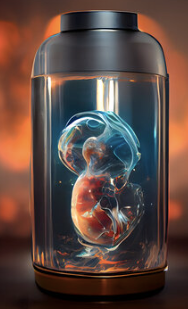
The idea of “ectogenesis” – growing babies outside the womb - has fired imaginations for over a century. In 1923, biochemist JBS Haldane coined the term ectogenesis. He imagined that it could save civilization from an impending collapse “owing to the greater fertility of the less desirable members of the population in almost all countries.” He proposed creating babies only from “the small proportion of men and women who were superior in musical taste and intelligence.” In 1929, Vera Brittain worried that such “laboratory-grown children” would give rise to a dystopian biological nightmare. Aldous Huxley elaborated on her dystopian fears in his novelBrave New World. He imagines children being grown in specially designed hatcheries and genetically manipulated to be either rulers or slaves.
Ectogenesis allows people to imagine the worlds of their dreams or nightmares. Fifty years after Haldane articulated his eugenic dreams and Huxley his dystopian nightmares, pioneering feminist Shulamith Firestone speculated that artificial womb technology (AWT) could liberate women. Her book The Dialectics of Sex (1970) views ectogenesis as a means to free “women from the tyranny of their reproductive biology” and allow them to finally reach equality with men.
Today, analyses of artificial womb technology echo the dreams and fears of Brittain, Huxley and Firestone. Kingma and Finn worry that the language used to describe the technology is itself a way of minimizing the complexity of natural gestation. They write, “The womb itself is not replaced; the “lamb-in-a-sack” is most like a free-floating fetus in its artificial amnion. Hence a more apt label would be: artificial amnion and placenta technology (AAPT).” They criticize much writing about these issues for promulgating a view that she calls “the fetal container model” by which we imagine fetuses as already separate, individuated “babies” that are incubated in pregnant women. This view was recently presented, and parodied, in an award-winning off-Broadway play in which the actors all played the parts of fetuses, awaiting decisions that would determine their fate.
Others distinguish an artificial womb from an artificial placenta and discuss the implications of each approach to life support for a baby born at the borderline of viability. There is debate about what, exactly, it means to be “born” and questions about whether a fetus that is transferred from a womb to a container of amniotic fluid and an oxygenation circuit has, in fact, been born, or merely transplanted from a natural womb to an artificial one.
Helen Sedgwick’s 2017 novel The Growing Season depicts a world in which gestation takes place entirely in artifical wombs. Sedgewick speculates about whether this is liberating for women or, instead, if it is a masculine plot to commodify reproduction and make actual women irrelevant. She speculates about the biological importance of bond between a pregnant woman and her and about the ways that the symbiotic nature of pregnancy is a template for other crucial human relationships.
Complete ectogenesis could be a “treatment” for many forms of infertility. It could obviate the need for abortion. It could increase gender equality. It could enable genetic parenthood without leaves of absence due to pregnancy-related health conditions or childbirth. It could fundamentally alter the medical management of extremely premature infants. It could also devalue or pathologize pregnancy and women’s psychological experience of gestation-related self-fulfillment. It could facilitate eugenics. Artificial womb technologies will change the way we think about bioethics, law, and reproductive biology. But only if we let them and only if we regulate them.
We are only beginning to understand the bioethics of pregnancy as a completely unique situation. Analogies obscure more than they clarify. The biological facts demand a richer bioethical imagination than one that leads to parables about violinists or trolley cars. As Horn writes, “…we must disentangle the discourse from the limitations of the world as it is now, and redirect it toward the work to be done in seeking the other worlds that could be.”
Related writing.
Why the Dutch Keep Pediatric Euthanasia Illegal
Pediatric euthanasia in The Netherlands has a unique legal status - it is illegal, openly practiced, and well-regulated. The most surprising part isn't the law that enabled this — it's what happened after.
The Tiniest Patients: Rethinking How We Decide
	When a baby is born at 22 or 23 weeks of pregnancy — half the normal gestational period — doctors and parents face one of the most agonizing decisions in all of medicine. Should they fight to keep the baby alive, knowing survival is u
When facts are not fixed: rethinking shared decision making at the margins of neonatal viability.
Parents and doctors face difficult decisions when a baby is born at the borderline of viability. Somehow, they must voice their values, shared concerns, and disagreements in a way that allows an initial decision about life-sustaining…
Survival After Court-Ordered Treatment Withdrawal
NR (as he is named in UK court documents) was born in 2020 with a malformed brain. He had, callosal agenesis, cortical dysgyria, dysplastic basal ganglia, a cleft lip and palate, and anopththalmia (no eyeballs). He was not expected to survi
About the author
John D. Lantos is a pediatrician and bioethicist writing on AI in medicine, neonatal intensive care, and end-of-life decisions. His essays appear in JAMA, JAMA Pediatrics, the Hastings Center Report, the New England Journal of Medicine, and Aeon. Read more about John.