From the blog
Voting for Trump Worse Than Smoking
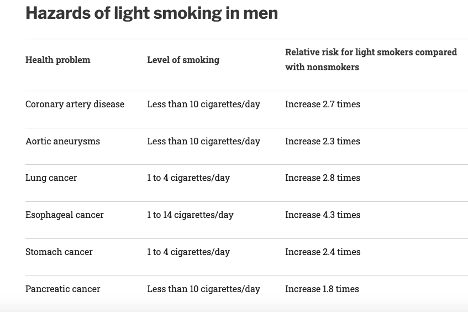
Light smokers are 2-3 times more likely to get lung cancer, stomach cancer, and coronary artery disease than are people who don’t smoke. People who live in counties that voted most strongly for Trump are 3.3 times more likely to have died
Light smokers are 2-3 times more likely to get lung cancer, stomach cancer, and coronary artery disease than are people who don’t smoke.
People who live in counties that voted most strongly for Trump are 3.3 times more likely to have died of COVID-19 than those in counties that voted the other way.
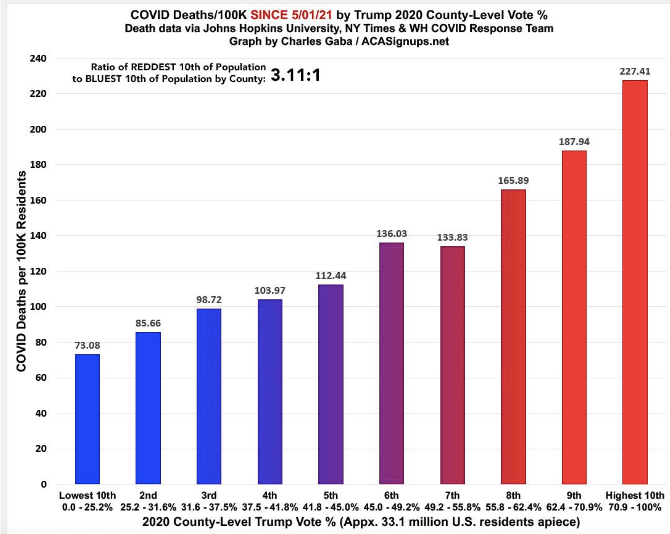
The relationship between Trump’s percentage of the vote and COVID deaths is almost linear.
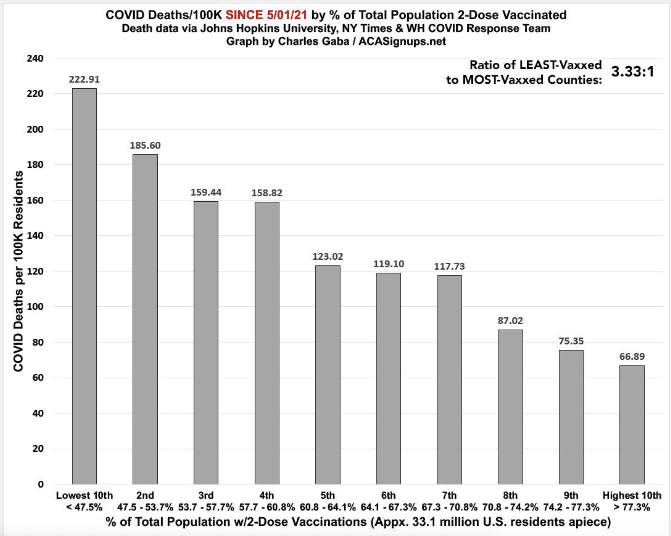
The reasons are clear. The relationship between political preference and COVID-19 immunization rates mirrors the death rates.
One could, of course, quibble with the statistics. These cancer rates are for light smokers. Death rates for heavy smokers are much higher. But death rates are likely much higher among actual Trump voters than for voters in counties that favored Trump.
Believing Trump's lies is bad for your health.
Related writing.
Why the Dutch Keep Pediatric Euthanasia Illegal
Pediatric euthanasia in The Netherlands has a unique legal status - it is illegal, openly practiced, and well-regulated. The most surprising part isn't the law that enabled this — it's what happened after.
The Lost Aura of the Doctor in the Age of AI
	Artificial intelligence can now make difficult diagnoses, detect drug interactions, read medical images, predict outcomes, counsel patients — and even write peer reviews. As these capabilities expand, doctors risk becoming supervisors
The Tiniest Patients: Rethinking How We Decide
	When a baby is born at 22 or 23 weeks of pregnancy — half the normal gestational period — doctors and parents face one of the most agonizing decisions in all of medicine. Should they fight to keep the baby alive, knowing survival is u
Emilia Perez: New Life or New Gender?
The award-winning film Emilia Perez addresses a central question in gender medicine. When a patient wants to transition, is it because they want to change their gender or because they want to change their life? If the later, a gender trans
About the author
John D. Lantos is a pediatrician and bioethicist writing on AI in medicine, neonatal intensive care, and end-of-life decisions. His essays appear in JAMA, JAMA Pediatrics, the Hastings Center Report, the New England Journal of Medicine, and Aeon. Read more about John.