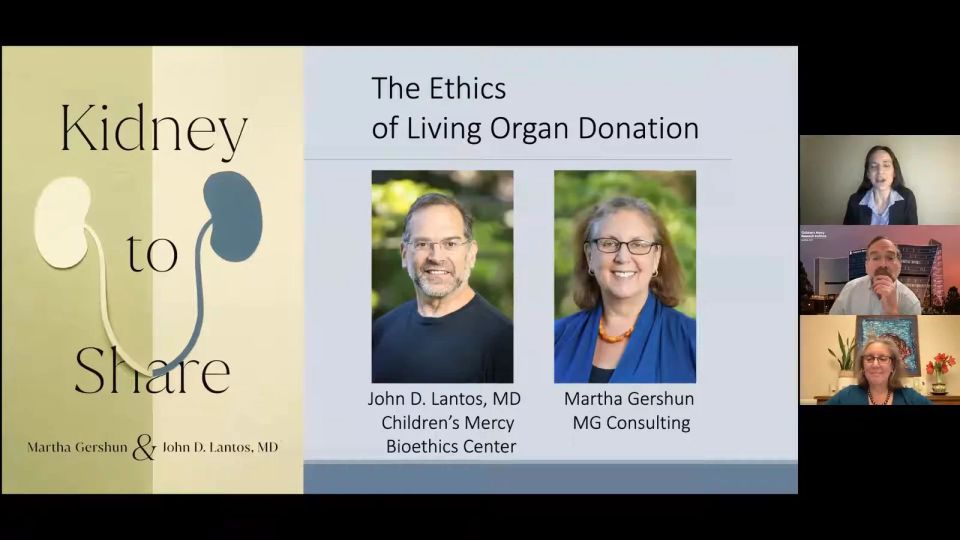
Kidney to Share | Martha Gershun & Dr. John Lantos | 12/8/21
December 9, 2021 · Columbia Center for Clinical Medical Ethics · 1 hr 14 min
About this recording
An archived video recording featuring John D. Lantos from Columbia Center for Clinical Medical Ethics.
- Format
- Video recording · 1 hr 14 min
- Recorded or aired
- December 9, 2021
- Institution or outlet
- YouTube / Columbia Center for Clinical Medical Ethics
- Archive identifier
- V063
- Speakers
- John D. Lantos, MD, Lydia Dugdale, Martha Gershun
Transcript
95 passages
- 00:04
Lydia Dugdale
I'd like to welcome everyone to tonight's talk. We're delighted to have you with us. I know some more people will be joining us, but we're going to get started so we have plenty of time for conversation. My name is Lydia Dugdale. I'm the director of Columbia's Center for Clinical Medical Ethics, and I am so delighted to host Martha Gershon and my friend Dr. John Lantos for their talk tonight titled Kidney to Share, A Living Kidney Donor's Experience and lessons learned about barriers and opportunities in kidney donation.
- 00:40
Lydia Dugdale
So Martha and John are gonna be talking about their new book. Martha is a nonprofit consultant writer and community volunteer. She's done many, many things, but I will mention that she has previously authored a book, Care and Custody, a novel of three children at risk. And this is a book about siblings caught up in the child welfare system. Martha holds an MBA from Harvard Business School. And what really sort of is critical to tonight's talk is that in 2018, she donated a kidney at the Mayo Clinic to a woman she read about in the newspaper. So I'm sure you're on the edge of your seat as am I to hear more about this experience. John Lantos is a physician, and he holds a fancy chair in bioethics at Children's Mercy Hospital. Robin Wagner- And the University of Missouri Kansas city school of medicine he's written a lot, most recently, do we still need doctors and neonatal bioethics to two books and then. Robin Wagner- Actually, even more recently, a book titled ethics of shared decision making that was published just this year by Oxford my favorite thing from john's bio is that he was voted one of the best pediatricians in the Midwest according to the ladies home journal. Robin Wagner- So. Without further ado, in this talk, Martha is going to discuss her decision to donate a kidney to a stranger and the long, complicated process that finally led to a successful surgery nine months later. John is going to use this story to illustrate the ethical issues that arise in recovering and allocating organs from both living and deceased donors. They're going to give us some ways that the medical community that we could thoughtfully and safely reduce the burdens on living donors. So I imagine this is going to be quite provocative for us. Their book, as you saw from the advertisement, is titled Kidney to Share. It's available through Amazon as well as independent booksellers. And we will also put the link in the chat function to the book where you could acquire that. We're going to take about 45, 50 minutes to hear from Martha and John tonight, and then we'll have some time for Q&A, so we invite you to give us your questions as well. And finally, I'm supposed to remind you that if you would like to have a link to tonight's talk or sign up for our listserv, we'll drop the email address in the chat where you can reach us. So without further ado, I'm inviting to the proverbial podium Martha and John. Thank you so much.
- 03:19
Dr. John Lantos
Thank you, Leah, and thanks for that nice introduction. I don't think my chair is fancier than yours, though.
- 03:27
Dr. John Lantos
um we're going to talk we're going to do tag team which is sort of how we wrote this book this project was one of the most fun things i've done in bioethics because it was really a about some topics that um i thought about a little bit but didn't really know much about and martha and i were um friends and we went to the same synagogue and would talk about all sorts of um things politics uh kids in the foster care system when she was a director of Casa, some of the bioethics issues. And then after she retired from Casa, she told me one day she decided to donate a kidney. And I was a little surprised. And we ended up having some long talks. And we were so fascinated by the talks. And we're both writers. We said, we should write a book. And so this book came out of it. But that's just sort of the beginning of the story, since once the book came out, we've been doing a lot of events like this. And the discussions have just been amazing, in part because it seems like a lot of the issues in the book kind of caught a wave of societal change, societal concerns, societal attention to some of the weird idiosyncrasies of the way we procure and distribute organs. So we're gonna go through some of the things we talk about in the book. We'll try to finish right at 45 minutes so we have time for that sort of discussion. What we do in the book is sort of go back and forth between Martha's story of her own experience and my gloss on it, which was just the way our conversations went. She would talk about all these weird things that were happening and I'd say, well, there's a history there, go through it. So for example,
- 05:16
Dr. John Lantos
little background, probably most people on this list know, but Lots of people waiting for kidneys, about 100,000 now in the US. People are waiting for a deceased donor, a cadaveric kidney, wait three to five years. And somewhere between 13 and 20 people die every day on the waiting list, waiting for a kidney donor. So there's an urgent need for more kidneys. Living donation is one of the ways to do it. Not only does it meet the need in a way that waiting for a quick overdose gets people off the waiting list, but outcomes are better because you can schedule the transplants. The matching is better. The donors are generally healthier. There's all sorts of reasons why. But
- 06:02
Dr. John Lantos
not too many people donate to non-relatives. In the United States, about two-thirds of donors are... James Rattling Leafs. kidneys come from deceased donors about a third come from living donors, but of those two thirds are people who donate to a biologic relative a spouse or life partner or do that through a paired exchange which we'll talk about a little bit, this is not hashtag this is paired exchange. James Rattling Leafs. And then there are people who donate to a stranger or donate anonymously people are pretty desperate that's a sign on a Kansas. patch of prairie, I need a kidney. People crowdsource for kidneys now. And
- 06:49
Dr. John Lantos
part of the change that we've noticed, which is pretty fascinating because not a lot of things change dramatically in bioethics. And every once in a while,
- 07:04
Dr. John Lantos
we get to a tipping point. I mean, it seems like that happened with medical aid in dying. And it seems like it happened with stranger donors, where sort of in the 1980s and 90s was when people started coming forward saying, oh, I just want to donate a kidney to a stranger. And the first response of most transplant centers was to send those people to a psychiatrist. The assumption was anybody who would walk in and say, take my kidney, give it to someone I don't know must be crazy.
- 07:36
Dr. John Lantos
And there are a lot of of both surveys showing that transplant centers did this and also detailed case reports of some of these evaluations by psychiatrists where they sort of were probing to find out like, we know this person must have psychopathology. How can we find it? Is it excess altruism? Is it religious zeal? Is it coercion? Is it secret coercion? Are they being paid under the table? What is motivating these people? There was even a task force in Canada where it's much more centralized, as everything is in the Canadian healthcare system, trying to decide whether transplant centers ought to take living anonymous kidney donors. As you can see, the title of the paper they wrote was Lunatic or Saint. And they did surveys of these people, and they did psychological evaluations, and shockingly, they found that contrary to the medical community's fears,
- 08:30
Dr. John Lantos
are a significant number of psychologically stable altruistically motivated individuals who want to donate to a stranger and seek no material compensation in return came as a shock to these canadian authors and they changed their policies as a result part of the reason for the shock is everybody sort of understands the psychological benefit of giving to a loved one You're seen as a hero by your family. You relieve the burden on the family of caring for a seriously ill family member. And so in the traditional way of thinking about this, the donor was undergoing risk but not getting any benefit. Well, not really because of these psychological benefits. But if you're given to someone you don't know, where are the psychological benefits? Now, transplant surgeons We're also quite skeptical even of relatives in the early days of transplant, although in the early days of transplant, donations from relatives were the only ones that worked because people didn't understand histocompatibility or immunosuppression. But Renee Fox and Judith Swayze, two medical sociologists who for decades were doing the best work studying the whole sociology of transplantation, have a whole chapter in this book about Andrew Rothenberg- Organ Replacement American society about how ambivalent surgeons were about operating on a perfectly healthy person, the benefit of another seriously wounded a healthy individual and they were willing. Andrew Rothenberg- Within families, because it was judged to be healthy altruism derived from genuine moral concern, but they were skeptical about these stranger donors so. Bruce Bunnick, Jr.: This the history and as well show it's now sort of the pendulum has swung the point where. Bruce Bunnick, Jr.: Many centers now advertise for stranger donors, there are programs to encourage them, and so this question of craziness is lurking in the background, but now has become. Bruce Bunnick, Jr.: background. Bruce Bunnick, Jr.: i'll skip over this for today and get on to.
- 10:48
Dr. John Lantos
Martha's story and you can judge for yourself how insane she might be.
- 10:54
Martha Gershun
Thank you, John. I always like to tell people I suspect I am crazy, but I don't think I'm crazy because I did this. This story most specifically starts back in 2017. I was a recently retired nonprofit executive. My kids were grown and out of the house. My husband continued to work running a prominent non-profit here in Kansas City. I had time on my hands. I had
- 11:25
Martha Gershun
engaged in several very meaningful volunteer projects. I had written a book about kids in the foster care system. You've heard about that. But I was really looking for the next big project. I was sitting on my bed and reading the Kansas City Jewish Chronicle. weekly publication I have probably read every week for the last 25 years. And there was an article about a woman. You see her here. She's the beautiful blonde, Deb Porter Gill, who lived in Fort Lauderdale but had grown up in Kansas City, had attended the synagogue that I attended where I met John, had two kids. I had two kids. She had been an attorney in the child welfare system, which is the system in which I had previously worked, and she needed a kidney. This wasn't Deb's first experience with the transplant system. She had first been diagnosed with kidney disease in her 30s and subsequently diagnosed with diabetes, and that made her eligible for a kidney pancreas transplant, a pretty common combination. Donna Sacco, and when they're done together, first of all, it has to be a cadaveric donation, because we don't take pancreas from living donors, so she was only eligible for cadaveric transplant at that point, and also moved her pretty high up on the list, because she was pretty sick. Donna Sacco, Deb received those Donna Sacco, organs from a woman in her 40s who died in a car accident, because she was not wearing her seatbelt. Take what moral from that story you want. For 18 years, those organs had served Deb really well. But now the kidney was failing. Pancreas were continuing to work fine, but the kidney was wearing out. And it had lasted 18 years, which is a long time for a deceased donor kidney. Typically 12 to 15 years is a good run. But Deb was only 56. She wasn't ready to be dead. And her doctor said she didn't have time to wait for another cadaveric kidney. list was too long her need was too great she was going to have to find a living donor
- 13:40
Martha Gershun
deb reached out to our local newspaper because they had written about her back when she had received those first organs told her story and i read it and i thought instantly i could do this i could be this person i don't know if i'll match but i can certainly make the phone call
- 14:02
Martha Gershun
I think it's important to note that kidney donation was not a new idea. And I think you find this is often true in people who, even people who are anonymous or non-directed donors, the highest form of altruism in this world, often something else has happened somewhere along in their lives. It's not the first time they thought about it. For me, it was my beloved cousin Anne from Omaha who had PKD, polycystic kidney disease. and received a living kidney transplant from her best friend, Cheryl Cooper, in 2002. Way back then, I remember thinking, maybe I could save Anne's life. I would certainly like to save Anne's life. But in fact, I wasn't even the same blood type. Anne was not a biological relative. She was my cousin by marriage. And I wasn't gonna be the person to save her. But because someone else did, we had nine more years with my cousin. She came to my son's bar mitzvah, my daughter's bat mitzvah. She was able to attend the weddings of both of her daughters, saw the birth of four grandchildren, came to Kansas City when my mother died for our memorial service. We had a full rich family life with Anne. So I understood what living organ donation could mean, not just to the recipient, but to their entire family. I got it viscerally what this could mean. And I had always admired Cheryl so much for saving my cousin's life and had been so grateful that she saved my cousin's life that it seemed like I could do this for someone else.
- 15:42
Martha Gershun
I always want to tell people, medically, this was way easier than I expected. I flew through the evaluation. John can tell you later there were a few hiccups, but by and large, I have unbelievable powerhouse kidneys. and structurally perfect kidneys, I was told. That was very exciting. I'm generally in quite excellent health. I was at the top end of age. I was 61 when we did the transplant, about 15 pounds overweight, but generally in good shape and able to do this. And in fact, the surgery went well. I recovered very quickly. It was out of the hospital in two days. We were home four days later. And within four weeks, I was back to my regular schedule but logistically this thing was really hard to do and it was my vision about those logistic barriers my questioning some of the problems problems i saw with the system that led me into conversation with john and eventually led to this book you you heard it noted i have an mba from the harvard business school i majored in marketing and customer service ops So the ways that organizations serve their customers is something that I had studied academically and something that I'd spent my entire career working on in both the corporate world and in the nonprofit world. And I knew that a lot of the things that I experienced were not smart ways to manage a customer. And let's face it, who could be a more important customer, client, stakeholder, patient, than a living organ donor who doesn't need the services of the system, but without whose contribution and participation the system cannot do what it needs to do. So out of that frustration,
- 17:40
Martha Gershun
I started talking with John about ways we might make recommendations to make the system better. So I'm gonna give you two examples so that this feels realistic to you all. The first is that I told complete truth was completely transparent and disclosed fully on the original intake forms. These were computer forms. When I first called to volunteer my kidney, I was sent to a website. Please fill out this form. And two things which I said on that form, which I didn't give any thought to at all, turned out to raise major red flags at the Mayo Clinic and cause a lot of problems. The first is that I disclosed that I occasionally smoke recreational cannabis. This was horrifying to them. They never seemed to care if I was a certified alcoholic. They didn't seem to care about that. But there was some residual stigma around marijuana. I always like to note it is legal in 23 states. But the fact that I had occasionally smoked a little weed in Colorado on vacation put me in a high-risk category as far as they were concerned. And they required that I speak to a substance abuse counselor. before they would even test my blood to see if I was a histocompatible match. I said, yes, of course. I was trying hard to save Deb's life. I didn't want to be a pain. I was trying not to look like a high maintenance customer here, but I was really annoyed. And then it turned out that of all the appointments available at the Mayo Clinic during the week, I was going to be up there to have my kidneys scanned and my heart tested. And many, many other tests. I had 24 appointments in all. They didn't have any available appointments with substance abuse counselors. They wanted me to come back. And the Mayo Clinic is six hours by car from my house for a one hour substance abuse appointment, book another hotel room, have my husband come with me, take another day off work because they didn't have capacity. And I started to think this is ridiculous. First of all, I don't need this appointment to begin with. I am not a drug addict. I do not have a substance abuse problem. And they couldn't distinguish between occasional recreational cannabis use and serious drug problems. And they were requiring something which they did not have capacity to provide, which I thought was pretty lousy customer service. As it turns out, and for those of you who read the book, you'll get this in all its full flavor. I was so adamant and such a strong advocate that they eventually said I did not have to meet with a substance abuse counselor. But you can only imagine that that might have been because I am articulate, educated, upper middle class in my 60s, dare I say it, white. And you wonder what might have happened to a 30-year-old black male with dreadlocks.
- 20:37
Martha Gershun
not as highly educated as I am, not so used to advocating for himself, trying to be tested to save the life of his mother. Would this have turned him off? Would the whole idea of a substance abuse counselor appointment been so offensive culturally that he would have virtually, literally run from the room screaming in a way that would have made that transplant not possible? They're good questions and they're important to ask. The other quick story, you'll see the box there. 30 days before any solid organ transplant, The donor must be tested for HIV, AIDS, and hepatitis. Makes perfect sense. Those are very contagious, very dangerous diseases. You would not want to transplant an infected organ into a recipient who's going to spend the rest of their life on immunosuppressant medications.
- 21:23
Martha Gershun
So I got that box in the mail about 14 days before I was going up to mail for the surgery. Please get your blood drawn and ship it back to us on dry ice. Well, I don't know about the rest of you, but I did not know how to ship on dry ice. I Googled it, didn't get anything. I called Mayo. They weren't really any help. They said, your local doctor will know how to do it. I called my doctor. They said, we've never shipped on dry ice in our lives. I called FedEx. They said, it's a controlled substance and if you don't pack it properly, you'll blow up our airplane. I called the grocery store. I'd once seen dry ice somewhere around the meat department, I thought. They said, we sell it in 20-pound slabs. You can't ship it.
- 22:07
Martha Gershun
And I had only a few days to get this done and get it back to the clinic so that our surgery could proceed as planned. Eventually, through the Yellow Pages, through Google, I found a company in the industrial part of our city that sells dry ice transport pellets. I went out there at 6 in the morning, found a nice guy to help me. pack my box properly. He said, unroll the window in your car. If this stuff leaks, it will kill you. You can be asphyxiated. I did not find that heartwarming. Drove to my doctor, got my blood drawn, got it done. But once again, ask yourself, how would someone without my resources, without a working car, without money to put gas in the car, without the ability to take the day off work, without a doctor, primary care physician to go to, without my pretty significant research, shopping, resources, skills, how would you get that done? And why in heaven's name does the clinic in our country, which does more living kidney transplants than anyone else in the world, not have a standard relationship with a lab to draw blood for these critical tests and ship them on dry ice? So once again, real problems with the system that don't make it easy for the one person trying to do a nice thing. John, do you want to tell them some
- 23:29
Dr. John Lantos
more? Yes. So we looked at some of these bureaucratic barriers and measured some of the concerns against the known shortages on the waiting list, and then ended up spending a little time in the book on various ways we might increase the supply of organs. Talk a little bit about, and I'll talk briefly about these, about countries that have done opt-out versus opt-in. Talked a bit more about markets, and in particular, some of the rapidly developing kind of gray markets, markets that aren't quite considered markets like the paired exchanges or chain donations. And then we end up coming back to Martha's story and talk about just providing more support for living donors in some of these situations, like the ones Martha briefly described here. But
- 24:25
Martha Gershun
let me
- 24:25
Dr. John Lantos
just go through some of these because they raise some interesting questions, not so much about living donations, but about cadavera. A couple of countries, Spain and Croatia, have been the pioneers, have said, instead of checking the box saying, I want to be a kidney donor, you have to check the box saying, I don't want to be a kidney donor, or you're presumed. consent and not surprisingly they have the highest rates of calaveric organ donation in the world it's still just 30 percent of uh or 30 per million but um it's higher than uh any other european or or american country could it work in the united states uh hard to know uh the experience with things like COVID vaccine mandates suggests that we have a much stronger culture of individualism and suspicion of central planning and government authority and that sort of thing. So it may lead to a backlash. It may not work so well. It may work in these countries, not because the change led to a change in the nation, but because the change reflected a culture of solidarity. But it's an idea. It might be worth a pilot project in the laboratory of the states just to see what happens.
- 25:48
Dr. John Lantos
Talk a bunch about markets for organs. And this has been one of those perennial debates since the early days of transplantation between mostly economists on one side and mostly bioethicists on the other, and both digging their heels and are absolutely convinced that their approach is the ethically preferable one. Economists say, of course, markets would increase the supply of organs. And we use markets whenever we want to change behavior. So what's the big deal? And bioethicists, on the other hand, say, well, we'll get to that. What are the arguments in favor of
- 26:31
Martha Gershun
markets? Well,
- 26:32
Dr. John Lantos
one is consistency. So other body parts can be sold. uh here are a few of them um and you know they're thriving markets in these what what's the difference people say so these are all body parts that regenerate but is that that's true but is that a um is that a moral criterion uh why isn't it um my own autonomy that should govern whether i want to sell any part of my body We talk about paired exchanges. Paired exchanges were invented by an economist. Al Roth is now a teacher at Stanford. He won the Nobel Prize in economics for coming up with this idea. He clearly saw it as a market exchange. You all know how it works. I want to donate to my loved one. We're not a match. Somebody else wants to donate to their loved one. They're not a match, but we're a match for each other's loved ones. And so we strike a deal. You give to my... Love but i'll give to yours it's reimbursement fact it's so obviously reimbursement that they had to amend the prohibition on market exchanges in order to legalize it our Roth says, of course, it's a market and what's wrong with that.
- 27:51
Dr. John Lantos
Interestingly, many bioethicists who generally oppose markets don't have a problem with this, it seems like it's not. the psychology of a market exchange or the idea that you achieve Pareto optimality, it's the thing about actual cash, which seems to raise red flags for some people. Once you do paired donations, you can do chain donations. Instead of two people, you can do three, four, up to N, the largest so far has been 30. Transplant 60 people altogether was written up in the New York Times. Sometimes the first person who donates isn't a match for the last person. Once you start a chain, in order to close the chain, you need the last person to be a match for the first recipient. If that doesn't happen, people have started using vouchers. Now this gets closer and closer to cash, closer and closer to a market. I'll give to your recipient, you give to the next recipient, and if I don't get one, You give me and my recipient a voucher that we can use to buy a kidney when one becomes available and we're given preference for it. Once you do that, you could give a voucher, perhaps not to buy a kidney, but to buy a liver or buy cancer chemotherapy or pay for your child's college tuition.
- 29:18
Dr. John Lantos
And at some point, the fiction that these are not market exchanges collapses. So these are the arguments in favor of markets. I mean, the first and most powerful is respect for autonomy, usually something that people in bioethics endorse, my body, my property. And in this case, what I want to do is save somebody else's life. So it would seem like that would also
- 29:47
Dr. John Lantos
draw in beneficence and justice. And then, as I said, this argument in favor of consistency, not just selling other body parts, but looking at the risk of kidney donation compared to the risk of other things that people do for money, like working in the forestry industry or flying airplanes or oil and gas rigs, or certainly sports where football players and boxers take enormous risks for enormous dollars. But somehow that's not seen as coercive in a way that paying someone to donate their kidney would be. And again, the arguments against markets coercion and exploitation. I'm sure in this bioethics audience, everybody is familiar with these. There's a certain abhorrence
- 30:40
Dr. John Lantos
to the idea of markets and a fear that rich people will coerce poor people into giving up their organs. The more these paired exchanges and gray markets develop, the harder it is to
- 31:01
Dr. John Lantos
consistently oppose gradual encroachments that will eventually, in my opinion, lead to probably experiments, pilot projects with well-regulated markets, but I'm sure we'll have more to talk about during the discussion on that one. Back to you, Emma.
- 31:24
Martha Gershun
Well, I always like to share the happy ending. I will tell you that this did not happen as a direct straight line. The first time that my husband and I drove up to Mayo for the surgery, it didn't happen. I successfully passed all the tests the day before. A lot of things have to be done again. We have to be sure your heart works, your lungs work. Nobody wants to kill you with anesthesia. I went back to my hotel room with a bottle of antiseptic soap and a bottle of laxative, hoping not to mix the two up, because that would be terrible. And at eight o'clock at night, after I had appropriately chugged the bottle of laxative, I got a phone call. I recognized the area code, that Mayo area code I'd been watching for nine months. It was the nephrology fellow in the hospital. Deb was sick. She was too sick, and they were calling the surgery off. I have to tell you, in all the scenarios in my mind, all the ups and downs of getting approved for this process, it never occurred to me that once we got to the clinic and I had a surgery time assigned, 5 a.m., that they would call the surgery off. But in fact, Deb had been getting sicker and sicker while we waited to get the surgery done. And her body had retained so much fluid from her not very well functioning kidneys that there were shadows on her lung x-rays. And they couldn't tell if these might be infections, if this might be an infection problem. And once again, you would not want to flood someone's body with immunosuppressive drugs post-transplant if they have a lung infection. much better to wait and see what it was, to wait till they could culture it, to wait till the infectious disease people could get there in the morning. And so they canceled the surgery. Nobody seemed to pay much attention to me at that point. I don't mean this in a whiny way. I was not the sick person, but I was six hours from home with my husband in a hotel room needing to use the bathroom urgently with great frequency. And nobody could tell me what was going on. HIPAA demanded that they not tell me anything about Deb's condition specifically. The nephrology fellow said, I'd put you on the phone, but she's crying too hard. I can't put you on the phone with her.
- 33:54
Martha Gershun
There was really nothing I could do but go to sleep in a hotel room and wake up in the morning and start to try and find people at the clinic who maybe knew what was going on. What it meant for me? Was I supposed to stay there? Was I supposed to go home? What was I supposed to do?
- 34:14
Martha Gershun
I had a donor advocate at the clinic who was fabulous. And she very quickly got to all the people, came back with the information. Deb by then was in communication with me and really was my primary source of information. And eventually it resolved that I should go home and wait. And with any luck, they'd figure out what was going on and we could reschedule this. Everybody knew Deb would die without this surgery. By now her kidneys were barely functioning at all. And so I understood that the goal was to make this happen. It was just how and when and safely. This is kind of the moment in our story when everything went up in the air. My husband had very carefully scheduled the time off work to be with me for the surgery and my recovery. Now that was all up in the air, he was gonna have to reschedule a different time off that was not gonna work very well with his very important and very busy work schedule. I'm a planner and all the plans were gone, but this drumbeat, we're gonna save Deb's life, we're gonna save Deb's life. It seemed to throw the clinic into a bit of a tizzy too. And they called and told me that, Things were okay. It looked like
- 35:32
Martha Gershun
it really was just fluid in Deb's lung. They were able to use diuretics to solve that problem. Could I please be there the next morning for testing again and then surgery? And I said, do you guys want me to drive through the night? And the response was, well, what do you mean? I said, I'm six hours away. They said, you are? And I'm thinking, I'm a really important part of this process. It is said on my chart since the day we started, I live in Kansas City. They're the ones who sent me home. It seemed very inconsiderate and not very helpful that they sort of thought of me as a part on a shelf. Schedule surgery, take part for Martha down, foot and body. That they didn't think she might be somewhere else. She might not just be able to hop on a car and get down here. Lori Foley, As it turns out, they they changed the surgery date, I said, I would not drive through the night, I was pretty sure that wasn't safe or smart and. Lori Foley, They agreed, but again I advocate for myself, you again have to ask what do some of these things mean for people not quite as articulate not quite as educated not quite as pushy, as I am. Lori Foley, I did go back to Mayo I did pass the test again. and the surgery was a success. And you can see, this is a picture taken the day after surgery. I was up walking around, Deb wasn't walking just yet. What you can't see in this picture is the best part of the story, of course. At the foot of the bed is one of those IV bags connected to a tube, connected to Deb, filling with perfectly golden urine. My kidney, now Deb's kidney, was working. And honestly, when I saw that bag filling with urine, my heart almost stopped. I couldn't believe, even though I had a surgical scar to prove it and I was kind of sore, that we had actually done this. The next picture you see was taken about 18 months later. Deb came to Kansas City to see her parents. She took me out for sushi. So there's a sweet cut line, give a kidney, get some sushi.
- 37:48
Martha Gershun
She was doing well then and she continues to do well. She and I were on a Zoom call last week for an agency that was raising awareness about organ donation. She's living her life in Fort Lauderdale, Florida. Before COVID hit, she was able to travel quite a bit, which is something very important to her. She sent me a text. She was zip lining in Central America. And I have to tell you, I'm brave enough to donate a kidney, but I am not brave enough to zip line. And so I think my right kidney will be forever jealous that it didn't get taken on that adventure. Deb and I stay in touch through Facebook. We text sometimes by phone. Soon as we can get rid of this messy COVID thing, we'll be able to see each other in person again. I have a standing invitation to go to Florida, and I think there will come a Kansas City winter when that looks like a very good idea. This is the happy ending. these pictures tell you why people do this sometimes considered insane thing that for me was so meaningful i don't think it was crazy at all
- 39:00
Dr. John Lantos
um so um we end up in the book talking about uh three different kinds of barriers to uh living donation medical psychosocial and financial each of which uh raises some ethical issues the medical ones seem the most straightforward donors are screened very carefully and the transplant team the surgeons reserve the right to reject people based on their assessment of whether the medical risks are too high that gets back to this question of autonomy and whether uh there should be a little bit more of a gray zone or a tolerance for a donor to say wait a second wait a second tell me the risks exactly and let me make the decision about whether my borderline hypertension should disqualify me from donating i i may be willing to take that risk today that decision belongs entirely to the transplant team and
- 40:09
Dr. John Lantos
We could talk about that if people are interested. The psychosocial barriers. This stuff about seeing a substance abuse counselor because you smoke a little pot is sort of a remnant of the idea that people who want to donate, if not crazy, at least have serious psychological problems. They're drug addicts. They need money for their drugs. They're being coerced. There's some deep suspicion. Martha didn't mention it but they also wanted to get records from every psychotherapist she'd ever seen to know you know to search out and find the presumed mental health problems that
- 40:53
Dr. John Lantos
transplant teams worry about these it's hard to know what the effect of these kind of screenings are as Martha told her story you could tell that she was empowered enough Articulate enough and stubborn enough to overcome some of the barriers, but other people might not be, and we'll show you some data in a minute. Finally, didn't talk much about the financial stuff, but days off work, travel costs, those are all not covered by the recipient's insurance. Medical costs are all covered, but unless these other costs are covered, depending on You know where the donor lives and how long the process takes and whether you have to go back to see a substance abuse counselor or go back because the surgery was canceled can add up to thousands of dollars. Now these all have real world consequences. This is one study that looked at a thousand people who, like Martha, filled out the online I want to be a donor form and shows what happened to them in one transplant center in one year. uh 30 about a third uh opted out whether that's because the questions were too intrusive we don't know it didn't go into that kind of detail only about 20 uh actually made it to evaluation and only about 15 ended up donating if you look at who donated twice as many white people as black people uh ended up donating how much of that is medical how much is psychosocial how much is financial barriers Again, this study didn't show it, but
- 42:38
Dr. John Lantos
it seems we ought to look at that a little bit more carefully and see whether the kinds of barriers and just hassles and costs that we write about play a factor in some of this racial disparity. There are programs to help with financial costs. National Living Donor Assistance Center, which is part of CMS, has a means-tested program to cover lost wages, travel costs, and dependent care needs. If the recipient, interestingly, has a household income of $61,000 or less, that's 350% of the federal poverty level, if your recipient has more money than that, you as a donor do not get this support. The support is a good idea, but since this does save everybody money, save or make money for everybody else, it would seem that the means testing is just sort of vindictive and a little stingy. Why not simply cover these necessary expenses
- 43:52
Martha Gershun
for anybody who wants to donate?
- 43:54
Dr. John Lantos
Would it have cost CMS too much to pay for Martha's Hotel in Rochester, Minnesota? There are nonprofits who seek to fill the gap. The National Kidney Registry was started by somebody who did a payer exchange and realized what the barriers were and decided to create a foundation to fill the gap. They only work with paired or chain donations. They are the organization that coordinated that 30
- 44:24
Dr. John Lantos
transplant, 60 person chain donation with philanthropic support. They're able to provide reimbursement for lost wages, travel, lodging. They even give donation life and disability coverage in case a donor has these problems. And they facilitate remote donations, so you wouldn't have to do what Martha did and travel to Mayo. They will coordinate so that you can get your kidney taken out closer to home and shipped to where the recipient is. Again, that's the good thing, but why leave it to an entrepreneurial nonprofit rather than building this into the system? So we end up with a modest proposal in the book. We say treat donors like donors, that is, treat organ donors the way we treat financial donors. Hospitals are very good at taking care of people who give them money. They don't make them ship things on dry ice. They don't make them travel six hours through the night in order to write a check to the hospital. They have vast departments, development departments whose job it is to facilitate financial donations.
- 45:48
Dr. John Lantos
It seems like they should have similar offices for people who want to donate in Oregon, facilitate the travel, pay for their hotel. Put a wall up honoring them in the hospital where their donation that, just like a financial donation, not only furthered the hospital's mission in a general sense, but saved a particular individual life. So with that, we'll stop and look forward to your questions and comments. Thanks everybody for coming out late at night like this.
- 46:28
Lydia Dugdale
Thanks so much, John and Martha. That was really, really fascinating. I have many questions personally. I want to invite the audience to put questions into the chat or into the Q&A feature. Either one, I'll find them. Let's start with a question from Leanne. How do you think the role of the media has impacted the process of organ donation? Do you think the media has had a positive or negative impact?
- 46:57
Dr. John Lantos
Yeah, it's a great question. People, particularly digital media, but even traditional media, I mean, Martha read about this in the Kansas City Jewish Chronicle. It publicizes the plight of donors, and that's a good thing. The main ethical concern that people have raised about the media is that it becomes a beauty contest. I don't know if you meant this, Martha, when you said Deb's the gorgeous blonde in the picture, but the fact that she is a gorgeous blonde, probably increased her chances of getting a donation. People now do crowdsourcing campaigns, and there's a whole science to doing those. It's a public relations science. So you can now get consultants for your crowdsourcing campaign, and they'll tell you what kind of pictures to put up, how to deal with maybe aspects of your story that are less savory than others got to tell a story that's more likely to generate interest and that all costs money and that increases disparities so people who are empowered people have access to those sorts of resources are more likely to get a kidney and that hence the beauty contest uh pejorative uh about this uh oh go ahead no
- 48:20
Martha Gershun
go ahead john finish
- 48:22
Dr. John Lantos
Yeah. How about how bad that is? I mean, it does increase the supply of organs. I mean, somebody is no longer waiting for a calabaric organ. So the net benefit, I think, is still positive. So it's one of those situations where overall people are better off. But one of the prices is widening disparity.
- 48:43
Martha Gershun
Yeah, I think that's really true. There's another way that the media plays around both cadaveric and living organ donation, and that's the way transplants are portrayed in fiction, in TV. And now that I've participated in this process, and I'm a big consumer of this stuff on TV, right? Chicago Med and Grey's Anatomy, and there's a new one coming out, The Good Sam, we're already taping it. the way they portray organ donation is absurd. It doesn't happen that way.
- 49:18
Martha Gershun
First of all, they have to get it done in half an hour. And in my case, it took nine months. But I think like every lawyer who watches a legal show, anybody who's participated in this knows that the way we portray it in these stories is just not true. And I think it changes the way people think about it because they don't have a sense of what it's really like. In my view, the biggest egregious player this past year has been Be Positive. I don't know if any of you have seen that, but it's a sitcom about a woman, a drunk, who meets a guy back at her high school reunion and decides to donate a kidney to him. And much of the story is making fun of her attempts to get sober, her attempts to get clean. What does it really mean if she donates a kidney to him? And the entire story is absurd. This is not how it works. Obviously, if the Mayo Clinic is worried that I smoke a joint or two, imagine what they would think about someone who is an affirmed alcoholic making a decision while on a bender to donate a kidney. So I think the media has been slightly irresponsible in portraying this as a caricature, which isn't necessarily very helpful.
- 50:30
Lydia Dugdale
Martha, is that part of what, drove you to write this book? Did you want to try to put a story out there that was as true to form as possible and sort of reshape the narrative?
- 50:43
Martha Gershun
Not because of the media, but literally because I was complaining to so many of my friends as I was going through this process, both business school friends and medical school friends. And my college roommate is the very prominent writer and pediatrician, Dr. Perry Klass. who I was talking to almost daily. I was talking to John Weekly. These are all friends who are writers, who know I'm a writer. And I think eventually they all just sort of said, stop bitching at me, write the book. Is that what you thought, John?
- 51:17
Dr. John Lantos
Yeah.
- 51:21
Lydia Dugdale
So I want to talk, and John, I think, you know, we would want to get there about this question of money, right? So maybe the media is, can be coercive right you hire the consultant you craft the beautiful profile you get the photo shoot and you put it in the right publication and you attract a donor who identifies with you and that's a separate question i want to get to martha because um i want to talk we will come back to that question of of your identification uh with the recipient uh on many levels but let's talk about commodification objectification instrumentalization the distinction between treating organ donors like financial donors and treating organ donors as organ donors is that financial donors have more to give i mean the the worthy ones do right in the mind of the hospital they can keep giving and so you've got to treat them good because the next go around it might be another x million of dollars martha only has one kidney to donate
- 52:27
Lydia Dugdale
And so can we make a case that we should treat her the same as a financial donor, given that her ability to donate is limited? Would she be treated more like the $50 donor to the hospital than the $500,000, $500 million donor? Yeah, so money, how money factors in. I'll stop there and just let's have at it on this point.
- 52:51
Martha Gershun
Well, I'm gonna take that one first because as a nonprofit executive, I've spent much of my career raising money And I've learned a couple of things. You are always nice to the $50 donor because you never know what's coming next. So it is true that I only have one living kidney to donate, but I hope at my death, there'll be another kidney, there'll be a heart. I'm a writer. John and I have given almost 30 talks now. I'm out there talking about this system all the time. Wouldn't they rather have me saying something different? The truth is I do encourage people to consider donating. It is so meaningful. But what different story might I have told if my experience were more seamless? Would I perhaps be more willing to encourage my friends with less financial resources, with less time? I think the trick to good fundraising is to be nice to every single person every single time.
- 53:57
Lydia Dugdale
I like that. I like that, Martha. John, how much is a kidney worth and can we buy them?
- 54:05
Dr. John Lantos
Yeah. So yeah, I mean, the two questions tie together. If the hospital was going to sort of base their support for living donors on a dollar value that they assigned, but how much would they assign? Or how much
- 54:27
Dr. John Lantos
would the market bear? And this, our most interesting discussions were with Al Roth when we spoke at Stanford and since have sort of followed his blog and a lot of the papers he's been writing. And sort of where he's come, which I'm sort of grudgingly coming around to is the idea that it's not so much the absolute dollar value, but it's doing a well-regulated market. So it's not a
- 54:59
Dr. John Lantos
kidneys going to the highest bidder. Well-regulated would mean instead of the current system with all this crazy means testing and submit your receipts for the hamburger you bought on the road when you're driving up to Mayo in order to get reimbursed, just say you get some dollar amount ten thousand fifteen thousand they pick a number that seems uh maybe a little bit more than average cost uh and see what happens um the two schools of thought which i call the economist school of thought and the bioethics school of thought uh raise uh testable hypotheses i mean either everybody who signs up to donate will be a marginal poor person about whom you worry that they're being coerced or objectified or exploited and when you interview them afterwards they'll say i wish i hadn't didn't have to do that but i was desperate my kids needed food to eat and if that was the case i think we'd say the bioethicists were right this really sucks and
- 56:08
Dr. John Lantos
it's unethical to continue What the economists say is, nope, that probably wouldn't happen. People like Martha would still donate. She just wouldn't be out 5,000 bucks. And people who donate would say, I feel good about my decision and I'd do it again and I'd recommend it to others. And I'm so glad that there was a little reimbursement so that on top of the dopamine rush I got from being an altruist, you know, I'm not, didn't cost me money. That's a testable question. Pick a state, probably Oregon, because they start everything, or California, and say, let's try it. Let's do a five-year pilot project and study it carefully and see what happens.
- 57:03
Lydia Dugdale
I mean, it's interesting, though. I was recently in a room of medical students, and one of them had presented on Robin Wagner- You know, renting the uterus per your slide and selling eggs and sperm and all of us in the room, who come from. Robin Wagner- You know, lower middle class families or lower class families, as was my case when I was in college, all of us read those announcements and thought wow 20 K for my eggs. Robin Wagner- that's like half of tuition right, this is long time ago when I was in college and. It was interesting. It was interesting to see how all of us had seriously considered it. Now I
- 57:46
Dr. John Lantos
would buy a couple of textbooks.
- 57:48
Lydia Dugdale
Right, exactly. And it's hard to think, you know, this is a room of Columbia medical people, so. where we ended up for whatever kind of humble circumstances many of us came from, we ended up in these very prestigious schools. And at the time as college students, we were able to think kind of rationally and clearly through this and maybe decide that that wasn't the best use of our bodies. But the money was very, very compelling. And it's hard to imagine. And that's also knowing that eggs are a renewable resource or whatever, like keep coming every month. um and yes there's this slightly odd thing of maybe there will be little lydia's one run running around somewhere uh but you know it's 20 20k in my pocket so it's hard to imagine this not going the same route i mean you can say you can say test it but i think human nature is we need to survive uh the disparity between rich and poor is only growing and this seems like It seems like a nice way, you know, renting a uterus is another nice way to make money for women. And one could argue that that should actually, it should be permissible with some regulation to give these women more protections.
- 59:13
Dr. John Lantos
But renting a uterus should be a- So both your examples are things that are legal now. So, I mean, you could have sold your eggs and you could be a surrogate mother in most states.
- 59:25
Lydia Dugdale
Right. So, but, but kidneys, right. But then the women who end up, I mean, so the argument is, is that the women who end up doing this are the, or men who are doing this, but usually it's women because eggs make a lot more money than sperm and, and renting uterus. It tends to be people who are rather desperate to make money. And do we not find that problematic or, you know, it's not a renewable resource in the case of a kidney. do we need to be very, very careful about underlying conditions? You know, more careful than maybe we would be normally. I'm just trying to, you know, we can study it, but I do feel like there's more to the ethics than just studying it and let the outcomes determine our ethics. Come on, John, that doesn't seem like the right way to do ethics.
- 1:00:11
Dr. John Lantos
So a better way is just to say, I know it's wrong and I know it's better for you than you do. I'm not going to let you make a choice to be exploited.
- 1:00:23
Martha Gershun
Well, and I want to throw something. I want to throw a wrench in here. So John knows I'm kind of a libertarian in this deal. I'm a real body autonomy person. And I think it... I think it's perfectly reasonable for someone to want to sell a part of their body in this way. I've worked in the poverty community most of my career. People do very dangerous things, legal and illegal, to pay the rent and support their families. Women stay with abusive men to keep the rent paid. Poor people, mostly people of color, worked at frontline public facing jobs through the pandemic. People worked in meat packing plants. So aren't we a little hoity-toity to say, I won't let you sell your kidney, a one-time
- 1:01:11
Martha Gershun
shot at getting enough money to buy a car, to pay tuition, to buy shoes, to do something for your kids, to get a house with enough rooms that not everybody in the family gets COVID. But we don't care if you have to work in a meatpacking plant with absolutely no protocols during a global pandemic. Poor people always do dangerous things to feed their families. That's what it means to be poor. so why do we say some things are fine because i don't really know what went into making my sausage and my hamburger and my steak but i can see the kidney thing i guess i think it's a little um cerebral to say this thing isn't okay but all those other things i'm just not gonna you know i'm not gonna pay any attention to all the dangerous things people do every single day to feed their family Yeah, Martha, I think that's
- 1:02:04
Lydia Dugdale
well put. Yeah, yeah. I'll have to think about it. All
- 1:02:10
Martha Gershun
right. I think it's a think about thing, right?
- 1:02:13
Lydia Dugdale
Yeah. No, that's right. That's right. So Karen Sobeck, she's a member of our ethics committee here at Columbia, has also worked in transplant. So she has a comment here. She says, a good portion of my career has been as a kidney transplant coordinator on both coasts. She loved the talk. but she has one issue with the presentation. Transplant surgeons are not plumbers, not to disparage plumbers, and should have the ultimate decision on whether to accept a higher risk living or deceased donor. They also bear the burden for their transplant program to meet SRTR expectations or risk losing certification as a transplant center by accepting risky donors. And this is something actually we've been talking about on our committee quite a bit recently because Columbia tends to accept higher risk patients with more complex social situations than some of our peer institutions. And that can ding us when outcomes aren't as good as people who come from highly supportive, well-resourced communities. So comments from either of you on Karen's very insightful point.
- 1:03:24
Dr. John Lantos
Sure, I mean, oh, a couple of comments. I mean, one with cadaveric, uh organs as i'd love to get your opinion on this karen but um people do grade them and you know there's grade a organs and grade b organs and the grade b organs are uh acceptable with the consent of the recipient so though i assume this happens at your place it happens at ours they'll say you know a heart or a liver has become available it's marginal
- 1:03:56
Dr. John Lantos
do you Do you want to accept it, knowing that chances are the outcomes won't be as good, but you're weighing staying on the list and all the risks of dying on the list, hoping that a better one will come along? I mean, it's almost like a futures market kind of calculation. And in that sense,
- 1:04:19
Dr. John Lantos
they let the recipient decide.
- 1:04:24
Dr. John Lantos
I have sympathy, though, for the idea that um surgeons ultimately get to make the call about how much risk they're willing to take i mean i think that's true for surgery generally and surgeons are uniquely empowered in a way that most other medical specialists are not to say uh i don't like the way this looks this is too risky for me i'm not going to operate on you and with living donors because it's someone who's not sick and the operation is not being done for their benefit Setting the threshold in a very risk averse place, I think is appropriate. I still think though, there may be a small gray zone where an appeal ought to be considered. I would still give the surgeon the final word, but I'd say maybe be a little bit more flexible. As far as the rules, I don't know the answer to this, but how much do transplant programs get dinged If a donor develops kidney failure 10 years down the road, which was really what we'd been talking about, we would be talking about, I don't think it would much affect the outcome for the recipient. I
- 1:05:42
Dr. John Lantos
mean, in Martha's case, for example, I mean, there were two
- 1:05:45
Martha Gershun
concerns. If I keel over tomorrow of end-stage renal disease, I'm more than two years out. They don't know what's
- 1:05:52
Dr. John Lantos
happening. But the two things they might've deemed you for were borderline high blood pressure, and a slightly abnormal glucose tolerance test, neither of which I think would have had any effect on the outcome for the recipient. What they were worried about was Martha's long-term outcome, which they don't track. So it's not a regulatory thing. I think it's the surgeon's ethics, which is hard to argue with, so.
- 1:06:17
Martha Gershun
Something else, I think there's a real distinction between people who do what I did and people who are trying to save the lives of a family member. I mean, I really did want to help Deb. And once I sign on for a project, I'm all in. And so, you know, I was going to get that puppy done. But I wasn't trying to save the life of my kid or my mother or my husband. And I think there is maybe something to be said for letting a donor take a little more risk. I mean, what would you do to save the life of your kid, right? You'd run in front of a car. You'd run into a burning building. And so... The fact is, if at any point they'd said to me, no, forget it, you have to stop, I'd have been bummed. And in five days, I'd have had another project to pursue. But if it were a family member,
- 1:07:06
Martha Gershun
it could ruin your life, right? I mean, you could be trying to save the lives of the breadwinner, of the father of your children, of your five-year-old son. And I'm not sure that the system... has really thought through. We know what happens if we let somebody donate and then they have a bad medical outcome. We do not track what happens if we don't let someone donate and they have a bad mental health outcome from that. There's a lot we don't pay attention to in this.
- 1:07:33
Lydia Dugdale
Yeah, very interesting. Martha, I do want to hear just while we've got you pinned here, tell us about donating to debt versus someone with whom you had no affinity. I'm sure you've thought about that.
- 1:07:49
Martha Gershun
John and I talk about it all the time. And of course, the answer is I don't really know. I
- 1:07:57
Martha Gershun
found out I was a histocompatible match before I ever talked to her. I read one newspaper article. I saw she was a beautiful blonde. She looked a little like my cousin, Ann. I knew she was Jewish. I knew she was from my town. And then spent three months getting tested and approved as a match. Then I met her. But I do think knowing her kept me going when this thing was hard. It wasn't some anonymous person. I wasn't throwing my kidney over the wall. So when the going got tough, I didn't have any choice about walking away. It was Deb. It was a real person. John and I have talked a lot. Would I have gone to the same amount of trouble for someone very different from me, someone of a different race, someone... someone who didn't have my politics um someone who was an anti-semite or a homophobe that i found abhorrent uh maybe just somebody who used bad english and not the oxford comma which could like drive me crazy um i don't know uh i had the good fortune to be mashed with an extraordinary woman from whom i have deep affection but is it possible that i might have done this for someone i didn't like right there's two choices you could also give anonymously you never know
- 1:09:13
Martha Gershun
or you meet and don't like, would you keep going? Would you give a kidney to a heated brother-in-law? I don't know. They're good questions.
- 1:09:23
Dr. John Lantos
We talk about this all the time and you always say you don't know, but of course you know. You never signed up to donate before. It wasn't until you saw Deb's picture and she reminded you of your cousin.
- 1:09:36
Martha Gershun
John's right. I know you can always call and anonymously donate your kidney through the National Kidney Registry. I knew that. yeah and i didn't you're right oh john i feel it when you're right
- 1:09:48
Lydia Dugdale
um i'm going to give the last question to the head of our ethics committee and director of clinical ethics here at columbia dr pregger asked doesn't the fact that only one country in the world iran having legalized selling kidneys say something about the potency of ethical reservations about legalization
- 1:10:14
Dr. John Lantos
um so i put a a link uh in the chat there about uh what our off calls repugnant markets i mean it's this this is clearly a repugnant uh market um
- 1:10:31
Dr. John Lantos
and there's a whole literature on on repugnant markets i mean we've talked about some of them i mean some people consider surrogate pregnancy a repugnant uh market and i've talked about banning it india i believe had a burgeoning market in womb rental, whole hospital wards full of women who for 500 bucks would carry a pregnancy. Now I think the most thriving market for surrogate mothers is Chinese people coming to California to have a baby born in the United States so they'll have American citizenship and then take the baby back to California, I think the going rate is between $30,000 and $50,000. So I mean, I guess that question of
- 1:11:25
Dr. John Lantos
which repugnances drive policy, I mean, there's only two industrialized countries in the world, I think, where capital punishment is legal. We're one of them. Doesn't that say? uh that we should have some ethical reservations about it i mean many people do but do you reach a tipping point and i mean i think the way kidney transplant is going unless people start figuring out ways to grow them in in vitro the pressure is going to be to do these pseudo market exchanges that will more and more come to resemble markets and eventually it will come to seem precious in the way that Martha was talking about not to at least expand programs that say we're going to cover costs but we're going to do it in the most efficient way possible which is to get rid of means testing you
- 1:12:35
Lydia Dugdale
know
- 1:12:36
Dr. John Lantos
huge transaction costs and incentives relying about your means and we're going to get rid of the need for submitting receipts and just say you know we'll give you 10 000 bucks you know whether that becomes a market in the repugnant sense or whether it becomes a market in the efficient sense that it increases donations doesn't increase exploitation beyond our moral tolerance and saves more lives i still think is an empirical question
- 1:13:13
Lydia Dugdale
Well, thank you. We've reached the end of our time. I'm just so grateful to both of you. And I also echo what Dr. Jimenez-Lu put in the Q&A feature about thanking you for bringing out the differences, how this would have been transplanting donation for someone less educated, less resourced, and even someone with a different skin color. So highlighting the complexity of the system, the ethical issues inherent It's been inspiring, Martha, to hear your story, to reflect on what this might mean for each of us, where our altruism starts and stops. So thank you. I encourage everyone listening to get a copy of the book and learn more. So thank you very much. Wishing you a good night. Thank you so much for having us. Pleasure.
- 1:14:04
Dr. John Lantos
One more there in the chat. I'd love to talk about it, Ken, sometime.