Doctors, Parents, and Wikipedia: Communicating with the Internet-Savvy Parent
August 28, 2015 · Seattle Children's · 36 min
About this recording
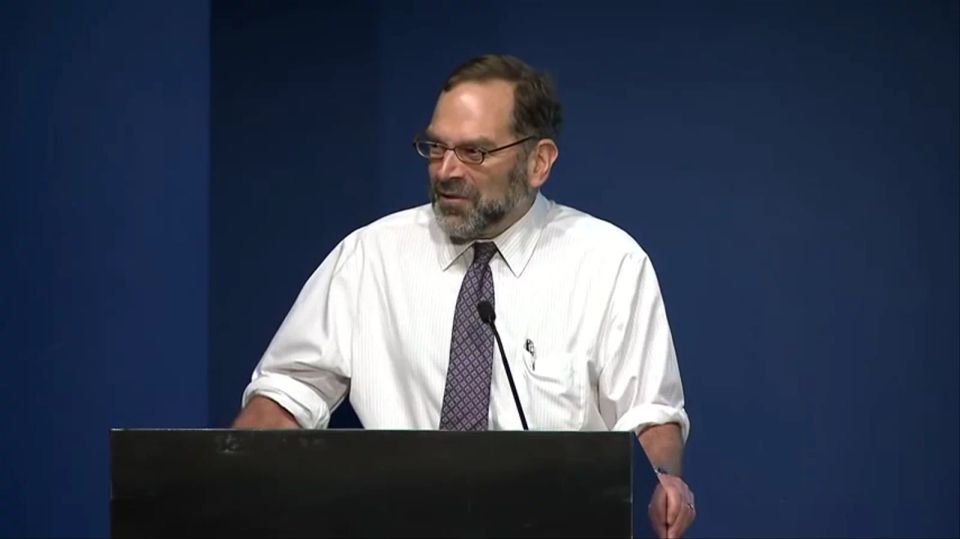
An archived video recording featuring John D. Lantos from Seattle Children's.
- Format
- Video recording · 36 min
- Recorded or aired
- August 28, 2015
- Institution or outlet
- YouTube / Seattle Children's
- Archive identifier
- V027
- Speaker
- John D. Lantos, MD
Transcript
33 passages
- 00:05
Dr. John Lantos
Thanks. It's been a great conference. Thanks to Doug and Ben and the whole faculty of the Truman Katz Center. I think we've done some incredibly careful thinking about some really difficult issues. So I hope everybody's fired up to take insights from this meeting back home and improve care for kids. Also keep in mind there's lots of other forums around the country where pediatricians and child health professionals interested in these sorts of issues gather. The American Society of Bioethics and Humanities meeting is coming up down in Houston in October. The AAP, the PAS has bioethics interest groups and sessions and all of those organizations have interest groups. The AAP has the section of bioethics looking for people to get involved and move into leadership positions in those groups. So if people want to get more involved in any of those organizations, I'm sure Ben and Doug or email me or go to the websites of the organizations. And I want to say a special thanks to the folks here in Seattle for my annual unlimited supply of gummy worms, which I never Never really yet any other place except here on the open bar for gummy worms.
- 01:31
Dr. John Lantos
Figured at this point in the conference it'd probably be good to start with a poem. Since we have been talking a lot about truth telling and disclosure, I thought remembering what Emily Dickinson had to say about it might be a good way to set the tone for this last presentation. She wrote, Tell all the truth, but tell it slant. Success in circuit lies. Too bright for our infirm delight, the truth's superb surprise. As lightning to the children eased with explanation kind, the truth must dazzle gradually, or every man be blind.
- 02:24
Dr. John Lantos
So I'm going to talk about the internet, Wikipedia, internet-savvy parents. And the topic flows, I think, quite naturally from many of the topics that we've been talking about today. Because in some ways, what the internet does is change our ideas about truth-telling, disclosure, and transparency. It changes the way We think about those by making many more truths and many different sorts of truths available to both doctors and patients and leads to a very different sort of discussion. It also allows the construction of truth to be a much messier process than it has been in the past. With the internet, just as with the proliferation of more traditional media and multiple news channels, You can segment the audience market and present different truths to different people in different contexts. And you can choose, for example, which news to watch to reinforce your own beliefs. Or you can choose which websites to go to about vaccines to reinforce your own beliefs. So in the internet age, everybody is telling the truth and telling it a bit slant.
- 03:48
Dr. John Lantos
Traditionally, the truth in medicine has been something defined by doctors. It belonged to doctors. Truths were thought to be the process of scientific discovery. And as such, they were both objective and a little bit esoteric. They could be known by doctors in a way that they weren't known or knowable by patients, except as we explain them to the patients. And doctors' special knowledge was the result of rigorous, sometimes arcane, training in the mysteries of biology and physiology and cell biology and all the other biomedical sciences. So the doctor-patient or doctor-patient-parent relationship was one of an asymmetry of knowledge and power. The doctor would read the patient's truths and interpret them for the patient and do so by a very systematic process, starting with the curious conversation that we call taking a history in which we lead patients through a structured interview that we have internalized in order to elicit from them in their words the knowledge that we need to figure out what is wrong with them. They would tell us where it hurt, when it started, et cetera, et cetera. And then we would examine them using a similarly arcane set of techniques called the physical examination in order to read the secrets of their body and feed those back to them. We'd add laboratory tests and imaging studies and electrophysiological measurements and the like in order to confirm or rule out particular diagnoses, which we would then
- 05:27
Dr. John Lantos
tell the patients.
- 05:30
Dr. John Lantos
In the old days, we would usually just recommend one medically indicated treatment. Nowadays, we discuss many different options and present different treatment paths, explain the risks and benefits of each, but the shared decision-making process, as Doug Opal talked about, is one by which the doctor chooses a strategy, and our job has traditionally been to provide the facts upon which the patients then exercise their values and preferences in order to arrive at a shared decision-making process. Now, the internet and the democratization of information has blown this model into a thousand pieces. It has allowed the radical demystification of information about the meaning of signs and symptoms, the causes of disease, the process of diagnosis and prognostication, and the choice of treatment. It's not, of course, completely demystified. At least in my opinion, a medical degree is still worth more than a degree from the University of Google or Wikipedia or YouTube. But the differences between the two are shrinking. And they are shrinking in ways that are interesting, surprising, challenging, subversive, empowering, and dangerous all at the same time. I think there are four big changes that have happened as a result of the internet. I'm going to try to talk a little bit about each of these, the democratization of information, the creation of these worldwide social support and information sharing communities, new forms of advocacy that patients and parents together can engage in through the kinds of communication made possible by the Internet. And the last one, which I'm not going to talk about today, but is also interesting, new sorts of long-distance doctor-patient relationships and telemedicine and that whole field, but that's a little beyond the scope of this talk.
- 07:40
Dr. John Lantos
So there's all sorts of modes of communication on the internet and everybody's doing it. This was a couple years old and I'm sure is already out of date and just talked about the number of US adults who have looked online for health information in the past year. Almost two-thirds of adults had done that. This oversimplifies or minimizes how much use the internet is getting because looking for health information is of course just the sort of tip of the iceberg of what people can do on social media. This slide sort of suggests the ways that different internet platforms or internet, don't even know the right word,
- 08:32
Dr. John Lantos
different ways of using the internet can vary in their richness and the amount of social support they provide. moving from wikis and blogs at sort of the low end where that's sort of one-way information, the information's out there, you go search for it, you read it, to forums that are more interactive like Facebook groups, content communities, social networks, and then probably the most extreme is virtual social worlds where people can totally immerse themselves in a virtual reality on the internet. And what this does is sort of for anybody who has a disease or has a child with a disease, it starts to sort of open up a vast range of knowledge. Let me just give a few examples to suggest the ways the world has changed. I mean, say you want to know something about Rett syndrome. You can start by going to Wikipedia where you'll find the Rett syndrome page and it gives a fair amount objective information about the genetics and the symptoms and there are links to other pages. And if you dig a little bit deeper on Rett Syndrome, you can start to find blogs by parents that give
- 09:54
Dr. John Lantos
personal stories of particular children who have Rett Syndrome. You can join the Rett Syndrome Facebook group where you meet and interact with other families who have children with Rett syndrome. You can share your story. You can read their stories. You can ask questions. You can compare notes about your doctor. You can compare notes about what they told you about particular symptoms. People share resources. People share videos and the like. Same thing has happened with
- 10:32
Dr. John Lantos
almost every disease. One of the more interesting and one that those of you who are in this room heard a little bit about trisomy 13 and 18. It's changed, I think, the way we are able to talk to parents or even to think about kids who have these rare chromosomal anomalies. Doctors used to tell parents that trisomy 18 was a lethal anomaly for which resuscitation in the delivery room was not indicated. This was from a 2008 paper that was published in Pediatrics that reflected this longstanding consensus that trisomy 18 was a lethal congenital anomaly. The labeling of that condition as a lethal congenital anomaly was a somewhat arbitrary form of truth. There had been reports in peer-reviewed medical literature of kids with trisomy 18 or trisomy 13 surviving for many years, sometimes even surviving into adulthood. There were some discussions in the peer-reviewed medical literature about whether the lethality of these conditions was associated with decisions to withhold or withdraw life-sustaining treatment. But nevertheless, there was this fairly widespread consensus
- 11:56
Dr. John Lantos
The message to give to parents was that this was clearly a lethal congenital anomaly. These days I think anybody who says that to a parent is likely to, be met with ridicule because parents can go to the internet today and you can find all sorts of things. I didn't try to do the, a lot of these are YouTube videos. I tried that once here a couple years ago and it was a disaster. But you can go look it up and get the action figures. Trust me, this little baby with trisomy 13 is smiling and looking around and does not appear to be at all dead.
- 12:43
Dr. John Lantos
And parents go to these websites. You'll find many stories from parents who tell about their experiences raising children with these syndromes. And they have heartwarming stories. And they have pictures. And they tell about bad experiences they've had with doctors like you who told them that their child couldn't survive. It may even be you who they are talking about.
- 13:10
Dr. John Lantos
You can then go to the Trisomy Facebook group, which is a much more interactive forum. People on the Facebook group share stories and tell about advocacy for children with trisomy 13 and 18. And sometimes this feeds back to traditional media where a notice of a meeting for families with trisomy 18 that was to take place in Salt Lake City led to a conference that then got written up in the Salt Lake City newspaper. And then the newspaper article was reposted to the Facebook group and the web and amplified. And anybody around the world who's looking to find this information can find pictures like this of happy families. Let me give another example. We got an ethics consult about a year ago for a baby with mosaic trisomy 22. something I'm sure you're all familiar with. No?
- 14:15
Dr. John Lantos
Neither was I. And the baby had multiple congenital anomalies, had been in the NICU for six weeks or two months, I can't remember, and was unable to be extubated. And the question was whether to do a tracheostomy. And there was disagreement among the medical and nursing staff about whether a tracheostomy was in the baby's best interest. And I went to PubMed, and did a literature search on trisomy 22 and particularly on mosaic trisomy 22 and found six case reports as the total result of this search for the last 20 years about mosaic trisomy 22. And the reports were all painted a pretty bleak picture about the prognosis for this syndrome. I went to talk to the parents and they said actually there are many kids with trisomy 22 and a mosaic trisomy 22 who have gotten tracheostomies. So I asked them how they knew and they said there's a Facebook group for mosaic trisomy 22. And I said, oh
- 15:19
Dr. John Lantos
I didn't say anything at that point, went back to my office and got on the internet and went and it turned out it was a private group. So I wanted to read what was written on the group. But you had to ask the moderator for permission to join the group. And that felt a little funny. Like, should I join this group that the patients that I was doing an ethics consultation upon belonged to and had told me about? So I went back to the group. and said, you know, that Facebook group that you told me about, I'd really like to join that Facebook group. I know it's a private group. Would it be okay with you, I asked, if I join the Facebook group? And the dad looked at me and he said, yeah, I actually Googled you
- 16:09
Dr. John Lantos
last night and downloaded a couple of your articles and you seem okay.
- 16:22
Dr. John Lantos
So I asked to join the group and I didn't hear back from the moderator for a few days. And in the meantime, over these next few days, I took my own case to our ethics committee and asked whether it was okay or whether it was a boundary violation for me to join this group. And we had a very interesting discussion. Some people were concerned but that by joining the group I might inhibit the family that was in our hospital from posting things knowing that somebody in our hospital was reading it. So it would make the group less valuable. In other words, it would be a bad outcome for them. Others worried that I might learn things online and have to decide whether or not to share them with other team members. I mean, what if they said bad things about a doctor or nurse in the hospital? Should I keep that confidential? Some people asked, was I spying on them? And if so, for what purpose? Some questioned my motivation. Here was my motivation.
- 17:32
Dr. John Lantos
I really just wanted to learn more about mosaic, about trisomy 22 and mosaic trisomy 22. And a couple days later, I heard back from the moderator who said, welcome to our group, Dr. Lantos. Happy to have you. So I went on the group, and I saw in the conversation thread that over the two days, the moderator had sent a note to the group saying, hey, there's a doctor, there's a pediatrician in Kansas City who wants to join the group. Do any of you have a patient, a baby in Kansas City? And do you know this guy? And is he OK? And the family said, yeah, he's all right. And then the moderator invited me to join the group. One of the things I found was, remember there were six case reports in the medical literature. There are 110 families currently active on the Trisomy 22 Facebook group. That is 110 families who have a kid today. And the range of outcomes, the information that you could find about Mosaic Trisomy 22 was much broader than anything that's available in the medical literature. The story then had another
- 18:45
Dr. John Lantos
interesting aspect. There was a reporter for the Wall Street Journal who wanted to write a story about social media. And she had found the paper that Ben and Annie Janvier and I think Barbara Farlow had written about trisomy 18, about trisomy babies. I don't know, did she ever call you? Amy Marcus was her name. and found that Annie Janvier and I and Barbara Farlow had also written an ethics rounds about trisomy 18. So she called me and wanted to know about families getting information from the internet. And I said, yeah, families get lots of information, but doctors do too. And I told her the story of the family. And she then said, could I call the family? What should, I wasn't sure.
- 19:35
Dr. John Lantos
That sort of made me feel uneasy about giving that this private group may. So I called the doctor who was the primary care doctor for the family and asked her if she would ask the family if they were interested in talking to anyone from the Wall Street Journal. And I also sent a note to the moderator of the list asking her if it would be okay with her as moderator of the list to have this, existence of this private list discussed in a Wall Street Journal article. She posted that to the list, got some feedback from people who were universally supportive. In fact, what they said was we really want the world to know about these lists as places to go to get information if they have a child who wants this. The family said they were willing to talk to the reporter. We gave them the reporter's number and said it's up to you. We're not going to give her your number. But if you want to call her, you can set up an arrangement. They did, and it led to a paper or an article in the Wall Street Journal. And they sent a picture of their three children, including
- 20:48
Dr. John Lantos
Chloe, who's there on my right or left. And they talked about getting information on the web. It's an interesting twist on how people both doctors and patients find information, communicate with one another. It's true for almost every disease. I mean, probably the most common are the preemie websites where, you know, NICUs are pretty private places. I mean, sometimes there are TV shows about them, but most people can't see what's going on in the NICU or traditionally could not see what's going on in the NICU. But now people make videos and post pictures of their own kids on ECMO and put them on their blogs and you can actually find information. videos of kids being cannulated for the ECMO circuit. Let me tell one more story, a complicated one in that this is a family who came to our fetal health center after a prenatal diagnosis of various congenital anomalies. As they were going through the process of being evaluated in the fetal health center, Mom was blogging about it on her blog called Faith, Hope and Mommyhood.blogspot.com. And at the same time our hospital was doing one of these television reality TV shows where a TV crew was in looking for families to tell their stories and they ended up making a TV show called Inside Pediatrics where they had many families going through many
- 22:30
Dr. John Lantos
different kinds of medical situations. On the mom's blog, she talked about being approached to be on the TV show and talked about the reason she was blogging and the reason they decided to be on the TV show was because they wanted to share their story with the world. And here was their story. At about 10 weeks, a routine ultrasound revealed a cystic hychroma. At 12 weeks, the fetus had genetic testing which revealed normal chromosomes. But then a follow-up ultrasound at 26 weeks showed some other congenital anomalies, including a congenital diaphragmatic hernia and cleft lip and palate. And at 28 weeks was officially transferred to our fetal health care center. And as she wrote on the blog, Matt, that's her husband, and I had a big roundtable discussion with some serious VIPs. And they were given bad news about what the findings showed. We call these integrated consults. It's where the various subspecialists in the fetal health center sit down around a big table and talk about what we've found and what we think the prognosis is. It's interesting and unusual to have that sort of discussion and then read about it on somebody's blog the next day, but that's what happened. Matt and I had prepared for the worst, and the docs just confirmed that we were correct with her hernia, cleft, and heart issues. She will have too hard a time struggling to breathe to get herself to any surgeon that can help. All of these issues, all physical, all fixable have stacked up against her and are too much for her baby body to bear. This family was told that these lesions were probably incompatible with life. They made a prenatal care for postnatal palliative care and mom continued to blog about that. and interestingly continued to talk to the television crew about how they were preparing to love their baby for,
- 24:33
Dr. John Lantos
as she wrote, making her as comfortable as possible. The timeframe of life, whether it's minutes, hours, or a day, will not be known until she's here. We don't know how Piper will be at Deliveroo. We don't know how much time we will have. We don't know a single thing. I pray that our minds are open and ready for love and peace during Piper's life and not clouded by fear of pain." And the mom wrote, I'm so thankful that we will have time to experience her as a family together no matter how long she's here.
- 25:05
Dr. John Lantos
Turned out after Piper was born, she was not as sick as we had thought she was going to be. And again, from mom's blog, the echo after delivery showed that her aorta is not too small to function. Her heart is able to sustain her body. And she was explaining to the faithful readers of her blog exactly what a coarctation is and how that might be fixed. and also some of the ongoing prognostic uncertainty about how they had to stabilize her oxygen and carbon dioxide before they could take her to surgery to repair her congenital diaphragmatic hernia. And there's no telling how long this journey will be. On their blog they posted pictures of themselves with their lovely baby Piper. They had their one week birthday pictures of Piper intubated and even pictures of Piper's siblings holding her in the NICU. Piper had a very complicated course in the NICU. First couple of months she did a little better, got a G tube, got off the vent and onto CPAP, but then had an aspiration pneumonia. In December she got a trach, trouble feeding, persistent pulmonary hypertension. She ended up with a GJ tube. and in April was still in the NICU on a vent and remained dependent on nitric oxide. She had not yet been stable enough to have many of her congenital anomalies repaired. But the family kept telling this story to a supportive community of many readers who shared similar stories and
- 26:56
Dr. John Lantos
wrote in to celebrate each week birthday. There they are at their 24-week birthday. That's mom, dad, and the pediatric surgeon, Corey Iqbal, looking in from behind.
- 27:13
Dr. John Lantos
Sadly, Piper deteriorated and got worse, and eventually they made a decision to take her off life support, which they then again described in great detail. On this blog we sat and chilled with Piper Grace surrounded by a dozen or so of her favorite NICU team members. We loved her, chatted with her, thanked her for her time here with us. I was holding Piper Grace with Matthew at my shoulder when she left us at 8.04 p.m. Thursday, June 11th. Our hearts are shattered. Dozens of nurses lined the hallway outside her pod and we sent her out with so much love it was palpable. And then she talks a little bit about why she writes. Writing up was difficult. We did not lose this battle. It was not a tragedy. She didn't fight for nothing. It's an inspirational story, I think, that as we think about communicating with parents about prenatal decisions, about NICU decisions, about decisions to redirect care, we need to know
- 28:21
Dr. John Lantos
Either we can direct them to these stories or they are going to find these stories themselves and we might need to expect a different sort of understanding, a different sort of sophistication, maybe a different sort of demand for honesty, truth, and full disclosure. It's also possible that stories like this can lead to questions about, how scientific or accurate or
- 28:57
Dr. John Lantos
whether our prenatal estimates of what's going on are right or wrong. That is, this is a family who had been told prenatally that their child was going to die shortly after birth. Child didn't die shortly after birth. The next family that comes in and they're told their child's going to die shortly after birth might say, yeah, you guys, we know how good you are at predicting that. Or they might say, I don't want to go through nine months like this. So there's different sorts of responses that can happen. So it's changing the way we communicate. Let me just, in the last part of the talk, talk a little bit about the way the internet is changing advocacy for certain kids with certain conditions. If everything goes public, At least anything that parents choose to make public goes public and goes public at lightning speed. And if parents don't like what's going on in a hospital, the world can know about it almost instantaneously. This was a case that happened a few years ago. It happened to be at Children's Hospital of Philadelphia. It could have been at any, certainly any tertiary care children's hospital. On January 11, a mother named Chrissy Rivera posts a blog entry
- 30:21
Dr. John Lantos
on the website of the—or on her blog, but it was copied to the website of the Wolf-Hirshhorn Syndrome blog, saying that her child with Wolf Hirshhorn needed a kidney transplant and that the doctors at Children's Hospital of Philadelphia had told them that because of her underlying condition she wouldn't be eligible, the baby wouldn't be eligible for a kidney transplant. By the end of January 12th, that is the next day, 62,000 people had seen this blog entry and started a campaign to convince Children's Hospital of Philadelphia that they should list this child for a transplant, it got so
- 31:09
Dr. John Lantos
much attention that by January 13th, that is two days after the initial blog post, CHOP had to post a response on its website. And over the next few days, a quarter of a million people visited the website and read about this. controversy between a family and a children's hospital. As with all such controversies, the playing field is not quite level. The parents can put whatever they want on their blog and doctors and hospitals are bound by confidentiality and HIPAA not to give any details about an individual patient. So it's sort of a compelling personal story being responded to by general statements of institutional policy. There was an online petition at change.org sent to CHOP that got 50,000 signatures. Two days after CHOP's initial response, CHOP responded again with a general statement saying, we don't make decisions based on neurocognitive impairment. 37,000 people liked it. 180 people apparently didn't. They're the ones who wrote comments. The people who liked it simply liked it. It's hard to know how to tally the votes here about who's
- 32:31
Dr. John Lantos
winning. But by about a month later, the family and the hospital issued a joint statement. This event underscores the importance of our responsibility to effectively communicate with families. We appreciate the role the Riveras played in helping us recognize opportunities to improve our communication whether that meant communication with the world or with the riveras was unclear in this statement but maybe maybe both are true the riveras forgave them despite again online and despite an unfortunate encounter a few weeks ago we hold shop in high regard if our experience can ensure that our daughter is seen as Amelia and not as a diagnosis of her mental abilities, we feel will go a long way in making sure no parent has to endure the emotional distress that we face during this difficult time.
- 33:27
Dr. John Lantos
So that, I think, is another interesting story about just how the ways that information gets discussed disseminated is changing the way we think about transparency and communication in the internet age. It seems to me there are many new forms of information. There is, whether we like it or not, incredibly increased transparency. There's more opportunities for communication. for patients with each other, for doctors with each other, for doctors with patients and families and for all of us with the world at large in ways that make a public presence out of what used to be an entirely private interaction. There is, of course, more chance for lots of misinformation as a result of this, but it's not clear to me
- 34:29
Dr. John Lantos
whether or how to decide where there's more misinformation on the internet or in peer-reviewed medical journals. If you go back to the Mosaic trisomy 22 case or many of the trisomy 18 papers, much of the misinformation or at least much of the wrong information is in medical journals and the corrective information comes from social media and Family blogs. So I don't think it's possible to sort of draw conclusions or make ethical rules or guidelines beyond the most cautious warnings about being aware of the possibility for risks. But I think one of the other things that's happening in the social media world and the internet world is things are moving and changing so quickly and there are so many different types of communication that are possible that any sort of rules or regulations apply to what was happening last year, and that was so last year, and what's available now is not quite the same. I think we as health professionals need to know what's out there, both for our own education, as we can learn from it, but also to understand what our patients and parents are reading. so that we can communicate better with them. Thanks.